
Mapa mental
Equity theory
Mind map: Equity theory
Contenido del mapa
Equity theory
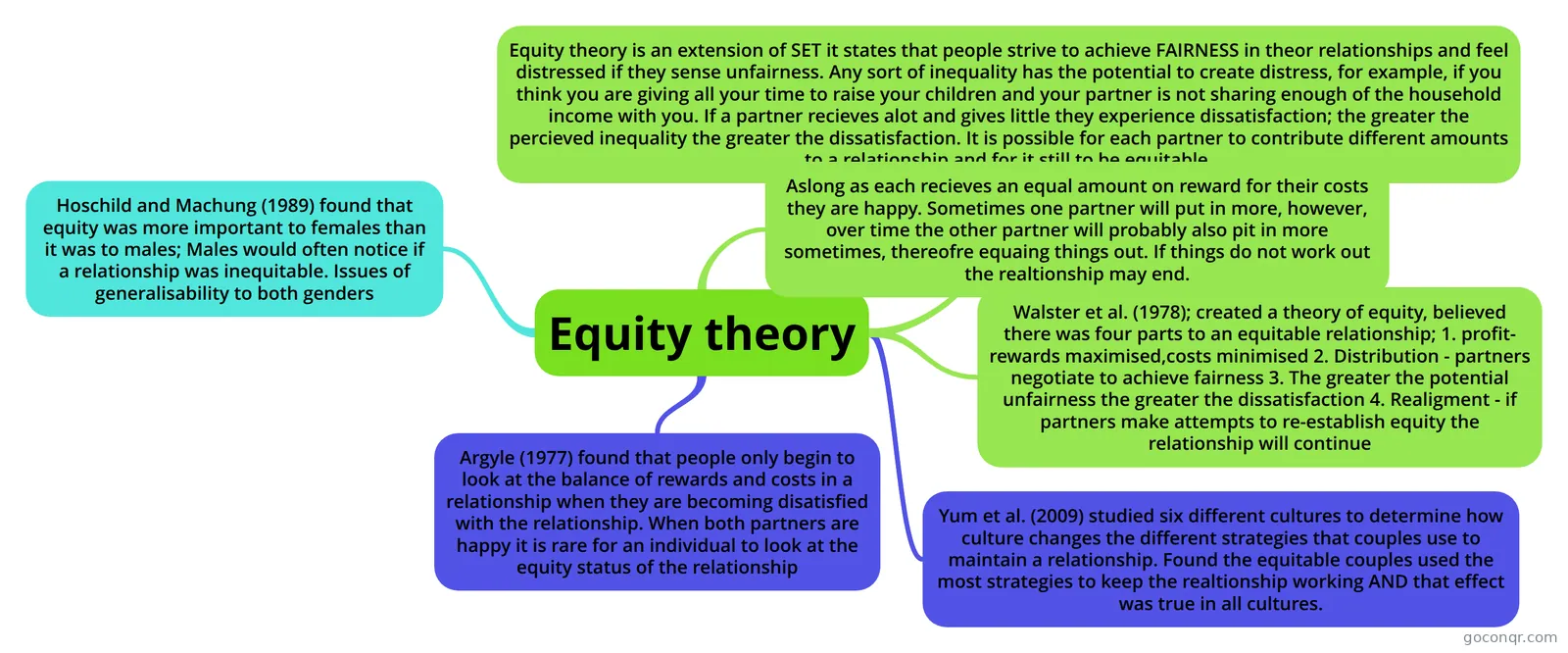
Equity theory is an extension of SET it states that people strive to achieve FAIRNESS in theor relationships and feel distressed if they sense unfairness. Any sort of inequality has the potential to create distress, for example, if you think you are giving all your time to raise your children and your partner is not sharing enough of the household income with you. If a partner recieves alot and gives little they experience dissatisfaction; the greater the percieved inequality the greater the dissatisfaction. It is possible for each partner to contribute different amounts to a relationship and for it still to be equitable.
Aslong as each recieves an equal amount on reward for their costs they are happy. Sometimes one partner will put in more, however, over time the other partner will probably also pit in more sometimes, thereofre equaing things out. If things do not work out the realtionship may end.
Walster et al. (1978); created a theory of equity, believed there was four parts to an equitable relationship; 1. profit- rewards maximised,costs minimised 2. Distribution - partners negotiate to achieve fairness 3. The greater the potential unfairness the greater the dissatisfaction 4. Realigment - if partners make attempts to re-establish equity the relationship will continue
Yum et al. (2009) studied six different cultures to determine how culture changes the different strategies that couples use to maintain a relationship. Found the equitable couples used the most strategies to keep the realtionship working AND that effect was true in all cultures.
Argyle (1977) found that people only begin to look at the balance of rewards and costs in a relationship when they are becoming disatisfied with the relationship. When both partners are happy it is rare for an individual to look at the equity status of the relationship
Hoschild and Machung (1989) found that equity was more important to females than it was to males; Males would often notice if a relationship was inequitable. Issues of generalisability to both genders
Información
- Descripción
- A-Levels (Relationships) Psychology Mapa Mental sobre Equity theory, creado por harry_bygraves el 03/06/2013.
- Creado por
- harry_bygraves
- Visitas
- 275
- Etiquetas
- Valoración