
Mapa mental
Biochemistry Exam 2
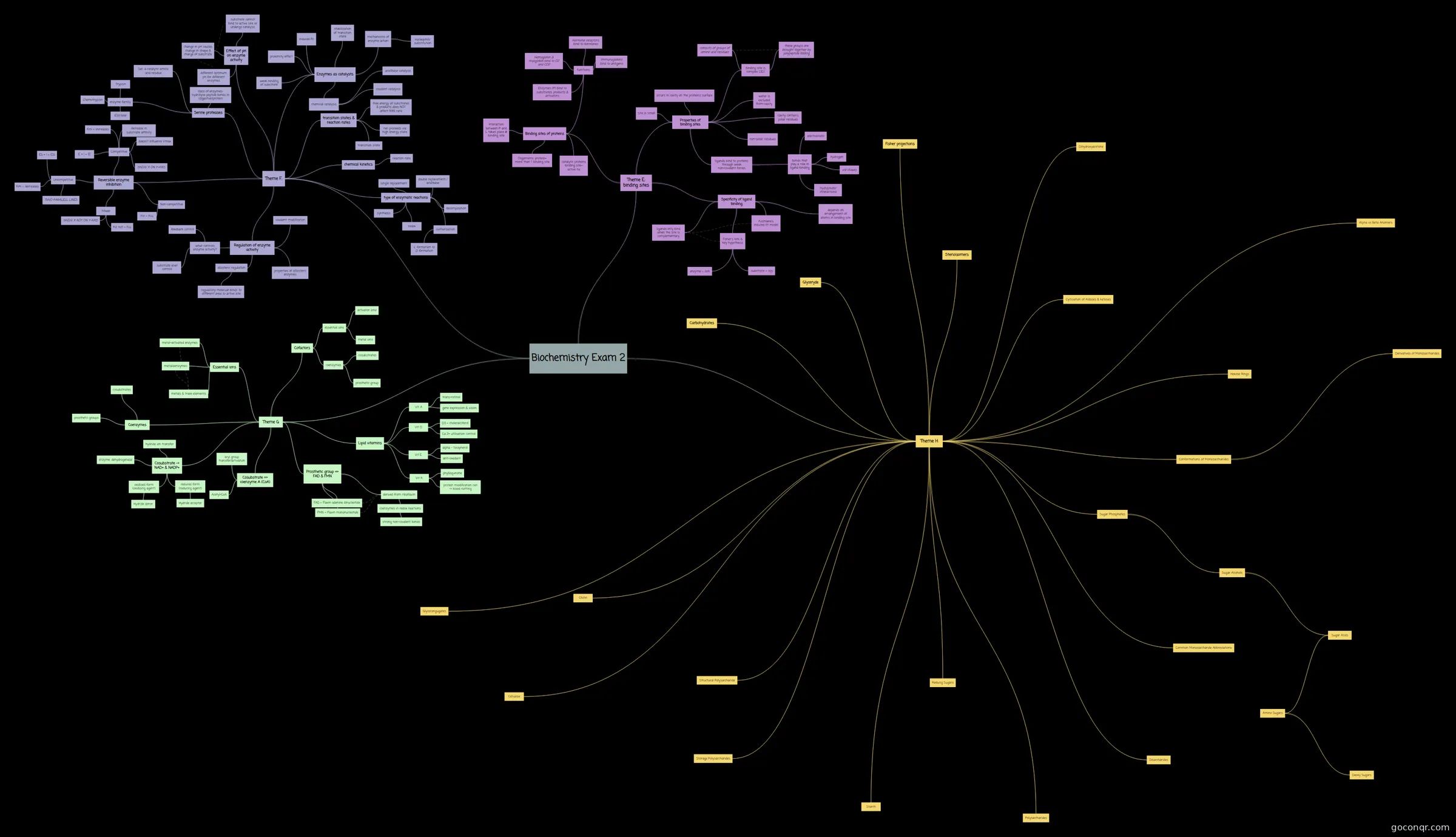
Mind map: Biochemistry exam 2
Contenido del mapa
Biochemistry Exam 2
Theme E: binding sites
- Binding sites of proteins
- P- proteins L- ligands Ps binds to Ls (which are smaller molecules) This is the first step to performing various functions
- functions
- Enzymes (P) bind to substrates, products & activators
- Hormone receptors bind to hormones
- Immunoglobins bind to antigens
- Hemoglobin & myoglobin bind to O2 and CO2
- interaction between P and L takes place @ binding site
- Oligometric protein= more than 1 binding site
- catalytic proteins binding site= active ite
- Properties of binding sites
- site is small
- occurs in cavity on the protein's surface
- binding site is complex (3D)
- consists of groups of amino acid residues
- from different parts of the linear amino acid chain
- these groups are brought together by polypeptide folding
- consists of groups of amino acid residues
- water is excluded from cavity
- helps to prevent ligand from having to compete with water
- cavity contains polar residues
- necessary for specificity & catalysis (in enzymes)
- non-polar residues
- makes it more energetically favorable for a non-polar ligand to bind (hydrophobic effect)
- ligands bind to proteins through weak non-covalent forces
- bonds that play a role in ligand binding
- electrostatic
- hydrogen
- v/d Waals
- hydrophobic interactions
- bonds that play a role in ligand binding
- Specificity of ligand binding
- depends on arrangement of atoms in binding site
- ligands only bind when the site is complementary
- Fisher's lock & key hypothesis
- if they dont fit 100% the reaction wont happen
- enzyme = lock
- substrate = key
- Koshland's induced fit model
- ligand binds specifically to protein but only after a conformational change is brought about -by binding -makes site complementary
- Binding sites of proteins
Theme F:
- type of enzymatic reactions
- redox
- enzyme: oxidoreductases A*- + B -> A + B*-
- single replacement
- enzyme: transferases AB + C -> A + BC
- double replacement / acid/base
- enzyme: hydrolases AB + CD -> AC + BD
- decomposition
- Enzyme: lysases AB -> A + B
- isomerisation
- enzyme: isomerases AB -> BA
- L formation to D formation
- synthesis
- enzyme: ligases A + B -> AB
- redox
- chemical kinetics
- reaction rate
- (V) amount of product formed per unit time
- reaction rate
- transition states & reaction rates
- free energy of substrates & products does NOT affect RXN rate
- rxn proceeds via high energy state
- transition state
- intermediate between substrate & product high free energy
- Enzymes as catalysts
- -enzymes speed up rxns by 10^8 to 10^13 -decreases activation energy -eqm remains unchanged
- weak binding of substrate
- -binding of substrate may not be too strong -Km must be optimised for effective catalysis -low enough for proximity of substances -high enough that ES -complex is not too stable
- proximity effect
- -correct positioning of substrates -lowers degree of freedom
- induced fit
- -during substrate binding there's a distortion of structure towards the transition state
- stabilisation of transition state
- -enzymes bind to transition state stronger than to substrate most important factor in the speed up of rxns
- mechanisms of enzyme action
- nucleophilic substitution
- nucleophilic substitution: -nucleophile: - e- rich - (-) charged - unshared electron pair-electrophile - e- poor - (+) charged -empty orbital redox reactions: -oxidation -loss of electron -caused by oxidising agent which gets reduced -reduction -gain of electrons -caused by reducing agent which gets oxidised -biological oxidation -addition of oxygen -removal of e-
- nucleophilic substitution
- chemical catalysis
- acid/base catalysis
- -increases the rate of rxn through catalytic proton ttransfer -catalysed by H+ or OH- diffusing out of solution (specific a/b) -H+ or OH- formed in transition state by another molecule or group (general a/b) -general acid vs general base -ionisable group will have pKa close to pH
- covalent catalysis
- acid/base catalysis
- Effect of pH on enzyme activity
- different optimum pH for different enzymes
- change in pH causes change in shape & charge of substrate
- substrate cannot bind to active sire or undergo catalysis
- Serine proteases
- class of enzymes- hydrolyse peptide bonds in (digestive)protein
- Ser: a catalytic amino acid residue
- enzyme family
- Trypsin
- positive charged residue -Lys, Arg
- Chemotrypsin
- large hydrophobic residue -Tyr, Phe, Trp, Leu
- Elastase
- small side chain -Gly, Ala
- Trypsin
- Reversible enzyme inhibition
- inhibitor: -a small molecule binds reversibly to an enzyme and influences the activity of that enzyme
- Competitive
- E + I = EI
- Km = increases
- decrease in substrate affinity
- doesn't influence Vmax
- SKEW X ON Y-AXIS
- Uncompetitive
- ES + I = ESI
- Km = decreases
- TWO PARALELL LINES
- Mixed
- SKEW X NOT ON Y-AXIS
- Kic not = Kiu
- Non-competitive
- Kic = Kiu
- Regulation of enzyme activity
- what controls enzyme activity?
- substrate level control
- -substrate increases rate -product reduces rate
- feedback control
- -prevents accumulation of intermediates
- substrate level control
- allosteric regulation
- regulatory molecule binds to different area to active site
- area where molecule binds is known as allosteric site
- regulatory molecule binds to different area to active site
- properties of alllosteric enzymes
- -generally have multiple active sites -activity changes due to metabolic activators and inhibitors -allosteric modulators bind non-covalently to enzyme
- covalent modification
- -activity of enzyme can be modulated by covalent attachment or removal of groups -slower than allosteric regulation -reversible but requires enzymes that catalyse the conversion -modified enzymes can be regulated allosterically or covalently
- what controls enzyme activity?
- type of enzymatic reactions
Theme G
- Cofactors
- -ions or molecules that are bound to proteins to aid in catalysis -can increase catalytic scope of enzymes
- essential ions
- activator iond
- -loose -participate in binding of substrate
- metal ions
- -tight -participate directly in catalysis
- activator iond
- coenzymes
- cosubstrates
- -loose -group transfer reagents
- prosthetic group
- -tight -group-transfer reagents
- cosubstrates
- Essential ions
- -most enzymes need essential ions for full catalytic activity -held by covalent bonds from amino acid side chains -can also be bound in prosthetic group
- metal-activated enzymes
- K+ Mg 2+ Ca 2+ Mg-ATP (Mg stabilizes phosphate bonds)
- metalioenzymes
- Zn Fe Cu Co
- metals & trace elements
- Coenzymes
- -classified based on interaction with apo-enzyme
- cosubstrates
- -act as substrate in enzyme-catalysed rxns -chemically unchanged -dissociate to be converted by another enzyme ti the original form
- prosthetic groups
- -remain attached to enzyme-catalyzed rxns -sometimes covalently bound to enzyme (otherwise strong non-covalent bonds) converted back to original form during rxn
- Cosubstrate -> NAD+ & NADP+
- -nicotinamide adenine dinucleotide (phosphate) -coenzyme in redox rxns
- oxidised form (oxidising agent)
- Hydride donor
- reduced form (reducing agent)
- Hydride acceptor
- hydride ion transfer
- enzyme: dehydrogenase
- -enzyme that converts alcohol to aldehyde or ketone
- Cosubstrate => coenzyme A (CoA)
- -many metabolic processes depend on CoA -responsible for transfer (activation) of acyl groups
- acyl group transfer/activation
- what is an acyl group? -usually derived from carbox acids -formula for acyl is: R - C=O -
- Acetyl-CoA
- -key metabolite -metabolises: fats, proteins and carbs
- Prosthetic group => FAD & FMN
- FAD = Flavin adenine dinucleotide
- FMN = Flavin mononucleotide
- derived from riboflavin
- coenzymes in redox reactions
- strong non-covalent bonds
- coenzymes in redox reactions
- Lipid vitamins
- Vit A
- trans-retinol
- gene expression & vision
- Vit D
- D3 = cholecalciferol
- Ca 2+ utilisation control
- Vit E
- alpha - tocopherol
- anti-oxedant
- Vit K
- phylloquinone
- protein modification rxn -> blood clotting
- Vit A
- Cofactors
Theme H
- Carbohydrates
- Glyceryde
- Fisher projections
- Sterioisomers
- Dihydroxyacetone
- Cyclisation of Aldoses & ketoses
- Alpha vs Beta Anomers
- Hexose Rings
- Conformations of Monosaccharides
- Derivatives of Monosaccharides
- Sugar Phosphates
- Sugar Alcohols
- Sugar Acids
- Amino Sugars
- Deoxy Sugars
- Amino Sugars
- Sugar Acids
- Sugar Alcohols
- Common Monosaccharide Abbreviations
- Disaccharides
- Polysaccharides
- Reducig Sugars
- Starch
- Storage Polysaccharides
- Structural Polysaccharide
- Cellulose
- Chitin
- Glycocongugates
Información
- Descripción
- 214 Exam 2 Biochemistry Mapa Mental sobre Biochemistry Exam 2, creado por Lea Calitz el 14/05/2018.
- Creado por
- Lea Calitz
- Visitas
- 2
- Etiquetas
- Valoración