
Mapa mental
Probability Theory
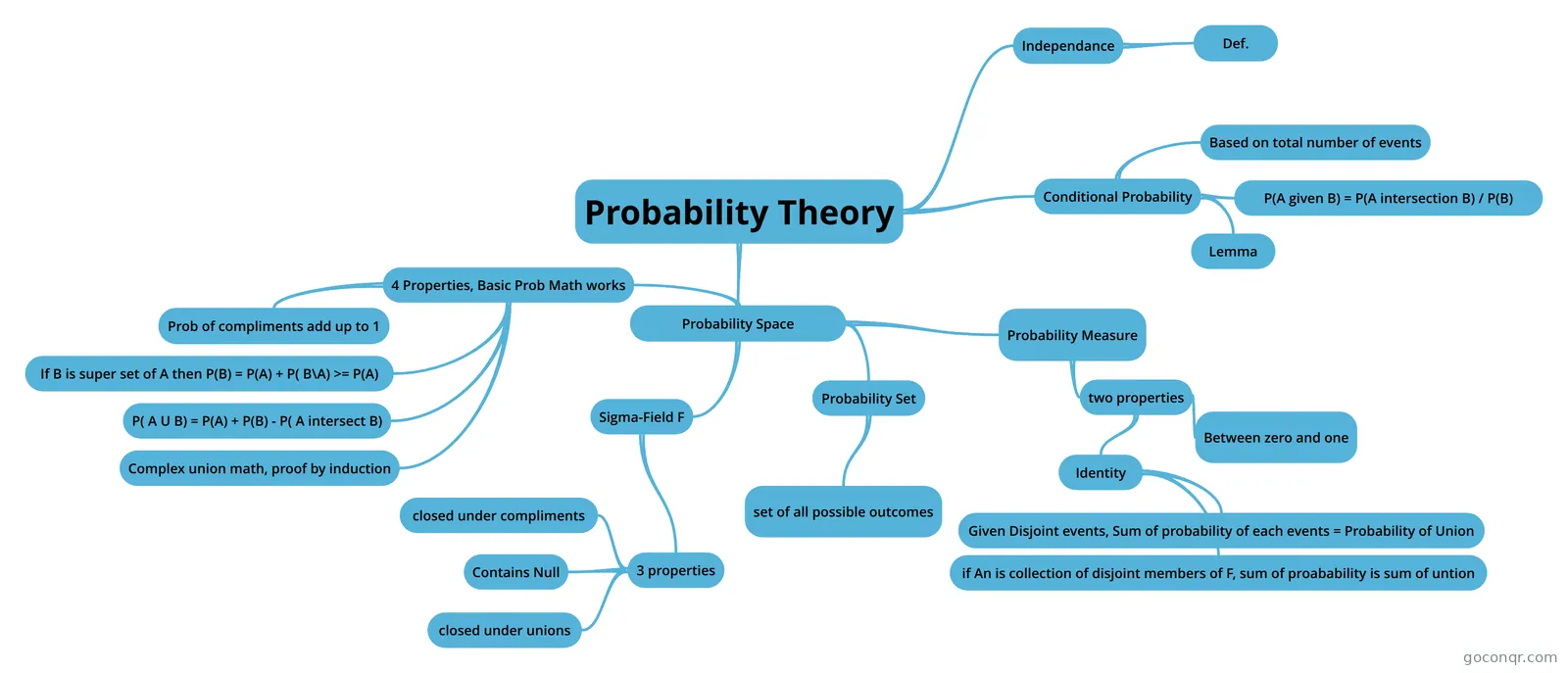
Mind map: Probability theory
Contenido del mapa
Probability Theory
Probability Space
- ( \(\Omega\) , \(\mathcal{F}\) , P )
- Sigma-Field F
- \(\sigma\) - field
- 3 properties
- closed under compliments
- \( if A \in \mathcal{F} \) then \(A^c \in \mathcal{F} \)
- closed under unions
- Contains Null
- \( \emptyset \in \mathcal{F} \)
- closed under compliments
- Probability Set
- \(\Omega\)
- set of all possible outcomes
- Probability Measure
- P on ( \(\Omega\) , \(\mathcal{F}\) )
- two properties
- Between zero and one
- P(null set) = 0, P(solution set) = 1
- Identity
- if An is collection of disjoint members of F, sum of proabability is sum of untion
- Given Disjoint events, Sum of probability of each events = Probability of Union
- Between zero and one
- 4 Properties, Basic Prob Math works
- Prob of compliments add up to 1
- \( P(A^c) = 1 - P(A) \)
- If B is super set of A then P(B) = P(A) + P( B\A) >= P(A)
- P( A U B) = P(A) + P(B) - P( A intersect B)
- Complex union math, proof by induction
- Prob of compliments add up to 1
Conditional Probability
- Based on total number of events
- \( \frac{N(A \cap B}{N(B)} \)
- P(A given B) = P(A intersection B) / P(B)
- Lemma
- \( P(A) = P(A \mid B)P(B) + P(A \mid B^c)*P(B^c) \) Question, prove above
- Based on total number of events
Independance
- Def.
- \( P(A \cap B) = P(A)(B) \)
- Def.