
Mapa mental
Rules & Regulations Radiology
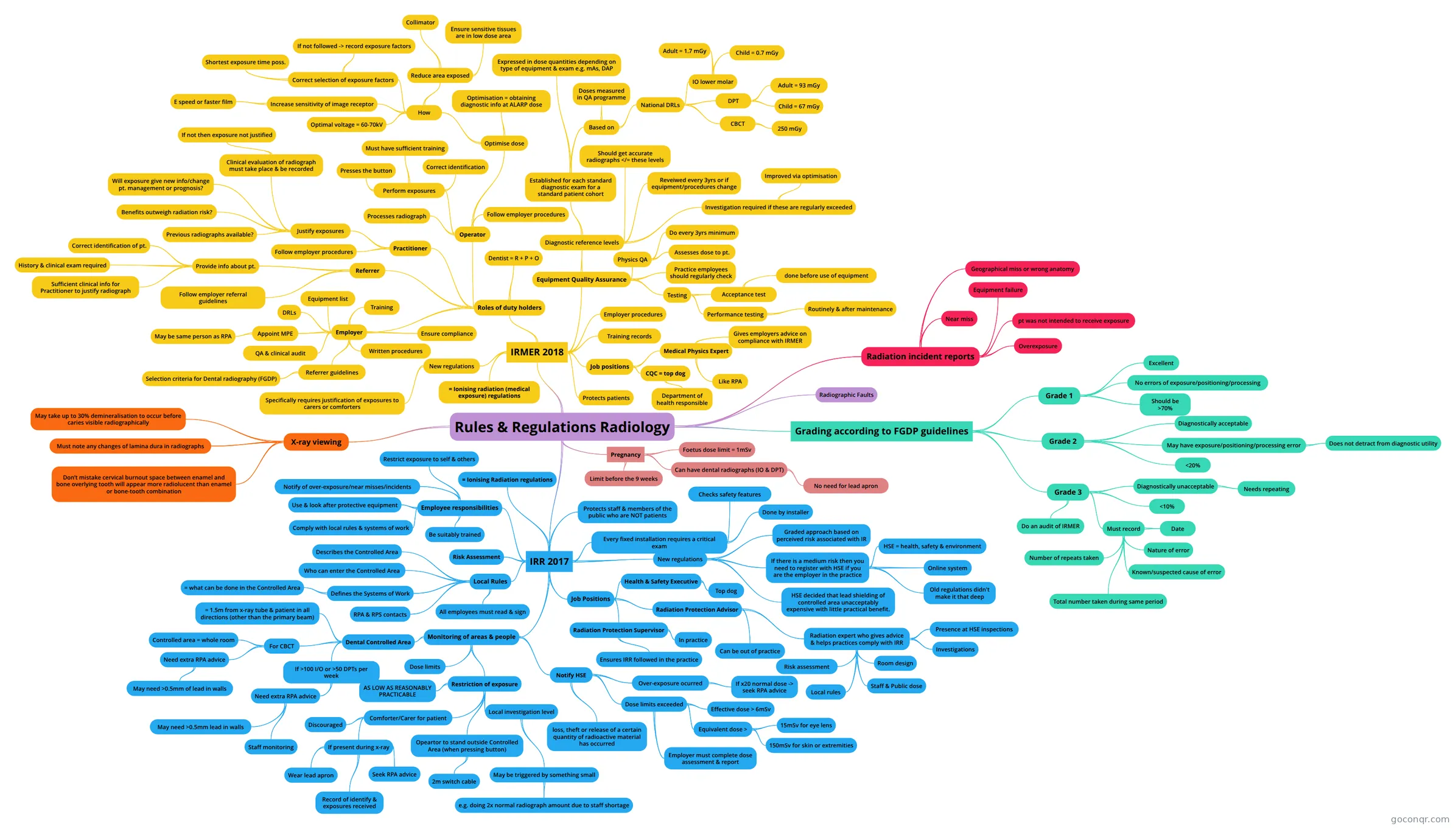
Mind map: Rules & regulations radiology
Contenido del mapa
Rules & Regulations Radiology
IRR 2017
- Protects staff & members of the public who are NOT patients
- = Ionising Radiation regulations
- New regulations
- Graded approach based on perceived risk associated with IR
- If there is a medium risk then you need to register with HSE if you are the employer in the practice
- Online system
- Old regulations didn't make it that deep
- HSE = health, safety & environment
- HSE decided that lead shielding of controlled area unacceptably expensive with little practical benefit.
- Job Positions
- Radiation Protection Advisor
- Can be out of practice
- Radiation expert who gives advice & helps practices comply with IRR
- Risk assessment
- Local rules
- Staff & Public dose
- Investigations
- Presence at HSE inspections
- Room design
- Radiation Protection Supervisor
- In practice
- Ensures IRR followed in the practice
- Health & Safety Executive
- Top dog
- Radiation Protection Advisor
- Risk Assessment
- Local Rules
- Describes the Controlled Area
- Who can enter the Controlled Area
- Defines the Systems of Work
- = what can be done in the Controlled Area
- RPA & RPS contacts
- All employees must read & sign
- Monitoring of areas & people
- Restriction of exposure
- AS LOW AS REASONABLY PRACTICABLE
- Opeartor to stand outside Controlled Area (when pressing button)
- 2m switch cable
- Local investigation level
- May be triggered by something small
- e.g. doing 2x normal radiograph amount due to staff shortage
- May be triggered by something small
- Comforter/Carer for patient
- Discouraged
- If present during x-ray
- Wear lead apron
- Record of identify & exposures received
- Seek RPA advice
- Dental Controlled Area
- = 1.5m from x-ray tube & patient in all directions (other than the primary beam)
- For CBCT
- Controlled area = whole room
- Need extra RPA advice
- May need >0.5mm of lead in walls
- If >100 I/O or >50 DPTs per week
- Need extra RPA advice
- May need >0.5mm lead in walls
- Staff monitoring
- Need extra RPA advice
- Dose limits
- Notify HSE
- Over-exposure ocurred
- If x20 normal dose -> seek RPA advice
- Dose limits exceeded
- Effective dose > 6mSv
- Equivalent dose >
- 15mSv for eye lens
- 150mSv for skin or extremities
- Employer must complete dose assessment & report
- loss, theft or release of a certain quantity of radioactive material has occurred
- Over-exposure ocurred
- Restriction of exposure
- Employee responsibilities
- Be suitably trained
- Restrict exposure to self & others
- Use & look after protective equipment
- Notify of over-exposure/near misses/incidents
- Comply with local rules & systems of work
- Every fixed installation requires a critical exam
- Checks safety features
- Done by installer
IRMER 2018
- = Ionising radiation (medical exposure) regulations
- Protects patients
- New regulations
- Specifically requires justification of exposures to carers or comforters
- Job positions
- CQC = top dog
- Department of health responsible
- Medical Physics Expert
- Like RPA
- Gives employers advice on compliance with IRMER
- CQC = top dog
- Training records
- Employer procedures
- Equipment Quality Assurance
- Diagnostic reference levels
- Reveiwed every 3yrs or if equipment/procedures change
- Should get accurate radiographs </= these levels
- Established for each standard diagnostic exam for a standard patient cohort
- Based on
- National DRLs
- IO lower molar
- Adult = 1.7 mGy
- Child = 0.7 mGy
- DPT
- Adult = 93 mGy
- Child = 67 mGy
- CBCT
- 250 mGy
- IO lower molar
- Doses measured in QA programme
- National DRLs
- Expressed in dose quantities depending on type of equipment & exam e.g. mAs, DAP
- Based on
- Investigation required if these are regularly exceeded
- Improved via optimisation
- Practice employees should regularly check
- Physics QA
- Do every 3yrs minimum
- Assesses dose to pt.
- Testing
- Acceptance test
- done before use of equipment
- Performance testing
- Routinely & after maintenance
- Acceptance test
- Diagnostic reference levels
- Roles of duty holders
- Employer
- Ensure compliance
- Written procedures
- Referrer guidelines
- Selection criteria for Dental radiography (FGDP)
- QA & clinical audit
- Appoint MPE
- May be same person as RPA
- DRLs
- Equipment list
- Training
- Referrer
- Follow employer referral guidelines
- Provide info about pt.
- Sufficient clinical info for Practitioner to justify radiograph
- History & clinical exam required
- Correct identification of pt.
- Practitioner
- Justify exposures
- Previous radiographs available?
- Benefits outweigh radiation risk?
- Will exposure give new info/change pt. management or prognosis?
- Clinical evaluation of radiograph must take place & be recorded
- If not then exposure not justified
- Follow employer procedures
- Justify exposures
- Operator
- Perform exposures
- Presses the button
- Must have sufficient training
- Correct identification
- Optimise dose
- Optimisation = obtaining diagnostic info at ALARP dose
- How
- Correct selection of exposure factors
- If not followed -> record exposure factors
- Shortest exposure time poss.
- Increase sensitivity of image receptor
- E speed or faster film
- Reduce area exposed
- Collimator
- Ensure sensitive tissues are in low dose area
- Optimal voltage = 60-70kV
- Correct selection of exposure factors
- Follow employer procedures
- Processes radiograph
- Perform exposures
- Dentist = R + P + O
- Employer
Grading according to FGDP guidelines
- Grade 1
- Excellent
- No errors of exposure/positioning/processing
- Should be >70%
- Grade 2
- Diagnostically acceptable
- May have exposure/positioning/processing error
- Does not detract from diagnostic utility
- <20%
- Grade 3
- Do an audit of IRMER
- Must record
- Date
- Nature of error
- Known/suspected cause of error
- Number of repeats taken
- Total number taken during same period
- Diagnostically unacceptable
- Needs repeating
- <10%
- Grade 1
X-ray viewing
- May take up to 30% demineralisation to occur before caries visible radiographically
- Don’t mistake cervical burnout space between enamel and bone overlying tooth will appear more radiolucent than enamel or bone-tooth combination
- Must note any changes of lamina dura in radiographs
Pregnancy
- Can have dental radiographs (IO & DPT)
- No need for lead apron
- Limit before the 9 weeks
- Foetus dose limit = 1mSv
- Can have dental radiographs (IO & DPT)
Radiation incident reports
- Equipment failure
- Geographical miss or wrong anatomy
- Near miss
- Overexposure
- pt was not intended to receive exposure
Radiographic Faults
Información
- Descripción
- First Year Dentistry Mapa Mental sobre Rules & Regulations Radiology, creado por sanna pathy el 08/03/2020.
- Creado por
- sanna pathy
- Visitas
- 3
- Etiquetas
- Historial
-
- Creado por Zainab Patel · 1 feb 2020
- Copiado por sanna pathy · 8 mar 2020
- Valoración
Más sobre Radiation Safety and Regulations