
Dental Radiology
114 resources created by 69 users
This Dental Radiology page on GoConqr gathers community-made quizzes, mind maps, flashcards and notes, from X-ray production and radiation protection to panoramic imaging, CBCT and jaw lesions. It's built for university students and professional candidates revising imaging, and for teachers after ready-made material. There are over 100 resources here, including more than 20 quizzes, over 60 flashcards and more than 10 mind maps. Open a quiz to spot your gaps, then see what you can add yourself.
Select topic
- X-Ray History and Equipment7
- Radiation Safety and Regulations10
- Intraoral Radiography Techniques9
- Extraoral and Panoramic Radiography9
- Radiographic Film Processing and Image Quality9
- Dental Radiographic Anatomy16
- Radiographic Interpretation8
- Radiographic Diagnosis of Dental Conditions9
- Radiographic Diagnosis of Jaw and Oral Lesions16
Top Dental Radiology resources
-
Mind map Skull views
-
28 cardsDental Radiography Landmarks
-
21 cardsDental Radiography Errors
-
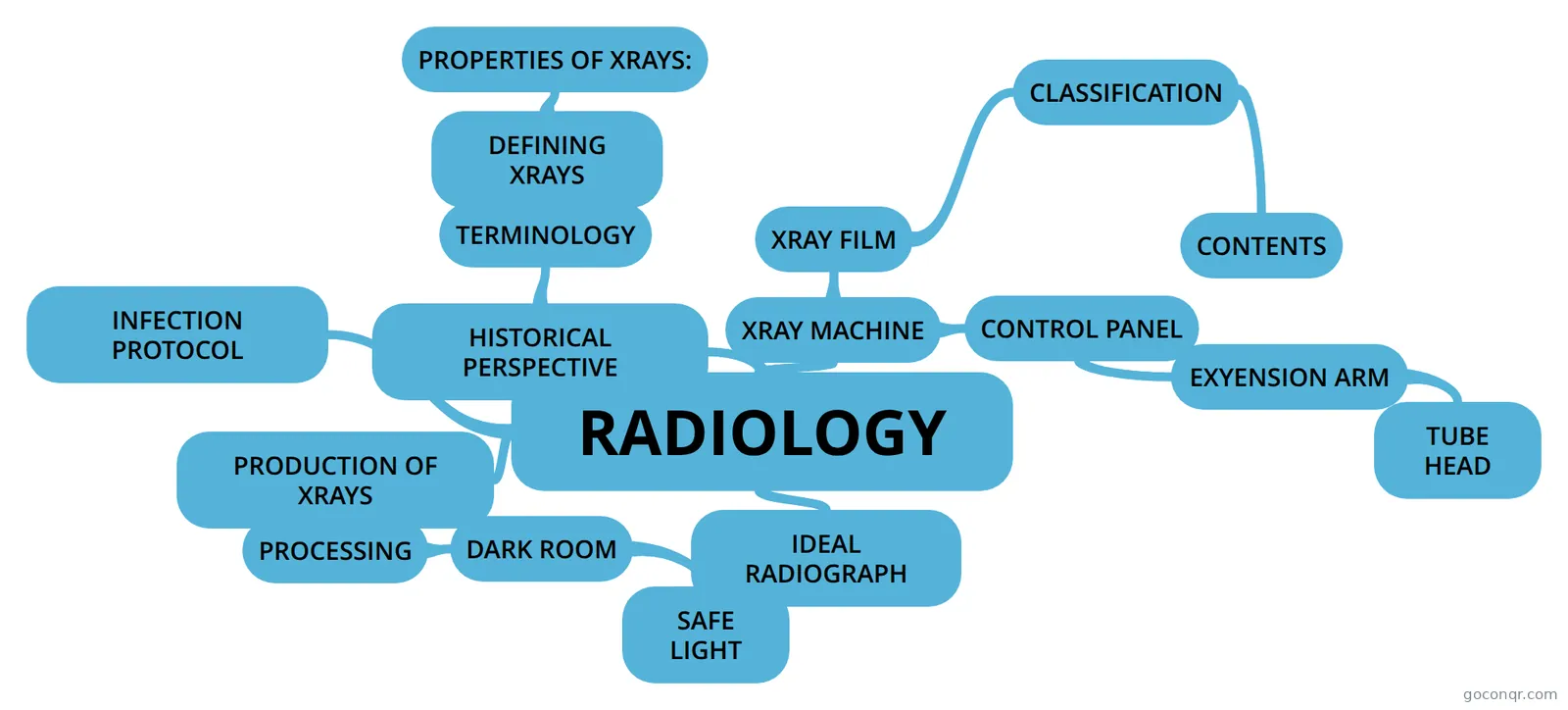 Mind map RADIOLOGY SHORT AND SWEET
-
62 questionsWeek 1 DFT Prep - IRR, IRMER, Social Media, Prescribing, Teamworking, Clinical Records, GDC standard 8 What is the annual radiation dose limit for a "classified employee"?
-
63 questionsRadiography 1 Where should the front edge of a bitewing radiograph be aligned?
-
22 questionsRadiographic Health and Safety What does the ALARP concept refer to?
-
67 cardsDevelopmental & Congenital Anomalies Does not include all lecture material. Please review PPT.
Quizzes
See all 23 quizzes-
62 questionsWeek 1 DFT Prep - IRR, IRMER, Social Media, Prescribing, Teamworking, Clinical Records, GDC standard 8 What is the annual radiation dose limit for a "classified employee"?
-
63 questionsRadiography 1 Where should the front edge of a bitewing radiograph be aligned?
-
22 questionsRadiographic Health and Safety What does the ALARP concept refer to?
-
10 questionsNBDE II- Radiology As discussed in class, for which of the following anatomical situations would the panoramic film be the bes...
Mind maps
See all 17 mind mapsFlashcards
See all 69 flashcards-
28 cardsDental Radiography Landmarks
-
21 cardsDental Radiography Errors
-
67 cardsDevelopmental & Congenital Anomalies Does not include all lecture material. Please review PPT.
-
22 cardsStructures of the Maxilla and Mandible as they Appear in Dental Radiographs These flashcards are used for identifying normal structures of the mandible and maxilla which may appear on...
-
34 cardslecture 3
-
31 cardsRadiology A device that can be used to demonstrate short scale and long scale contrast
-
38 cardsradio done by Assamidy
-
63 cardsNormal Anatomy Exam prep
Topics in Dental Radiology
More Dentistry topics
About Dental Radiology
GoConqr OriginalWhat the resources cover
The unit follows the path of a radiograph, from the beam to the report. Early material deals with the basics. The mind map called RADIOLOGY sets out the history, the properties of X-rays, the machine, the film and the control panel. The flashcards on radiation hazards and protection sit alongside the mind maps on rules and regulations and on the principles of IRR.
Technique, faults and anatomy
Once the basics are clear, move to practical technique. The Dental Radiography Errors flashcards run through film bending, cone cut, double exposure, movement and overexposure. The Dental Radiography Landmarks deck covers structures such as the nasal septum, the inferior nasal conchae and the inverted Y. Other decks cover intraoral anatomy, panoramic image anatomy and variations of radiographic anatomy.
Views and advanced imaging
The Skull views mind map covers the occipitomental view, positioning, sinuses and mid-face fractures. Extra Oral Imaging covers lateral jaw imaging of the body of the mandible. There are also decks on CBCT, salivary gland imaging and trauma to teeth and supporting tissues.
Interpretation and lesions
For reading images, try the decks on radiolucent lesions, cysts and cyst-like lesions, caries detection and inflammatory lesions of the jaw. The mind map on the differential diagnosis of radiopacity of the jaws has a matching note made from it. The Buccal Object Rule slide set helps with localisation.
A suggested order
- Skim the RADIOLOGY mind map for the big picture.
- Work through the errors and landmarks flashcards.
- Take a quiz such as DANB RHS Exam or one of the Radiology Test quizzes.
- Return to the mind maps for anything you missed.
This unit sits in the Clinical Assessment, Imaging and Patient Care strand of Dentistry. Pick a deck or quiz to start, and use the mind maps to tie it together.
Frequently asked questions
Which resource should I start with?
Start with the RADIOLOGY mind map for an overview of X-ray production, the machine and the film. Then move to the Dental Radiography Errors and Dental Radiography Landmarks flashcards, and finish with a quiz to see which areas need another look.
What do the mind maps cover?
They cover skull views, extra oral imaging, classification of films, DPT, advanced imaging, radiation values and the rules and regulations around radiology. There are also maps on the differential diagnosis of radiopacity of the jaws and on periapical radiographs, the latter in Spanish.
Are there quizzes for exam-style practice?
Yes. There are more than 20 quizzes, including the DANB RHS Exam, NBDE II- Radiology, several numbered Radiology Test quizzes and a Week 1 DFT Prep quiz covering IRR and IRMER. They suit university students and professional candidates.
Are these resources free, and who made them?
Every resource here is free to open, study and take, with no account needed. They were made by GoConqr users, not by GoConqr itself. A free account also saves your quiz scores and lets you make your own quizzes, maps, flashcards and notes.
Can teachers use this page?
Yes. Teachers can use the ready-made flashcard decks, quizzes, mind maps and the Buccal Object Rule slide set as starting points for revision sessions, or to give students a quick check on topics such as radiographic errors and anatomy.
What if I cannot find a topic?
Browse the flashcard decks and notes first, as many topics are tucked inside broader sets. Topics here range from caries radiology to developmental anomalies. If something is still missing, you can make your own resource on it.