
Mapa mental
River Processes and Pressures Cont...
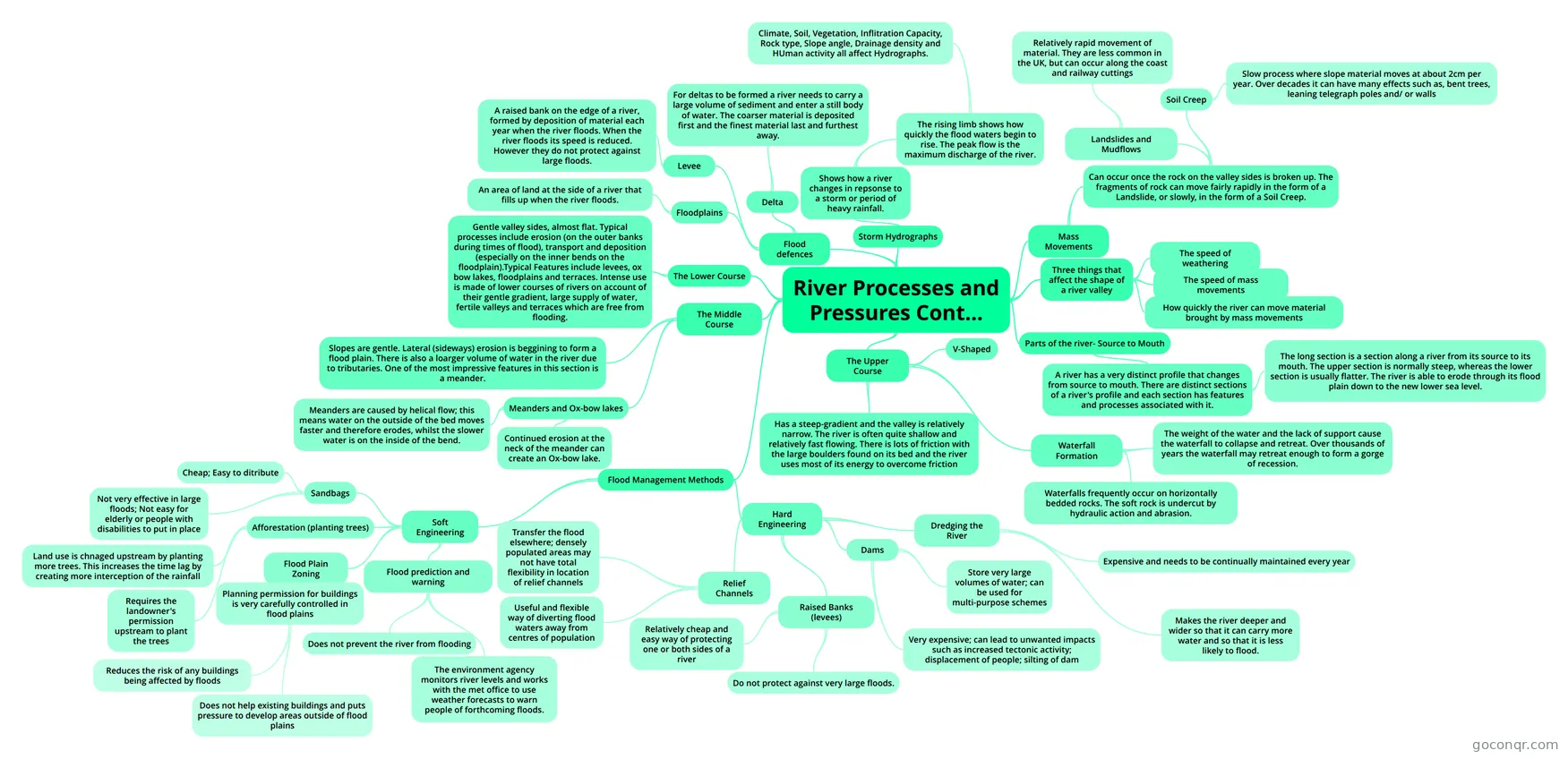
Mind map: River processes and pressures
Contenido del mapa
River Processes and Pressures Cont...
Mass Movements
- Can occur once the rock on the valley sides is broken up. The fragments of rock can move fairly rapidly in the form of a Landslide, or slowly, in the form of a Soil Creep.
- Landslides and Mudflows
- Relatively rapid movement of material. They are less common in the UK, but can occur along the coast and railway cuttings
- Soil Creep
- Slow process where slope material moves at about 2cm per year. Over decades it can have many effects such as, bent trees, leaning telegraph poles and/ or walls
- Landslides and Mudflows
- Can occur once the rock on the valley sides is broken up. The fragments of rock can move fairly rapidly in the form of a Landslide, or slowly, in the form of a Soil Creep.
Three things that affect the shape of a river valley
- The speed of weathering
- The speed of mass movements
- How quickly the river can move material brought by mass movements
Parts of the river- Source to Mouth
- A river has a very distinct profile that changes from source to mouth. There are distinct sections of a river's profile and each section has features and processes associated with it.
- The long section is a section along a river from its source to its mouth. The upper section is normally steep, whereas the lower section is usually flatter. The river is able to erode through its flood plain down to the new lower sea level.
- A river has a very distinct profile that changes from source to mouth. There are distinct sections of a river's profile and each section has features and processes associated with it.
The Upper Course
- V-Shaped
- Has a steep-gradient and the valley is relatively narrow. The river is often quite shallow and relatively fast flowing. There is lots of friction with the large boulders found on its bed and the river uses most of its energy to overcome friction
- Waterfall Formation
- Waterfalls frequently occur on horizontally bedded rocks. The soft rock is undercut by hydraulic action and abrasion.
- The weight of the water and the lack of support cause the waterfall to collapse and retreat. Over thousands of years the waterfall may retreat enough to form a gorge of recession.
The Middle Course
- Slopes are gentle. Lateral (sideways) erosion is beggining to form a flood plain. There is also a loarger volume of water in the river due to tributaries. One of the most impressive features in this section is a meander.
- Meanders and Ox-bow lakes
- Meanders are caused by helical flow; this means water on the outside of the bed moves faster and therefore erodes, whilst the slower water is on the inside of the bend.
- Continued erosion at the neck of the meander can create an Ox-bow lake.
The Lower Course
- Gentle valley sides, almost flat. Typical processes include erosion (on the outer banks during times of flood), transport and deposition (especially on the inner bends on the floodplain).Typical Features include levees, ox bow lakes, floodplains and terraces. Intense use is made of lower courses of rivers on account of their gentle gradient, large supply of water, fertile valleys and terraces which are free from flooding.
Flood defences
- Floodplains
- An area of land at the side of a river that fills up when the river floods.
- Levee
- A raised bank on the edge of a river, formed by deposition of material each year when the river floods. When the river floods its speed is reduced. However they do not protect against large floods.
- Delta
- For deltas to be formed a river needs to carry a large volume of sediment and enter a still body of water. The coarser material is deposited first and the finest material last and furthest away.
- Floodplains
Storm Hydrographs
- Shows how a river changes in repsonse to a storm or period of heavy rainfall.
- The rising limb shows how quickly the flood waters begin to rise. The peak flow is the maximum discharge of the river.
- Climate, Soil, Vegetation, Inflitration Capacity, Rock type, Slope angle, Drainage density and HUman activity all affect Hydrographs.
- The rising limb shows how quickly the flood waters begin to rise. The peak flow is the maximum discharge of the river.
- Shows how a river changes in repsonse to a storm or period of heavy rainfall.
Flood Management Methods
- Hard Engineering
- Dredging the River
- Makes the river deeper and wider so that it can carry more water and so that it is less likely to flood.
- Expensive and needs to be continually maintained every year
- Dams
- Store very large volumes of water; can be used for multi-purpose schemes
- Very expensive; can lead to unwanted impacts such as increased tectonic activity; displacement of people; silting of dam
- Relief Channels
- Useful and flexible way of diverting flood waters away from centres of population
- Transfer the flood elsewhere; densely populated areas may not have total flexibility in location of relief channels
- Raised Banks (levees)
- Relatively cheap and easy way of protecting one or both sides of a river
- Do not protect against very large floods.
- Dredging the River
- Soft Engineering
- Sandbags
- Cheap; Easy to ditribute
- Not very effective in large floods; Not easy for elderly or people with disabilities to put in place
- Afforestation (planting trees)
- Land use is chnaged upstream by planting more trees. This increases the time lag by creating more interception of the rainfall
- Requires the landowner's permission upstream to plant the trees
- Flood Plain Zoning
- Planning permission for buildings is very carefully controlled in flood plains
- Reduces the risk of any buildings being affected by floods
- Does not help existing buildings and puts pressure to develop areas outside of flood plains
- Planning permission for buildings is very carefully controlled in flood plains
- Flood prediction and warning
- The environment agency monitors river levels and works with the met office to use weather forecasts to warn people of forthcoming floods.
- Does not prevent the river from flooding
- Sandbags
- Hard Engineering
Información
- Descripción
- AS - Level (Physical Geography) Geography Mapa Mental sobre River Processes and Pressures Cont..., creado por Laura Lui el 28/03/2015.
- Creado por
- Laura Lui
- Visitas
- 0
- Valoración