
Mapa mental
Experiment
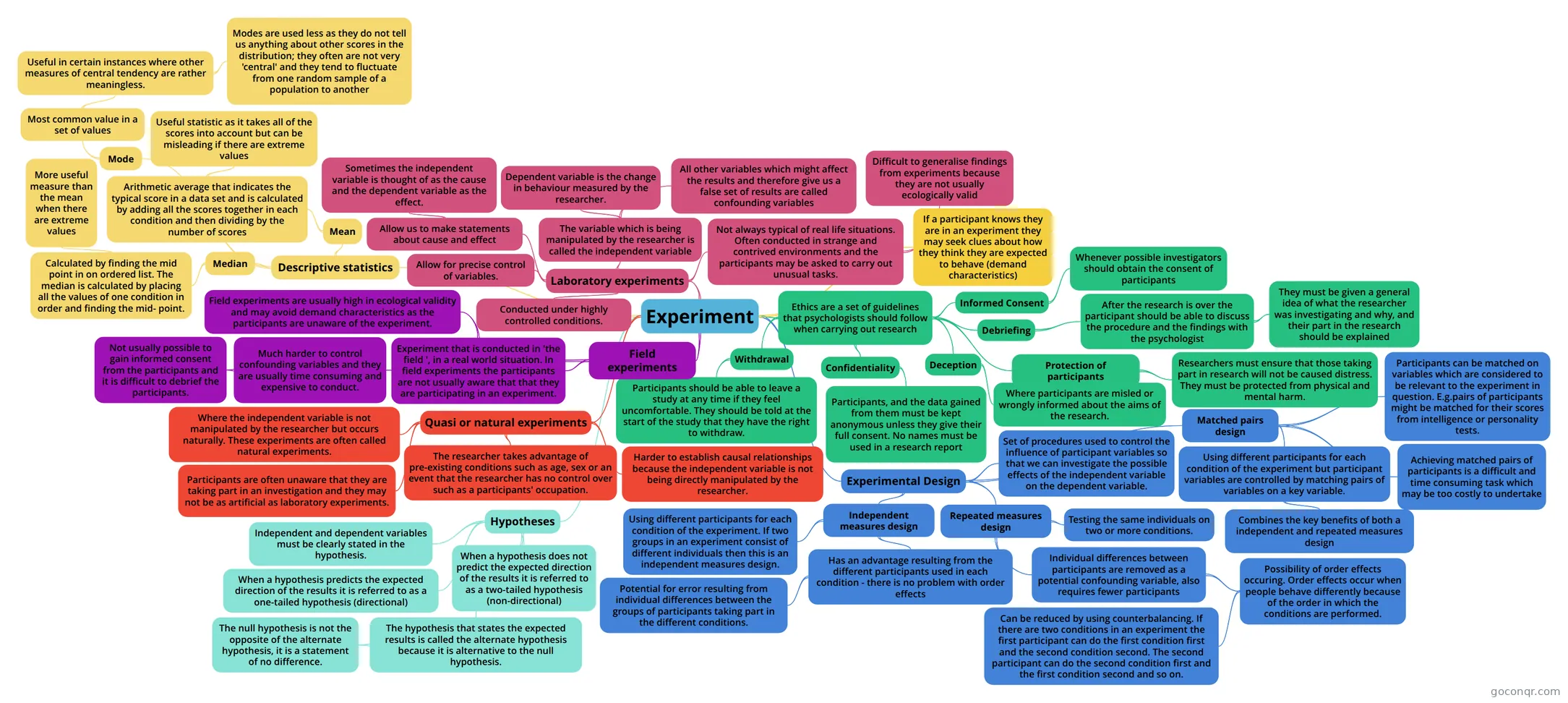
Mind map: Psychology experiments
Contenido del mapa
Experiment
Laboratory experiments
- Conducted under highly controlled conditions.
- The variable which is being manipulated by the researcher is called the independent variable
- Dependent variable is the change in behaviour measured by the researcher.
- All other variables which might affect the results and therefore give us a false set of results are called confounding variables
- Allow for precise control of variables.
- Allow us to make statements about cause and effect
- Sometimes the independent variable is thought of as the cause and the dependent variable as the effect.
- Not always typical of real life situations. Often conducted in strange and contrived environments and the participants may be asked to carry out unusual tasks.
- Difficult to generalise findings from experiments because they are not usually ecologically valid
If a participant knows they are in an experiment they may seek clues about how they think they are expected to behave (demand characteristics)
Ethics are a set of guidelines that psychologists should follow when carrying out research
- Informed Consent
- Whenever possible investigators should obtain the consent of participants
- Debriefing
- After the research is over the participant should be able to discuss the procedure and the findings with the psychologist
- They must be given a general idea of what the researcher was investigating and why, and their part in the research should be explained
- After the research is over the participant should be able to discuss the procedure and the findings with the psychologist
- Protection of participants
- Researchers must ensure that those taking part in research will not be caused distress. They must be protected from physical and mental harm.
- Deception
- Where participants are misled or wrongly informed about the aims of the research.
- Confidentiality
- Participants, and the data gained from them must be kept anonymous unless they give their full consent. No names must be used in a research report
- Withdrawal
- Participants should be able to leave a study at any time if they feel uncomfortable. They should be told at the start of the study that they have the right to withdraw.
- Informed Consent
Field experiments
- Experiment that is conducted in 'the field ', in a real world situation. In field experiments the participants are not usually aware that that they are participating in an experiment.
- Field experiments are usually high in ecological validity and may avoid demand characteristics as the participants are unaware of the experiment.
- Much harder to control confounding variables and they are usually time consuming and expensive to conduct.
- Not usually possible to gain informed consent from the participants and it is difficult to debrief the participants.
- Experiment that is conducted in 'the field ', in a real world situation. In field experiments the participants are not usually aware that that they are participating in an experiment.
Quasi or natural experiments
- Where the independent variable is not manipulated by the researcher but occurs naturally. These experiments are often called natural experiments.
- The researcher takes advantage of pre-existing conditions such as age, sex or an event that the researcher has no control over such as a participants' occupation.
- Participants are often unaware that they are taking part in an investigation and they may not be as artificial as laboratory experiments.
- Harder to establish causal relationships because the independent variable is not being directly manipulated by the researcher.
Experimental Design
- Set of procedures used to control the influence of participant variables so that we can investigate the possible effects of the independent variable on the dependent variable.
- Independent measures design
- Using different participants for each condition of the experiment. If two groups in an experiment consist of different individuals then this is an independent measures design.
- Has an advantage resulting from the different participants used in each condition - there is no problem with order effects
- Potential for error resulting from individual differences between the groups of participants taking part in the different conditions.
- Repeated measures design
- Testing the same individuals on two or more conditions.
- Individual differences between participants are removed as a potential confounding variable, also requires fewer participants
- Possibility of order effects occuring. Order effects occur when people behave differently because of the order in which the conditions are performed.
- Can be reduced by using counterbalancing. If there are two conditions in an experiment the first participant can do the first condition first and the second condition second. The second participant can do the second condition first and the first condition second and so on.
- Possibility of order effects occuring. Order effects occur when people behave differently because of the order in which the conditions are performed.
- Matched pairs design
- Using different participants for each condition of the experiment but participant variables are controlled by matching pairs of variables on a key variable.
- Combines the key benefits of both a independent and repeated measures design
- Participants can be matched on variables which are considered to be relevant to the experiment in question. E.g.pairs of participants might be matched for their scores from intelligence or personality tests.
- Achieving matched pairs of participants is a difficult and time consuming task which may be too costly to undertake
- Using different participants for each condition of the experiment but participant variables are controlled by matching pairs of variables on a key variable.
Hypotheses
- Independent and dependent variables must be clearly stated in the hypothesis.
- When a hypothesis predicts the expected direction of the results it is referred to as a one-tailed hypothesis (directional)
- When a hypothesis does not predict the expected direction of the results it is referred to as a two-tailed hypothesis (non-directional)
- The hypothesis that states the expected results is called the alternate hypothesis because it is alternative to the null hypothesis.
- The null hypothesis is not the opposite of the alternate hypothesis, it is a statement of no difference.
Descriptive statistics
- Mean
- Arithmetic average that indicates the typical score in a data set and is calculated by adding all the scores together in each condition and then dividing by the number of scores
- Useful statistic as it takes all of the scores into account but can be misleading if there are extreme values
- Arithmetic average that indicates the typical score in a data set and is calculated by adding all the scores together in each condition and then dividing by the number of scores
- Median
- Calculated by finding the mid point in on ordered list. The median is calculated by placing all the values of one condition in order and finding the mid- point.
- More useful measure than the mean when there are extreme values
- Calculated by finding the mid point in on ordered list. The median is calculated by placing all the values of one condition in order and finding the mid- point.
- Mode
- Most common value in a set of values
- Useful in certain instances where other measures of central tendency are rather meaningless.
- Modes are used less as they do not tell us anything about other scores in the distribution; they often are not very 'central' and they tend to fluctuate from one random sample of a population to another
- Useful in certain instances where other measures of central tendency are rather meaningless.
- Most common value in a set of values
- Mean
Información
- Descripción
- Mapa Mental sobre Experiment, creado por Annabelle Langmead el 04/05/2015.
- Creado por
- Annabelle Langmead
- Visitas
- 0
- Valoración