
Mapa mental
Four Working Principles in Situation Ethics
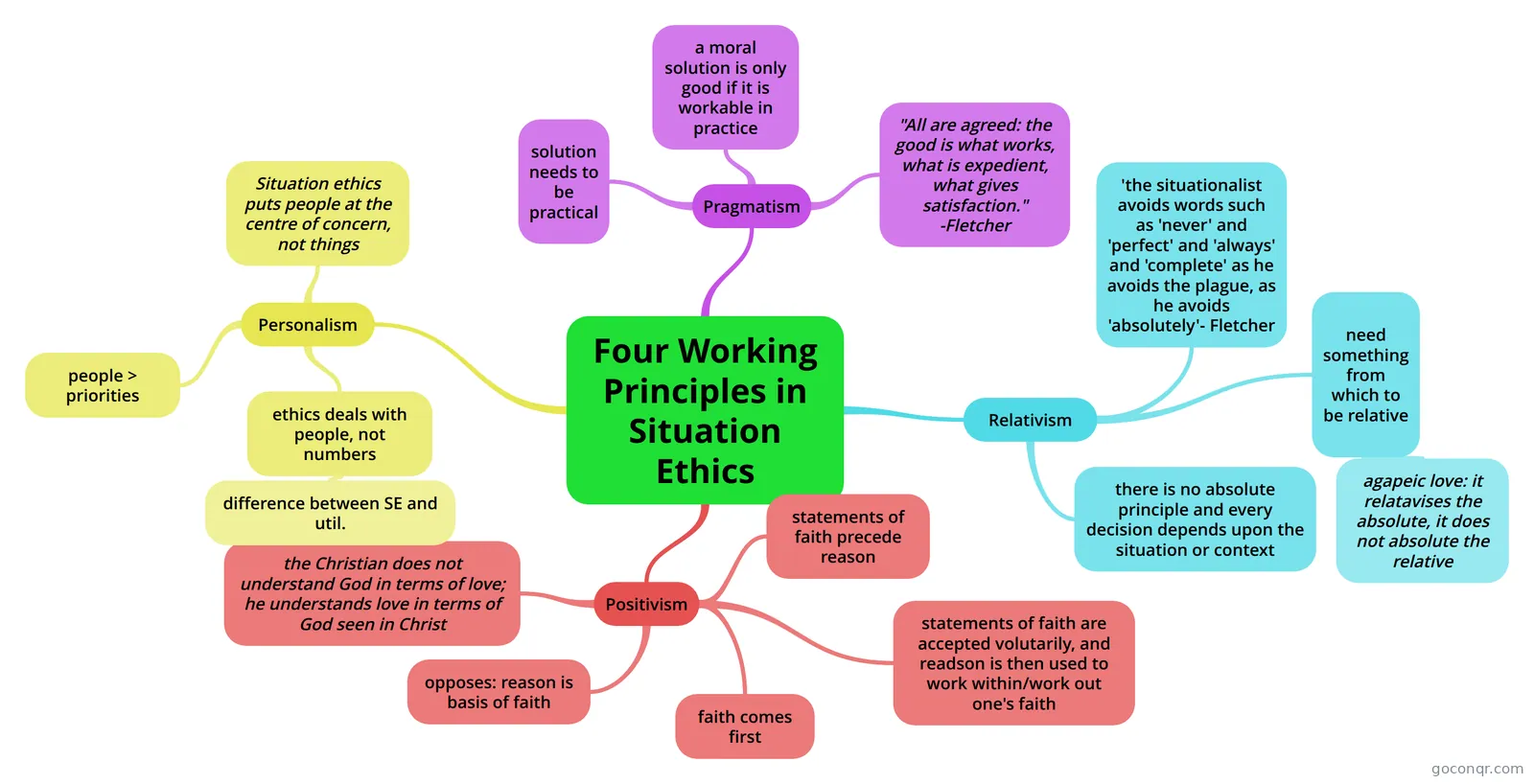
Mind map: Four working principles in situation ethics
Contenido del mapa
Four Working Principles in Situation Ethics
Pragmatism
- solution needs to be practical
- "All are agreed: the good is what works, what is expedient, what gives satisfaction." -Fletcher
- a moral solution is only good if it is workable in practice
Relativism
- 'the situationalist avoids words such as 'never' and 'perfect' and 'always' and 'complete' as he avoids the plague, as he avoids 'absolutely'- Fletcher
- need something from which to be relative
- agapeic love: it relatavises the absolute, it does not absolute the relative
- there is no absolute principle and every decision depends upon the situation or context
Positivism
- statements of faith precede reason
- statements of faith are accepted volutarily, and readson is then used to work within/work out one's faith
- opposes: reason is basis of faith
- faith comes first
- the Christian does not understand God in terms of love; he understands love in terms of God seen in Christ
Personalism
- ethics deals with people, not numbers
- difference between SE and util.
- people > priorities
- Situation ethics puts people at the centre of concern, not things
- ethics deals with people, not numbers
Información
- Descripción
- (Ethics) R.E. Mapa Mental sobre Four Working Principles in Situation Ethics, creado por jessica.lovell el 10/10/2013.
- Creado por
- jessica.lovell
- Visitas
- 726
- Etiquetas
- Valoración