
Mapa mental
Language & Gender
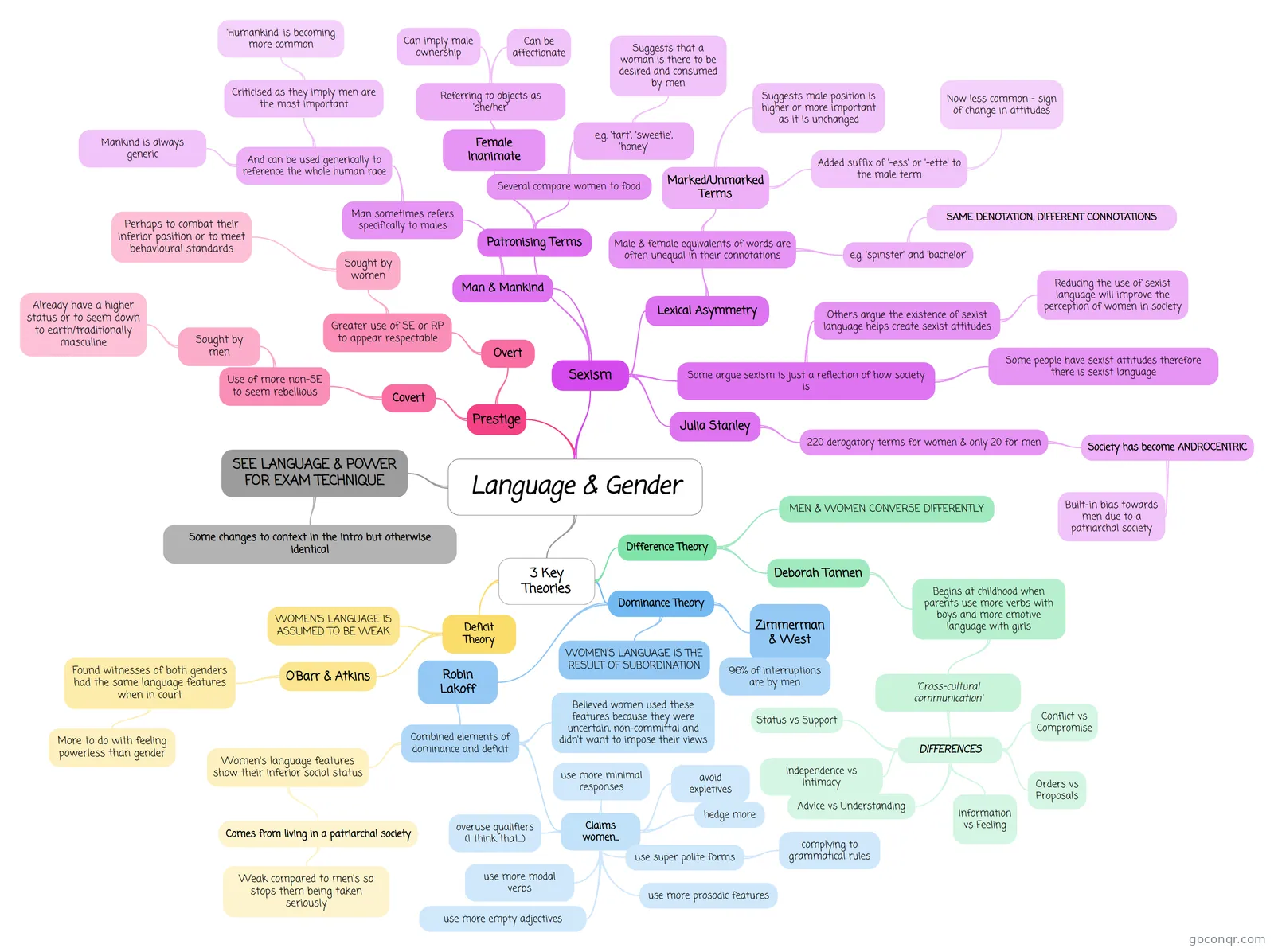
Mind map: Language and gender
Contenido del mapa
Language & Gender
3 Key Theories
- Difference Theory
- Deborah Tannen
- Begins at childhood when parents use more verbs with boys and more emotive language with girls
- 'Cross-cultural communication'
- DIFFERENCES
- Advice vs Understanding
- Status vs Support
- Independence vs Intimacy
- Information vs Feeling
- Orders vs Proposals
- Conflict vs Compromise
- DIFFERENCES
- 'Cross-cultural communication'
- Begins at childhood when parents use more verbs with boys and more emotive language with girls
- MEN & WOMEN CONVERSE DIFFERENTLY
- Deborah Tannen
- Dominance Theory
- WOMEN'S LANGUAGE IS THE RESULT OF SUBORDINATION
- Robin Lakoff
- Combined elements of dominance and deficit
- Claims women...
- hedge more
- use super polite forms
- complying to grammatical rules
- use more prosodic features
- use more empty adjectives
- use more modal verbs
- overuse qualifiers (I think that...)
- use more minimal responses
- avoid expletives
- Believed women used these features because they were uncertain, non-committal and didn't want to impose their views
- Women's language features show their inferior social status
- Comes from living in a patriarchal society
- Weak compared to men's so stops them being taken seriously
- Comes from living in a patriarchal society
- Claims women...
- Combined elements of dominance and deficit
- Zimmerman & West
- 96% of interruptions are by men
- Deficit Theory
- WOMEN'S LANGUAGE IS ASSUMED TO BE WEAK
- O'Barr & Atkins
- Found witnesses of both genders had the same language features when in court
- More to do with feeling powerless than gender
- Found witnesses of both genders had the same language features when in court
- Difference Theory
Sexism
- Julia Stanley
- 220 derogatory terms for women & only 20 for men
- Society has become ANDROCENTRIC
- Built-in bias towards men due to a patriarchal society
- Society has become ANDROCENTRIC
- 220 derogatory terms for women & only 20 for men
- Some argue sexism is just a reflection of how society is
- Some people have sexist attitudes therefore there is sexist language
- Others argue the existence of sexist language helps create sexist attitudes
- Reducing the use of sexist language will improve the perception of women in society
- Lexical Asymmetry
- Male & female equivalents of words are often unequal in their connotations
- Marked/Unmarked Terms
- Added suffix of '-ess' or '-ette' to the male term
- Now less common - sign of change in attitudes
- Suggests male position is higher or more important as it is unchanged
- Added suffix of '-ess' or '-ette' to the male term
- e.g. 'spinster' and 'bachelor'
- SAME DENOTATION, DIFFERENT CONNOTATIONS
- Marked/Unmarked Terms
- Male & female equivalents of words are often unequal in their connotations
- Patronising Terms
- Several compare women to food
- e.g. 'tart', 'sweetie', 'honey'
- Suggests that a woman is there to be desired and consumed by men
- e.g. 'tart', 'sweetie', 'honey'
- Female Inanimate
- Referring to objects as 'she/her'
- Can be affectionate
- Can imply male ownership
- Referring to objects as 'she/her'
- Several compare women to food
- Man & Mankind
- Man sometimes refers specifically to males
- And can be used generically to reference the whole human race
- Mankind is always generic
- Criticised as they imply men are the most important
- 'Humankind' is becoming more common
- And can be used generically to reference the whole human race
- Man sometimes refers specifically to males
- Julia Stanley
Prestige
- Overt
- Greater use of SE or RP to appear respectable
- Sought by women
- Perhaps to combat their inferior position or to meet behavioural standards
- Sought by women
- Greater use of SE or RP to appear respectable
- Covert
- Use of more non-SE to seem rebellious
- Sought by men
- Already have a higher status or to seem down to earth/traditionally masculine
- Sought by men
- Use of more non-SE to seem rebellious
- Overt
SEE LANGUAGE & POWER FOR EXAM TECHNIQUE
- Some changes to context in the intro but otherwise identical
Información
- Descripción
- Everything you need to revise Language & Gander for AS English Language.
- Creado por
- anna.swainson
- Visitas
- 45
- Etiquetas
- Valoración