
Mapa mental
Success and failure of dieting
Contenido del mapa
Success and failure of dieting
Restraint Theory
- Research suggests 89% of UK women have dieted at some point in their lives. (Klesges et al., 1987)
- Herman and Mack 1975 created the theory to explain causes and consequence of food intake. They suggested that attempting not to eat actually increases the chance of overeating
- Wardle and Beales 1988 randomly assigned 27 obese women to either an exercise, diet or control group. At week 4 & 6 ppts were assessed before & after a preload was consumed. At week 6, the assessment was done under stressful conditions
- It was found that women in the diet group ate more than the other ppts in both conditions
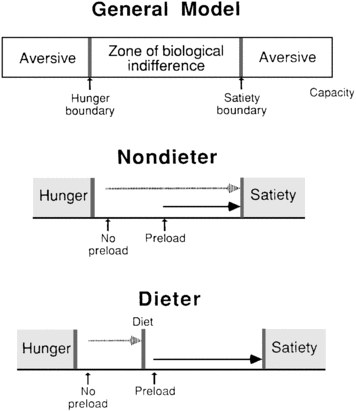
- The Boundary Model
- Herman & Polivy 1984 created the model which proposes boundaries for food intake. These include a hunger boundary & satiety. Dieters have another boundary in between these two, called the diet boundary.
- Dieters have a bigger gap between hunger and satiety, whilst restrained eaters have self imposed limits, however when those limits are breached, they are more likely to eat to satiety
The Role of Denial
- It has been found that trying to suppress a thought can actually make it even more prominent. Wegner asked ppts not to think about a white bear, but ring a bell if they did. Ppts that were told to not think about the bear rang the bell far more often than those that weren't told whether to think about it or not
- Wegner called this 'the Theory of Ironic Processes'
- This therefore means that when diets try to suppress thoughts of food, they actually end up worse off, and fail their diets
- It has been found that trying to suppress a thought can actually make it even more prominent. Wegner asked ppts not to think about a white bear, but ring a bell if they did. Ppts that were told to not think about the bear rang the bell far more often than those that weren't told whether to think about it or not
Evaluation
- Restraint Theory
- Implications for obesity treatment
- Ogden suggests that whilst research implies that restraint leads to overeating, the majority of treatments for obese patients involve restraint. This could lead to a vicious cycle of failing diets, which could lead the patients upset or depressed at their lack of success dieting
- Limited relevance
- Ogden suggests that despite dieters, bulimics & some anorexics report episodes of overeating, the theory can't explain the behaviour of anorexics that restrict their diet greatly
- Implications for obesity treatment
- The theory of ironic processes of mental control
- Soetens et al supports the theory. Ppts were divided into restrained & unrestrained eaters. Restrained group was then divided into high & low disinhibition
- Disinhibited restrained group used more thought suppression than other ppts, & also showed a rebound effect afterwards. This shows that restrained eaters that overeat try to suppress thoughts about food, but end up thinking about it more often
- Wegner admits the ironic effects observed weren't huge
- Soetens et al supports the theory. Ppts were divided into restrained & unrestrained eaters. Restrained group was then divided into high & low disinhibition
- Restraint Theory
IDA
- Cultural Bias
- Some cultural groups find it harder to diet successfully due to a natural inclination to obesity. Park et al. found Asian adults were more prone to obesity than Europeans
- Misra et al also found that Asian children & teenagers had a greater central fat mass than their European counterparts
- Some cultural groups find it harder to diet successfully due to a natural inclination to obesity. Park et al. found Asian adults were more prone to obesity than Europeans
- Free will vs Determinism
- It has been found that there are some genetic factors that could lead to a predisposition for obesity. These include a gene that codes for lipoprotein lipase, which helps store calories as fat
- Kern et al. found that LPL levels in previously obese people were far higher in those that had never been obese. This suggests why it may be harder for people to keep weight that they have lost off compared to someone that has never been obese
- It has been found that there are some genetic factors that could lead to a predisposition for obesity. These include a gene that codes for lipoprotein lipase, which helps store calories as fat
- Cultural Bias
Successful dieting
- Redden gave 135 ppts 22 jelly beans each, one at a time. One group saw generic info for each jelly bean (e.g. bean number 7) whilst the other group saw info about flavours. Ppts got bored quicker with the generic info, so ate less
Imágenes y archivos del mapa
Información
- Descripción
- Success and Failure of Dieting for AQA A A2 Psychology PSYA3 Eating Behaviour
- Creado por
- helen.rebecca
- Visitas
- 205
- Etiquetas
- Valoración