
Mapa mental
ELECTROLYSIS
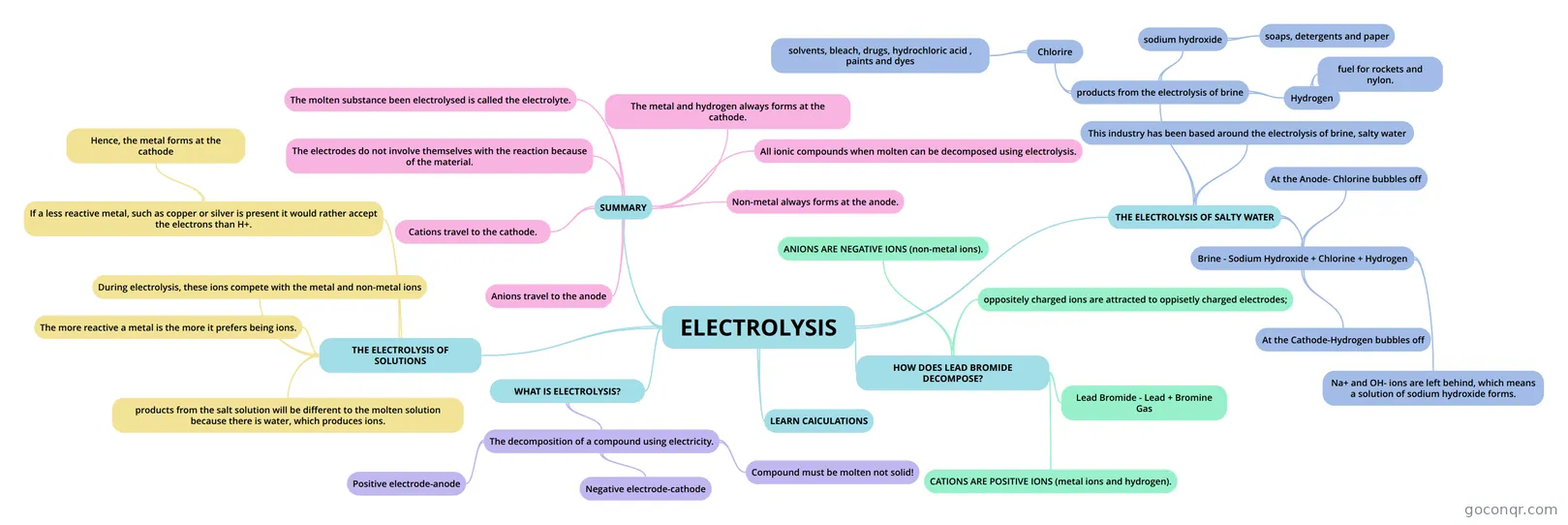
Mind map: electrolysis
Contenido del mapa
ELECTROLYSIS
WHAT IS ELECTROLYSIS?
- The decomposition of a compound using electricity.
- Negative electrode-cathode
- Positive electrode-anode
- Compound must be molten not solid!
- The decomposition of a compound using electricity.
HOW DOES LEAD BROMIDE DECOMPOSE?
- Lead Bromide - Lead + Bromine Gas
- oppositely charged ions are attracted to oppisetly charged electrodes;
- CATIONS ARE POSITIVE IONS (metal ions and hydrogen).
- ANIONS ARE NEGATIVE IONS (non-metal ions).
SUMMARY
- All ionic compounds when molten can be decomposed using electrolysis.
- Cations travel to the cathode.
- Anions travel to the anode
- Non-metal always forms at the anode.
- The metal and hydrogen always forms at the cathode.
- The molten substance been electrolysed is called the electrolyte.
- The electrodes do not involve themselves with the reaction because of the material.
THE ELECTROLYSIS OF SOLUTIONS
- products from the salt solution will be different to the molten solution because there is water, which produces ions.
- During electrolysis, these ions compete with the metal and non-metal ions
- The more reactive a metal is the more it prefers being ions.
- If a less reactive metal, such as copper or silver is present it would rather accept the electrons than H+.
- Hence, the metal forms at the cathode
THE ELECTROLYSIS OF SALTY WATER
- This industry has been based around the electrolysis of brine, salty water
- Brine - Sodium Hydroxide + Chlorine + Hydrogen
- At the Cathode-Hydrogen bubbles off
- At the Anode- Chlorine bubbles off
- Na+ and OH- ions are left behind, which means a solution of sodium hydroxide forms.
- products from the electrolysis of brine
- sodium hydroxide
- soaps, detergents and paper
- Chlorire
- solvents, bleach, drugs, hydrochloric acid , paints and dyes
- Hydrogen
- fuel for rockets and nylon.
- sodium hydroxide
LEARN CAlCULATIONS