
Mapa mental
Schaffer's stages of attachment
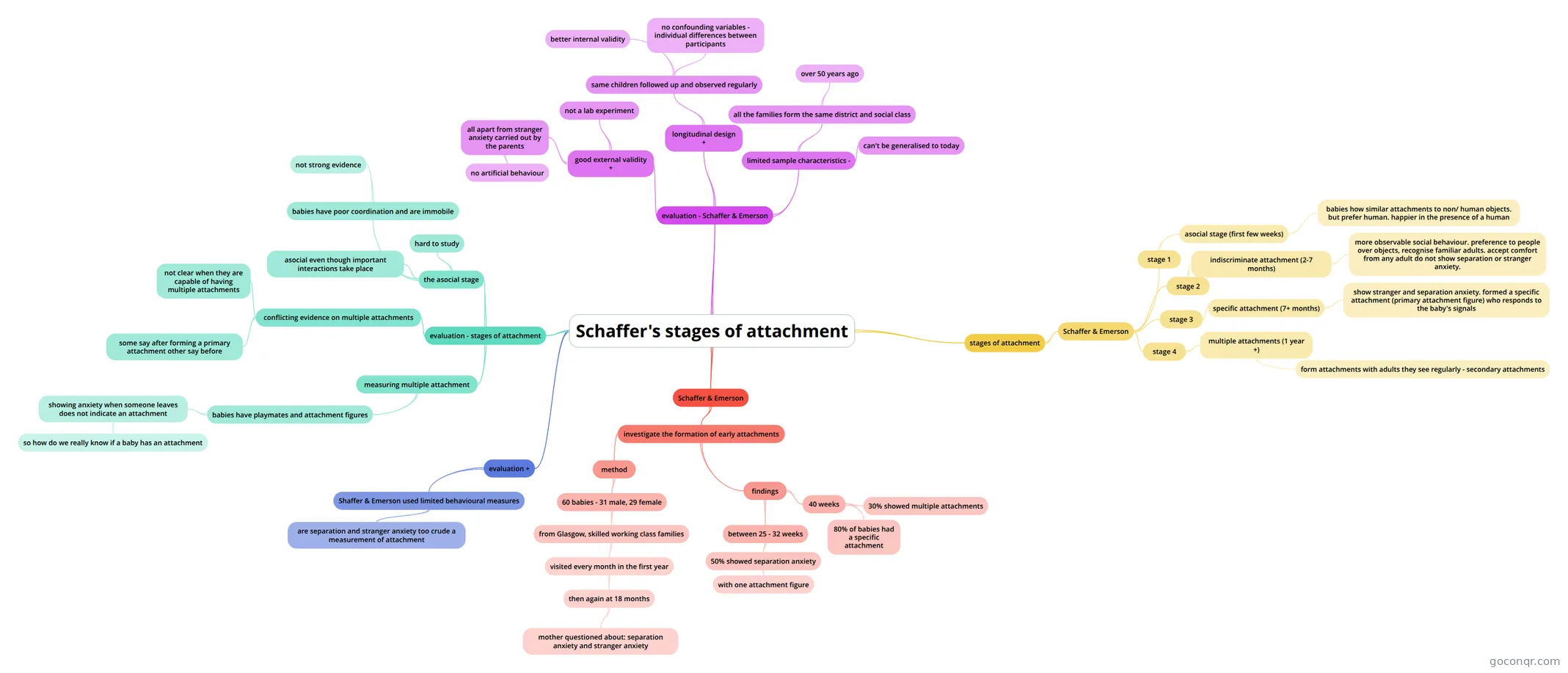
Mind map: Schaffer's stages of attachment
Contenido del mapa
Schaffer's stages of attachment
Schaffer & Emerson
- investigate the formation of early attachments
- method
- 60 babies - 31 male, 29 female
- from Glasgow, skilled working class families
- visited every month in the first year
- then again at 18 months
- mother questioned about: separation anxiety and stranger anxiety
- then again at 18 months
- visited every month in the first year
- from Glasgow, skilled working class families
- 60 babies - 31 male, 29 female
- findings
- between 25 - 32 weeks
- 50% showed separation anxiety
- with one attachment figure
- 50% showed separation anxiety
- 40 weeks
- 80% of babies had a specific attachment
- 30% showed multiple attachments
- between 25 - 32 weeks
- method
- investigate the formation of early attachments
stages of attachment
- Schaffer & Emerson
- stage 1
- asocial stage (first few weeks)
- babies how similar attachments to non/ human objects. but prefer human. happier in the presence of a human
- asocial stage (first few weeks)
- stage 2
- indiscriminate attachment (2-7 months)
- more observable social behaviour. preference to people over objects, recognise familiar adults. accept comfort from any adult do not show separation or stranger anxiety.
- indiscriminate attachment (2-7 months)
- stage 3
- specific attachment (7+ months)
- show stranger and separation anxiety. formed a specific attachment (primary attachment figure) who responds to the baby's signals
- specific attachment (7+ months)
- stage 4
- multiple attachments (1 year +)
- form attachments with adults they see regularly - secondary attachments
- multiple attachments (1 year +)
- stage 1
- Schaffer & Emerson
evaluation - Schaffer & Emerson
- good external validity +
- not a lab experiment
- all apart from stranger anxiety carried out by the parents
- no artificial behaviour
- longitudinal design +
- same children followed up and observed regularly
- better internal validity
- no confounding variables - individual differences between participants
- same children followed up and observed regularly
- limited sample characteristics -
- all the families form the same district and social class
- over 50 years ago
- can't be generalised to today
- all the families form the same district and social class
- good external validity +
evaluation - stages of attachment
- the asocial stage
- hard to study
- asocial even though important interactions take place
- babies have poor coordination and are immobile
- not strong evidence
- conflicting evidence on multiple attachments
- not clear when they are capable of having multiple attachments
- some say after forming a primary attachment other say before
- measuring multiple attachment
- babies have playmates and attachment figures
- showing anxiety when someone leaves does not indicate an attachment
- so how do we really know if a baby has an attachment
- showing anxiety when someone leaves does not indicate an attachment
- babies have playmates and attachment figures
- the asocial stage
evaluation +
- Shaffer & Emerson used limited behavioural measures
- are separation and stranger anxiety too crude a measurement of attachment
- Shaffer & Emerson used limited behavioural measures
Información
- Descripción
- AS - Level (chapter 3 - attachment ) psychology Mapa Mental sobre Schaffer's stages of attachment, creado por Daisy U el 23/12/2015.
- Creado por
- Daisy U
- Visitas
- 111
- Valoración