
Mapa mental
Methods in endocrinology
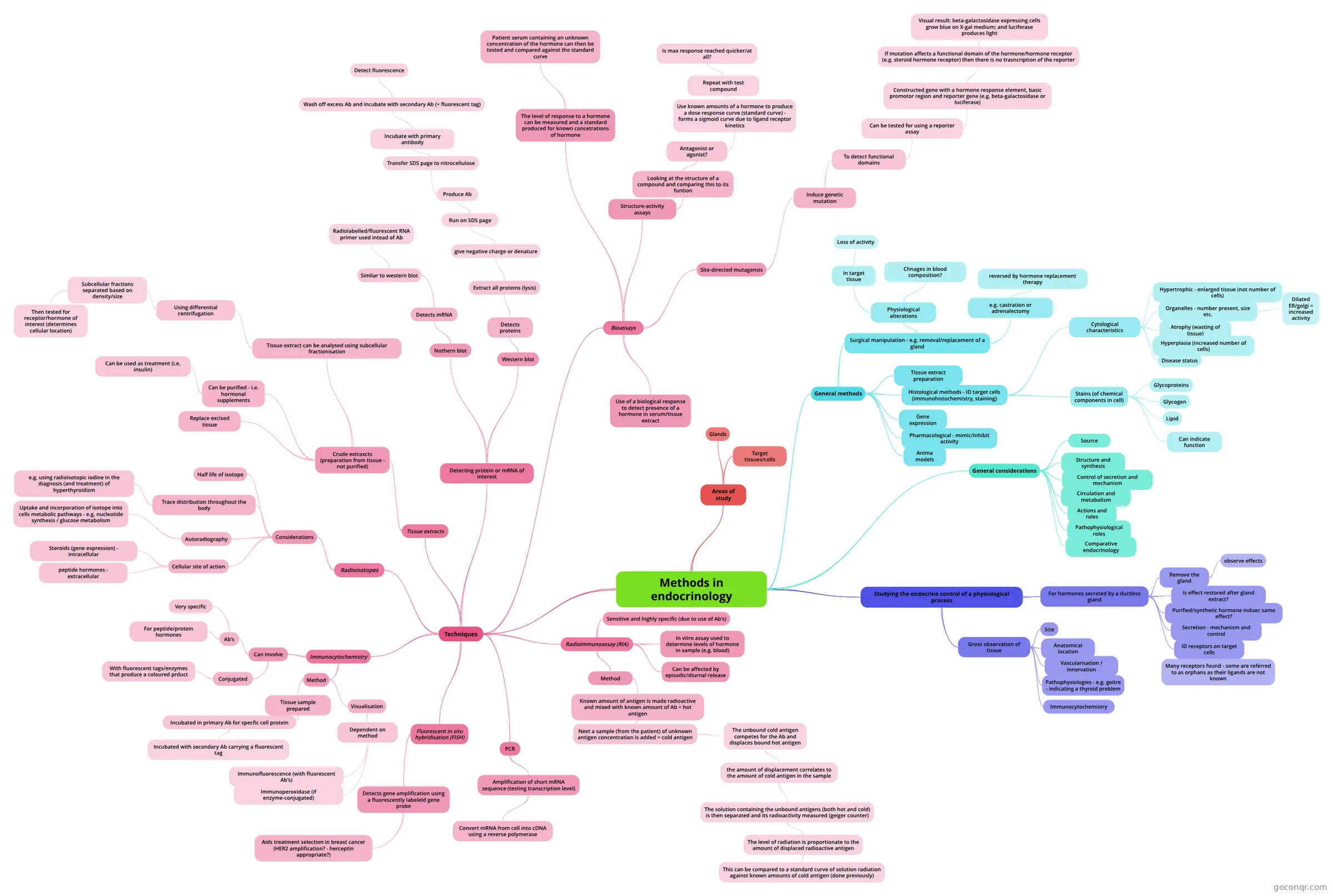
Mind map: Methods in endocrinology
Contenido del mapa
Methods in endocrinology
Areas of study
- Glands
- Target tissues/cells
General methods
- Surgical manipulation - e.g. removal/replacement of a gland
- Physiological alterations
- In target tissue
- Loss of activity
- Chnages in blood composition?
- In target tissue
- e.g. castration or adrenalectomy
- reversed by hormone replacement therapy
- Physiological alterations
- Tissue extract preparation
- Histological methods - ID target cells (immunohistochemistry, staining)
- Cytological characteristics
- Hypertrophic - enlarged tissue (not number of cells)
- Organelles - number present, size etc.
- Dilated ER/golgi = increased activity
- Atrophy (wasting of tissue)
- Hyperplasia (increased number of cells)
- Disease status
- Stains (of chemical components in cell)
- Glycoproteins
- Glycogen
- Lipid
- Can indicate function
- Cytological characteristics
- Gene expression
- Pharmacological - mimic/inhibit activity
- Anima models
- Surgical manipulation - e.g. removal/replacement of a gland
General considerations
- Source
- Structure and synthesis
- Control of secretion and mechanism
- Circulation and metabolism
- Actions and roles
- Pathophysiological roles
- Comparative endocrinology
Studying the endocrine control of a physiological process
- For hormones secreted by a ductless gland
- Remove the gland
- observe effects
- Is effect restored after gland extract?
- Purified/synthetic hormone induec same effect?
- Secretion - mechanism and control
- ID receptors on target cells
- Many receptors found - some are referred to as orphans as their ligands are not known
- Remove the gland
- Gross observation of tissue
- Anatomical location
- Size
- Vascularisation / innervation
- Pathophysiologies - e.g. goitre - indicating a thyroid problem
- Immunocytochemistry
- For hormones secreted by a ductless gland
Techniques
- Immunocytochemistry
- Can involve
- Ab's
- Very specific
- For peptide/protein hormones
- Conjugated
- With fluorescent tags/enzymes that produce a coloured prduct
- Ab's
- Method
- Tissue sample prepared
- Incubated in primary Ab for specfic cell protein
- Incubated with secondary Ab carrying a fluorescent tag
- Incubated in primary Ab for specfic cell protein
- Visualisation
- Dependent on method
- Immunofluorescence (with fluorescent Ab's)
- Immunoperoxidase (if enzyme-conjugated)
- Dependent on method
- Tissue sample prepared
- Can involve
- Fluorescent in situ hybridisation (FISH)
- Detects gene amplification using a fluorescently labeleld gene probe
- Aids treatment selection in breast cancer (HER2 amplification? - herceptin appropriate?)
- Detects gene amplification using a fluorescently labeleld gene probe
- Radioisotopes
- Considerations
- Half life of isotope
- Trace distribution throughout the body
- e.g. using radioisotopic iodine in the diagnosis (and treatment) of hyperthyroidism
- Autoradiography
- Uptake and incorporation of isotope into cells metabolic pathways - e.g. nucleotide synthesis / glucose metabolism
- Cellular site of action
- Steroids (gene expression) - intracellular
- peptide hormones - extracellular
- Considerations
- Radioimmunoassay (RIA)
- Sensitive and highly specific (due to use of Ab's)
- In vitro assay used to determine levels of hormone in sample (e.g. blood)
- Method
- Known amount of antigen is made radioactive and mixed with known amount of Ab = hot antigen
- Next a sample (from the patient) of unknown antigen concentration is added = cold antigen
- The unbound cold antigen competes for the Ab and displaces bound hot antigen
- the amount of displacement correlates to the amount of cold antigen in the sample
- The solution containing the unbound antigens (both hot and cold) is then separated and its radioactivity measured (geiger counter)
- The level of radiation is proportionate to the amount of displaced radioactive antigen
- This can be compared to a standard curve of solution radiation against known amounts of cold antigen (done previously)
- The level of radiation is proportionate to the amount of displaced radioactive antigen
- The solution containing the unbound antigens (both hot and cold) is then separated and its radioactivity measured (geiger counter)
- the amount of displacement correlates to the amount of cold antigen in the sample
- The unbound cold antigen competes for the Ab and displaces bound hot antigen
- Next a sample (from the patient) of unknown antigen concentration is added = cold antigen
- Known amount of antigen is made radioactive and mixed with known amount of Ab = hot antigen
- Can be affected by episodic/diurnal release
- Tissue extracts
- Crude extraxcts (preparation from tissue - not purified)
- Replace excised tissue
- Can be purified - i.e. hormonal supplements
- Can be used as treatment (i.e. insulin)
- Tissue extract can be analysed using subcellular fractionisation
- Using differential centrifugation
- Subcellular fractions separated based on density/size
- Then tested for receptor/hormone of interest (determines cellular location)
- Subcellular fractions separated based on density/size
- Using differential centrifugation
- Crude extraxcts (preparation from tissue - not purified)
- Detecting protein or mRNA of interest
- Nothern blot
- Detects mRNA
- Simliar to western blot
- Radiolabelled/fluorescent RNA primer used intead of Ab
- Simliar to western blot
- Detects mRNA
- Western blot
- Detects proteins
- Extract all proteins (lysis)
- give negative charge or denature
- Run on SDS page
- Produce Ab
- Transfer SDS page to nitrocellulose
- Incubate with primary antibody
- Wash off excess Ab and incubate with secondary Ab (+ fluorescent tag)
- Detect fluorescence
- Wash off excess Ab and incubate with secondary Ab (+ fluorescent tag)
- Incubate with primary antibody
- Transfer SDS page to nitrocellulose
- Produce Ab
- Run on SDS page
- give negative charge or denature
- Extract all proteins (lysis)
- Detects proteins
- Nothern blot
- PCR
- Amplification of short mRNA sequence (testing transcription level)
- Convert mRNA from cell into cDNA using a reverse polymerase
- Amplification of short mRNA sequence (testing transcription level)
- Bioassays
- Use of a biological response to detect presence of a hormone in serum/tissue extract
- The level of response to a hormone can be measured and a standard produced for known concetrations of hormone
- Patient serum containing an unknown concentration of the hormone can then be tested and compared against the standard curve
- Structure-activity assays
- Looking at the structure of a compound and comparing this to its funtion
- Antagonist or agonist?
- Use known amounts of a hormone to produce a dose response curve (standard curve) - forms a sigmoid curve due to ligand receptor kinetics
- Repeat with test compound
- Is max response reached quicker/at all?
- Repeat with test compound
- Use known amounts of a hormone to produce a dose response curve (standard curve) - forms a sigmoid curve due to ligand receptor kinetics
- Antagonist or agonist?
- Looking at the structure of a compound and comparing this to its funtion
- Site-directed mutagensis
- Induce genetic mutation
- To detect functional domains
- Can be tested for using a reporter assay
- Constructed gene with a hormone response element, basic promotor region and reporter gene (e.g. beta-galactosidase or luciferase)
- If mutation affects a functional domain of the hormone/hormone receptor (e.g. steroid hormone receptor) then there is no trasncription of the reporter
- Visual result: beta-galactosidase expressing cells grow blue on X-gal medium; and luciferase produces light
- If mutation affects a functional domain of the hormone/hormone receptor (e.g. steroid hormone receptor) then there is no trasncription of the reporter
- Constructed gene with a hormone response element, basic promotor region and reporter gene (e.g. beta-galactosidase or luciferase)
- Can be tested for using a reporter assay
- To detect functional domains
- Induce genetic mutation
- Immunocytochemistry
Información
- Descripción
- Endocrinology Mapa Mental sobre Methods in endocrinology, creado por maisie_oj el 12/04/2013.
- Creado por
- maisie_oj
- Visitas
- 169
- Etiquetas
- Valoración