
Mapa mental
Human Resource Managment
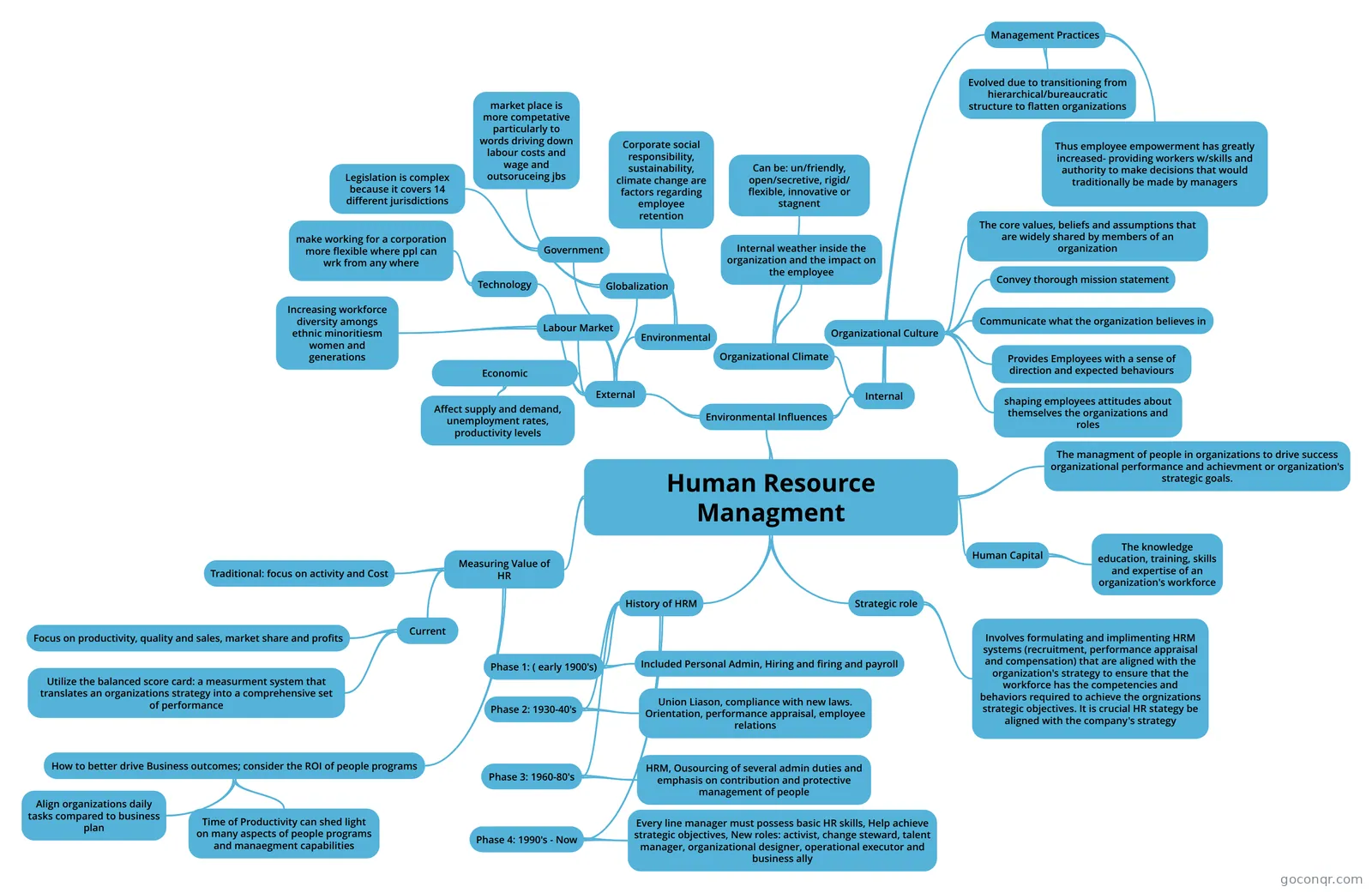
Mind map: Human resource management
Contenido del mapa
Human Resource Managment
The managment of people in organizations to drive success organizational performance and achievment or organization's strategic goals.
Human Capital
- The knowledge education, training, skills and expertise of an organization's workforce
Strategic role
- Involves formulating and implimenting HRM systems (recruitment, performance appraisal and compensation) that are aligned with the organization's strategy to ensure that the workforce has the competencies and behaviors required to achieve the orgnizations strategic objectives. It is crucial HR stategy be aligned with the company's strategy
History of HRM
- Phase 1: ( early 1900's)
- Included Personal Admin, Hiring and firing and payroll
- Phase 2: 1930-40's
- Union Liason, compliance with new laws. Orientation, performance appraisal, employee relations
- Phase 3: 1960-80's
- HRM, Ousourcing of several admin duties and emphasis on contribution and protective management of people
- Phase 4: 1990's - Now
- Every line manager must possess basic HR skills, Help achieve strategic objectives, New roles: activist, change steward, talent manager, organizational designer, operational executor and business ally
- Phase 1: ( early 1900's)
Measuring Value of HR
- Traditional: focus on activity and Cost
- Current
- Focus on productivity, quality and sales, market share and profits
- Utilize the balanced score card: a measurment system that translates an organizations strategy into a comprehensive set of performance
- How to better drive Business outcomes; consider the ROI of people programs
- Align organizations daily tasks compared to business plan
- Time of Productivity can shed light on many aspects of people programs and manaegment capabilities
Environmental Influences
- External
- Economic
- Affect supply and demand, unemployment rates, productivity levels
- Labour Market
- Increasing workforce diversity amongs ethnic minoritiesm women and generations
- Technology
- make working for a corporation more flexible where ppl can wrk from any where
- Government
- Legislation is complex because it covers 14 different jurisdictions
- Globalization
- market place is more competative particularly to words driving down labour costs and wage and outsoruceing jbs
- Environmental
- Corporate social responsibility, sustainability, climate change are factors regarding employee retention
- Economic
- Internal
- Organizational Culture
- The core values, beliefs and assumptions that are widely shared by members of an organization
- Convey thorough mission statement
- Communicate what the organization believes in
- Provides Employees with a sense of direction and expected behaviours
- shaping employees attitudes about themselves the organizations and roles
- Organizational Climate
- Internal weather inside the organization and the impact on the employee
- Can be: un/friendly, open/secretive, rigid/ flexible, innovative or stagnent
- Management Practices
- Evolved due to transitioning from hierarchical/bureaucratic structure to flatten organizations
- Thus employee empowerment has greatly increased- providing workers w/skills and authority to make decisions that would traditionally be made by managers
- Organizational Culture
- External
Información
- Descripción
- Midterm HRM Mapa Mental sobre Human Resource Managment, creado por Matthew Pisichko el 23/02/2016.
- Creado por
- Matthew Pisichko
- Visitas
- 160
- Valoración