
Mapa mental
Adrenal glands part 1: stress
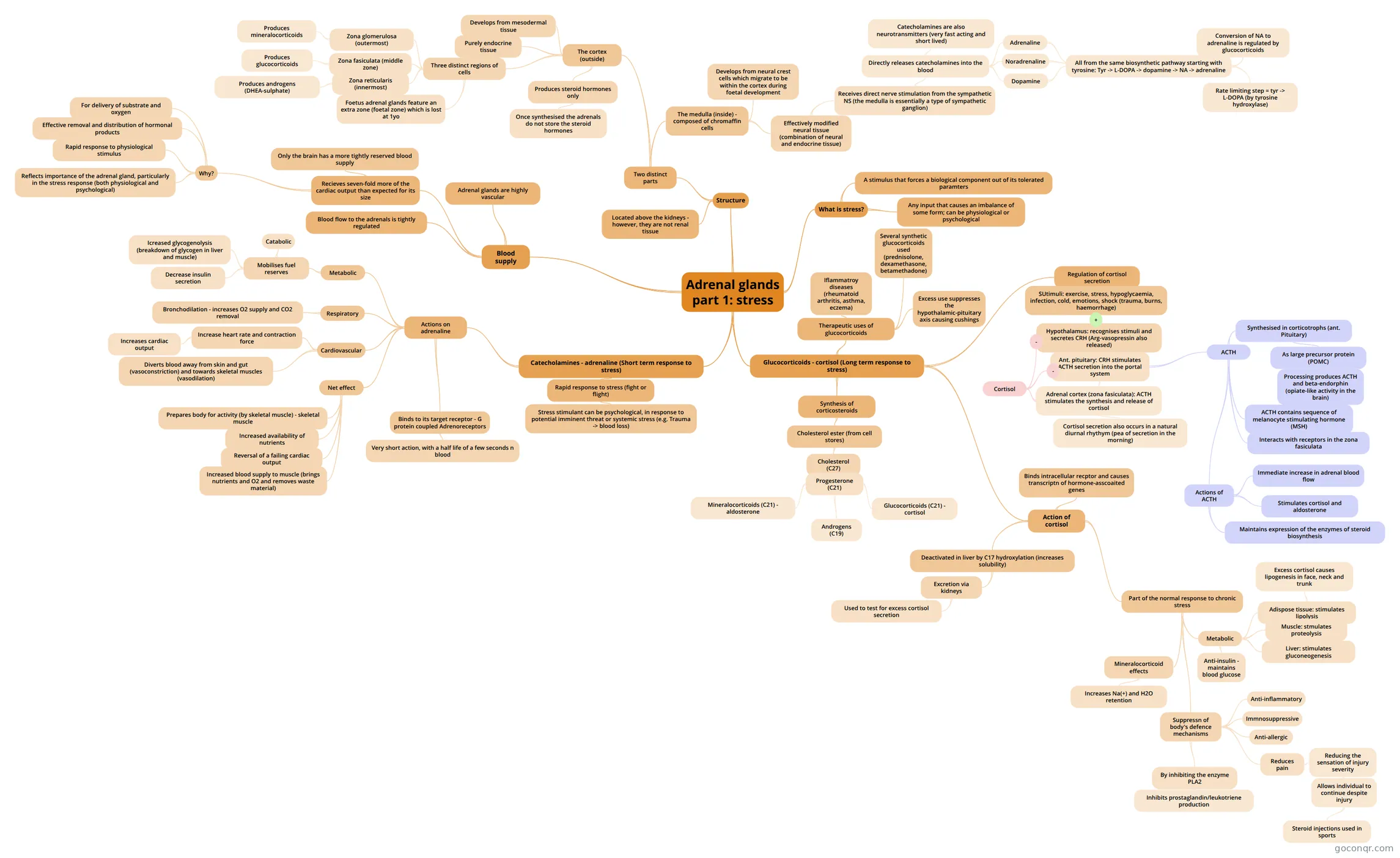
Mind map: adrenal glands and stress
Contenido del mapa
Adrenal glands part 1: stress
Structure
- Located above the kidneys - however, they are not renal tissue
- Two distinct parts
- The cortex (outside)
- Develops from mesodermal tissue
- Purely endocrine tissue
- Three distinct regions of cells
- Zona glomerulosa (outermost)
- Produces mineralocorticoids
- Zona fasiculata (middle zone)
- Produces glucocorticoids
- Zona reticularis (innermost)
- Produces androgens (DHEA-sulphate)
- Foetus adrenal glands feature an extra zone (foetal zone) which is lost at 1yo
- Zona glomerulosa (outermost)
- Produces steroid hormones only
- Once synthesised the adrenals do not store the steroid hormones
- The medulla (inside) - composed of chromaffin cells
- Develops from neural crest cells which migrate to be within the cortex during foetal development
- Effectively modified neural tissue (combination of neural and endocrine tissue)
- Receives direct nerve stimulation from the sympathetic NS (the medulla is essentially a type of sympathetic ganglion)
- Directly releases catecholamines into the blood
- Catecholamines are also neurotransmitters (very fast acting and short lived)
- Adrenaline
- Noradrenaline
- Dopamine
- All from the same biosynthetic pathway starting with tyrosine: Tyr -> L-DOPA -> dopamine -> NA -> adrenaline
- Rate limiting step = tyr -> L-DOPA (by tyrosine hydroxylase)
- Conversion of NA to adrenaline is regulated by glucocorticoids
- All from the same biosynthetic pathway starting with tyrosine: Tyr -> L-DOPA -> dopamine -> NA -> adrenaline
- Directly releases catecholamines into the blood
- Receives direct nerve stimulation from the sympathetic NS (the medulla is essentially a type of sympathetic ganglion)
- The cortex (outside)
Catecholamines - adrenaline (Short term response to stress)
- Actions on adrenaline
- Metabolic
- Mobilises fuel reserves
- Icreased glycogenolysis (breakdown of glycogen in liver and muscle)
- Decrease insulin secretion
- Catabolic
- Mobilises fuel reserves
- Respiratory
- Bronchodilation - increases O2 supply and CO2 removal
- Cardiovascular
- Increase heart rate and contraction force
- Increases cardiac output
- Diverts blood away from skin and gut (vasoconstriction) and towards skeletal muscles (vasodilation)
- Increase heart rate and contraction force
- Net effect
- Prepares body for activity (by skeletal muscle) - skeletal muscle
- Increased availability of nutrients
- Reversal of a failing cardiac output
- Increased blood supply to muscle (brings nutrients and O2 and removes waste material)
- Binds to its target receptor - G protein coupled Adrenoreceptors
- Very short action, with a half life of a few seconds n blood
- Metabolic
- Rapid response to stress (fight or flight)
- Stress stimulant can be psychological, in response to potential imminent threat or systemic stress (e.g. Trauma -> blood loss)
- Actions on adrenaline
What is stress?
- A stimulus that forces a biological component out of its tolerated paramters
- Any input that causes an imbalance of some form; can be physiological or psychological
Glucocorticoids - cortisol (Long term response to stress)
- Synthesis of corticosteroids
- Cholesterol ester (from cell stores)
- Cholesterol (C27)
- Progesterone (C21)
- Mineralocorticoids (C21) - aldosterone
- Androgens (C19)
- Glucocorticoids (C21) - cortisol
- Progesterone (C21)
- Cholesterol (C27)
- Cholesterol ester (from cell stores)
- Regulation of cortisol secretion
- SUtimuli: exercise, stress, hypoglycaemia, infection, cold, emotions, shock (trauma, burns, haemorrhage)
- Hypothalamus: recognises stimuli and secretes CRH (Arg-vasopressin also released)
- Ant. pituitary: CRH stimulates ACTH secretion into the portal system
- Adrenal cortex (zona fasiculata): ACTH stimulates the synthesis and release of cortisol
- Cortisol
- -
- -
- Cortisol secretion also occurs in a natural diurnal rhythym (pea of secretion in the morning)
- Cortisol
- ACTH
- Synthesised in corticotrophs (ant. Pituitary)
- As large precursor protein (POMC)
- Processing produces ACTH and beta-endorphin (opiate-like activity in the brain)
- As large precursor protein (POMC)
- ACTH contains sequence of melanocyte stimulating hormone (MSH)
- Interacts with receptors in the zona fasiculata
- Actions of ACTH
- Immediate increase in adrenal blood flow
- Stimulates cortisol and aldosterone
- Maintains expression of the enzymes of steroid biosynthesis
- Synthesised in corticotrophs (ant. Pituitary)
- Adrenal cortex (zona fasiculata): ACTH stimulates the synthesis and release of cortisol
- Ant. pituitary: CRH stimulates ACTH secretion into the portal system
- +
- Hypothalamus: recognises stimuli and secretes CRH (Arg-vasopressin also released)
- SUtimuli: exercise, stress, hypoglycaemia, infection, cold, emotions, shock (trauma, burns, haemorrhage)
- Action of cortisol
- Binds intracellular recptor and causes transcriptn of hormone-asscoaited genes
- Part of the normal response to chronic stress
- Metabolic
- Adispose tissue: stimulates lipolysis
- Excess cortisol causes lipogenesis in face, neck and trunk
- Anti-insulin - maintains blood glucose
- Muscle: stmulates proteolysis
- Liver: stimulates gluconeogenesis
- Adispose tissue: stimulates lipolysis
- Suppressn of body's defence mechanisms
- Anti-inflammatory
- Immnosuppressive
- Anti-allergic
- By inhibiting the enzyme PLA2
- Inhibits prostaglandin/leukotriene production
- Reduces pain
- Reducing the sensation of injury severity
- Allows individual to continue despite injury
- Steroid injections used in sports
- Allows individual to continue despite injury
- Reducing the sensation of injury severity
- Mineralocorticoid effects
- Increases Na(+) and H2O retention
- Metabolic
- Deactivated in liver by C17 hydroxylation (increases solubility)
- Excretion via kidneys
- Used to test for excess cortisol secretion
- Excretion via kidneys
- Therapeutic uses of glucocorticoids
- Iflammatroy diseases (rheumatoid arthritis, asthma, eczema)
- Several synthetic glucocorticoids used (prednisolone, dexamethasone, betamethadone)
- Excess use suppresses the hypothalamic-pituitary axis causing cushings
- Synthesis of corticosteroids
Blood supply
- Adrenal glands are highly vascular
- Recieves seven-fold more of the cardiac output than expected for its size
- Only the brain has a more tightly reserved blood supply
- Why?
- For delivery of substrate and oxygen
- Effective removal and distribution of hormonal products
- Rapid response to physiological stimulus
- Reflects importance of the adrenal gland, particularly in the stress response (both physiological and psychological)
- Blood flow to the adrenals is tightly regulated
Información
- Descripción
- Endocrinology Mapa Mental sobre Adrenal glands part 1: stress, creado por maisie_oj el 18/04/2013.
- Creado por
- maisie_oj
- Visitas
- 131
- Etiquetas
- Valoración