
Mapa mental
Modals
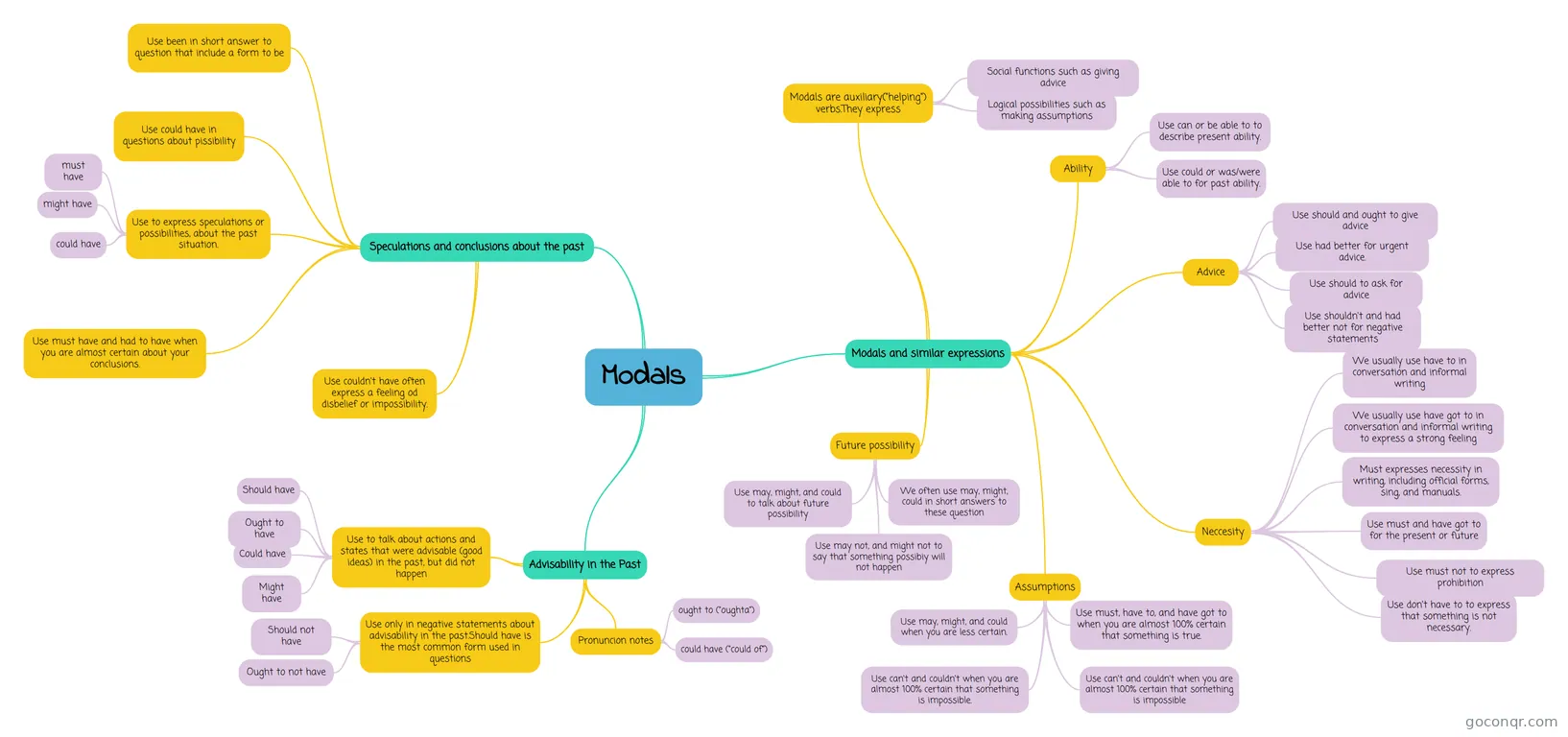
Mind map: Modals
Contenido del mapa
Modals
Modals and similar expressions
- Modals are auxiliary("helping") verbs.They express
- Social functions such as giving advice
- Logical possibilities such as making assumptions
- Ability
- Use can or be able to to describe present ability.
- Use could or was/were able to for past ability.
- Advice
- Use should and ought to give advice
- Use had better for urgent advice.
- Use should to ask for advice
- Use shouldn't and had better not for negative statements
- Neccesity
- We usually use have to in conversation and informal writing
- We usually use have got to in conversation and informal writing to express a strong feeling
- Must expresses necessity in writing, including official forms, sing, and manuals.
- Use must and have got to for the present or future
- Use must not to express prohibition
- Use don't have to to express that something is not necessary.
- Assumptions
- Use must, have to, and have got to when you are almost 100% certain that something is true.
- Use can't and couldn't when you are almost 100% certain that something is impossible
- Use can't and couldn't when you are almost 100% certain that something is impossible.
- Use may, might, and could when you are less certain.
- Future possibility
- Use may, might, and could to talk about future possibility
- Use may not, and might not to say that something possibiy will not happen
- We often use may, might, could in short answers to these question
- Modals are auxiliary("helping") verbs.They express
Advisability in the Past
- Use to talk about actions and states that were advisable (good ideas) in the past, but did not happen
- Should have
- Ought to have
- Could have
- Might have
- Use only in negative statements about advisability in the past.Should have is the most common form used in questions
- Should not have
- Ought to not have
- Pronuncion notes
- could have ("could of")
- ought to ("oughta")
- Use to talk about actions and states that were advisable (good ideas) in the past, but did not happen
Speculations and conclusions about the past
- Use to express speculations or possibilities, about the past situation.
- must have
- might have
- could have
- Use must have and had to have when you are almost certain about your conclusions.
- Use couldn't have often express a feeling od disbelief or impossibility.
- Use could have in questions about pissibility
- Use been in short answer to question that include a form to be
- Use to express speculations or possibilities, about the past situation.
Información
- Descripción
- Mapa Mental sobre Modals, creado por Ximena Nicole Mo el 21/04/2016.
- Creado por
- Ximena Nicole Mo
- Visitas
- 0
- Valoración