
Mapa mental
Brain & Cognition Lectures 1-4 Revision Summary
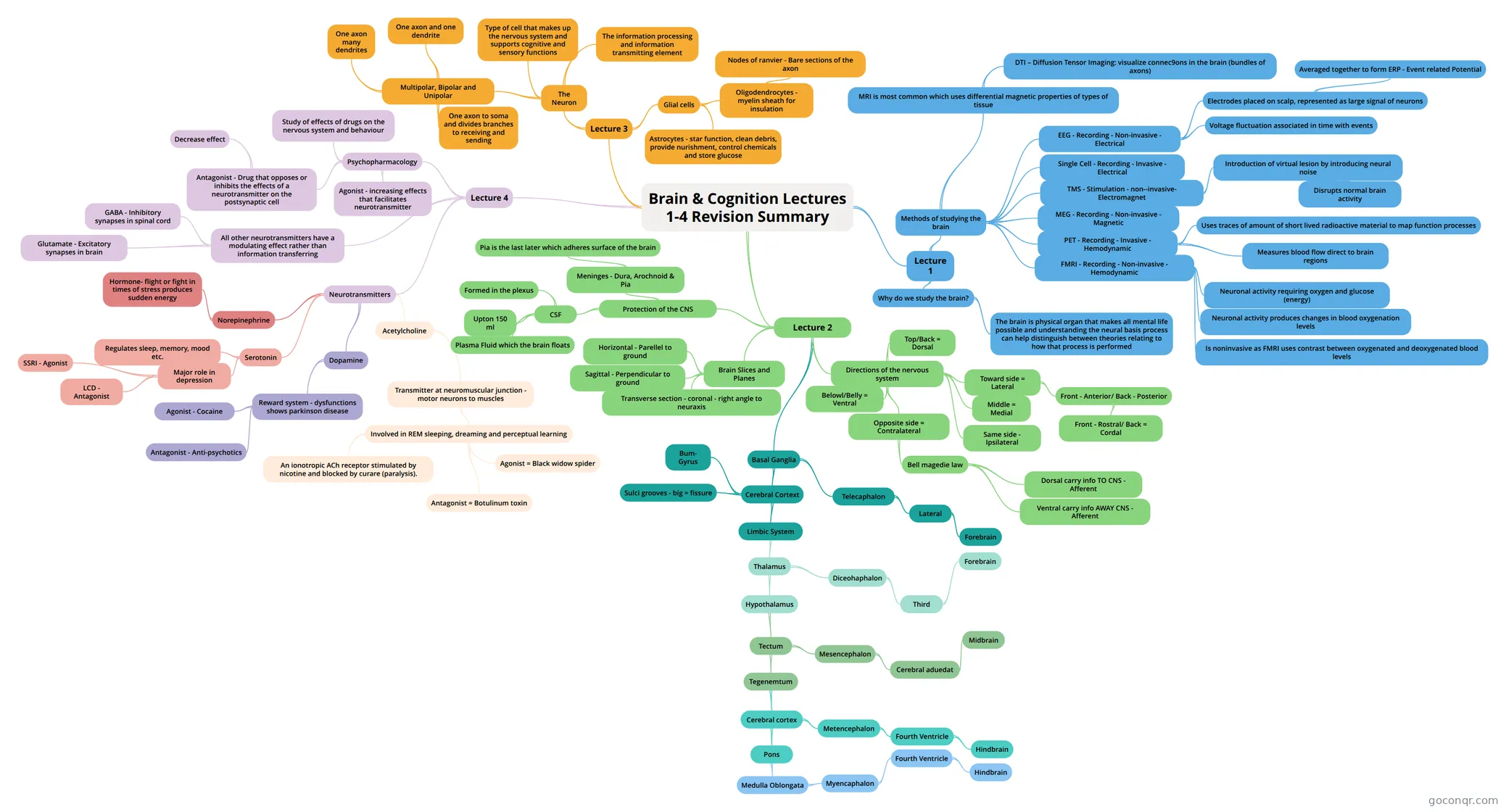
Mind map: Brain & Cognition revision summary
Contenido del mapa
Brain & Cognition Lectures 1-4 Revision Summary
Lecture 1
- Why do we study the brain?
- The brain is physical organ that makes all mental life possible and understanding the neural basis process can help distinguish between theories relating to how that process is performed
- Methods of studying the brain
- EEG - Recording - Non-invasive - Electrical
- Electrodes placed on scalp, represented as large signal of neurons
- Averaged together to form ERP - Event related Potential
- Voltage fluctuation associated in time with events
- Electrodes placed on scalp, represented as large signal of neurons
- Single Cell - Recording - Invasive - Electrical
- TMS - Stimulation - non--invasive- Electromagnet
- Introduction of virtual lesion by introducing neural noise
- Disrupts normal brain activity
- Introduction of virtual lesion by introducing neural noise
- MEG - Recording - Non-invasive - Magnetic
- PET - Recording - Invasive - Hemodynamic
- Uses traces of amount of short lived radioactive material to map function processes
- Measures blood flow direct to brain regions
- FMRI - Recording - Non-invasive - Hemodynamic
- Neuronal activity requiring oxygen and glucose (energy)
- Neuronal activity produces changes in blood oxygenation levels
- Is noninvasive as FMRI uses contrast between oxygenated and deoxygenated blood levels
- MRI is most common which uses differential magnetic properties of types of tissue
- DTI – Diffusion Tensor Imaging: visualize connec9ons in the brain (bundles of axons)
- EEG - Recording - Non-invasive - Electrical
- Why do we study the brain?
Lecture 2
- Directions of the nervous system
- Top/Back = Dorsal
- Belowl/Belly = Ventral
- Toward side = Lateral
- Front - Anterior/ Back - Posterior
- Front - Rostral/ Back = Cordal
- Front - Anterior/ Back - Posterior
- Middle = Medial
- Same side - Ipsilateral
- Opposite side = Contralateral
- Bell magedie law
- Dorsal carry info TO CNS - Afferent
- Ventral carry info AWAY CNS - Afferent
- Bell magedie law
- Brain Slices and Planes
- Transverse section - coronal - right angle to neuraxis
- Sagittal - Perpendicular to ground
- Horizontal - Parellel to ground
- Basal Ganglia
- Cerebral Cortext
- Limbic System
- Thalamus
- Hypothalamus
- Tectum
- Tegenemtum
- Cerebral cortex
- Pons
- Medulla Oblongata
- Myencaphalon
- Fourth Ventricle
- Hindbrain
- Fourth Ventricle
- Myencaphalon
- Medulla Oblongata
- Metencephalon
- Fourth Ventricle
- Hindbrain
- Fourth Ventricle
- Pons
- Cerebral cortex
- Mesencephalon
- Cerebral aduedat
- Midbrain
- Cerebral aduedat
- Tegenemtum
- Tectum
- Diceohaphalon
- Third
- Forebrain
- Third
- Hypothalamus
- Thalamus
- Bum- Gyrus
- Sulci grooves - big = fissure
- Limbic System
- Telecaphalon
- Lateral
- Forebrain
- Lateral
- Cerebral Cortext
- Protection of the CNS
- Meninges - Dura, Arochnoid & Pia
- Pia is the last later which adheres surface of the brain
- CSF
- Plasma Fluid which the brain floats
- Formed in the plexus
- Upton 150 ml
- Meninges - Dura, Arochnoid & Pia
- Directions of the nervous system
Lecture 3
- The Neuron
- Type of cell that makes up the nervous system and supports cognitive and sensory functions
- The information processing and information transmitting element
- Multipolar, Bipolar and Unipolar
- One axon many dendrites
- One axon and one dendrite
- One axon to soma and divides branches to receiving and sending
- Glial cells
- Astrocytes - star function, clean debris, provide nurishment, control chemicals and store glucose
- Oligodendrocytes - myelin sheath for insulation
- Nodes of ranvier - Bare sections of the axon
- The Neuron
Lecture 4
- Psychopharmacology
- Study of effects of drugs on the nervous system and behaviour
- Antagonist - Drug that opposes or inhibits the effects of a neurotransmitter on the postsynaptic cell
- Decrease effect
- Agonist - increasing effects that facilitates neurotransmitter
- All other neurotransmitters have a modulating effect rather than information transferring
- GABA - Inhibitory synapses in spinal cord
- Glutamate - Excitatory synapses in brain
- Neurotransmitters
- Acetylcholine
- Transmitter at neuromuscular junction - motor neurons to muscles
- Involved in REM sleeping, dreaming and perceptual learning
- An ionotropic ACh receptor stimulated by nicotine and blocked by curare (paralysis).
- Antagonist = Botulinum toxin
- Agonist = Black widow spider
- Involved in REM sleeping, dreaming and perceptual learning
- Transmitter at neuromuscular junction - motor neurons to muscles
- Dopamine
- Reward system - dysfunctions shows parkinson disease
- Antagonist - Anti-psychotics
- Agonist - Cocaine
- Reward system - dysfunctions shows parkinson disease
- Serotonin
- Regulates sleep, memory, mood etc.
- Major role in depression
- LCD - Antagonist
- SSRI - Agonist
- Norepinephrine
- Hormone- flight or fight in times of stress produces sudden energy
- Acetylcholine
- Psychopharmacology
Información
- Descripción
- Psychology -Brain & Cognition Lectures 1-4 Revision Summary
- Creado por
- Soyful Alam
- Visitas
- 20
- Etiquetas
- Valoración