
Mapa mental
Schaffer and Emerson 1964
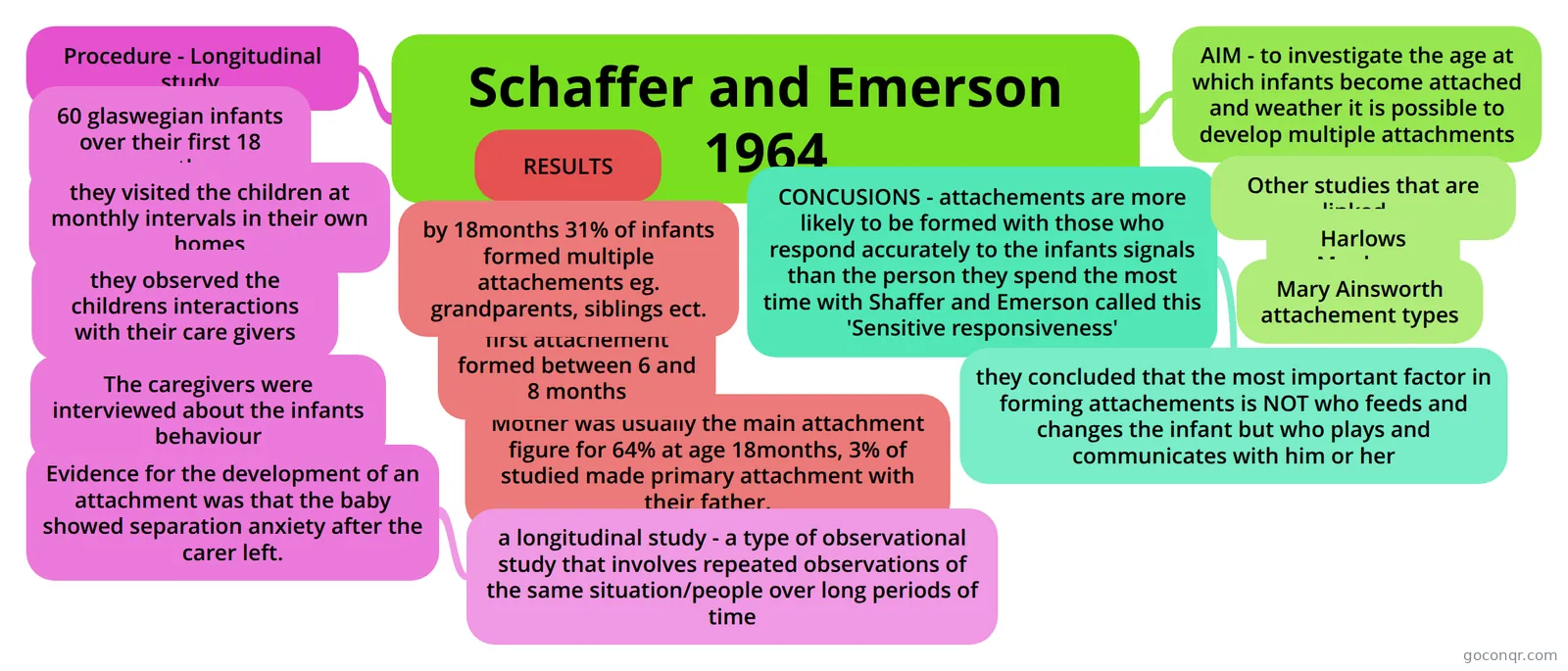
Mind map: Schaffer and Emerson 1964 attachment study
Contenido del mapa
Schaffer and Emerson 1964
AIM - to investigate the age at which infants become attached and weather it is possible to develop multiple attachments
- Other studies that are linked...
- Harlows Monkeys
- Mary Ainsworth attachement types
RESULTS
- Mother was usually the main attachment figure for 64% at age 18months, 3% of studied made primary attachment with their father.
- first attachement formed between 6 and 8 months
- by 18months 31% of infants formed multiple attachements eg. grandparents, siblings ect.
CONCUSIONS - attachements are more likely to be formed with those who respond accurately to the infants signals than the person they spend the most time with Shaffer and Emerson called this 'Sensitive responsiveness'
- they concluded that the most important factor in forming attachements is NOT who feeds and changes the infant but who plays and communicates with him or her
Procedure - Longitudinal study.
- 60 glaswegian infants over their first 18 months
- they visited the children at monthly intervals in their own homes
- they observed the childrens interactions with their care givers
- Evidence for the development of an attachment was that the baby showed separation anxiety after the carer left.
- a longitudinal study - a type of observational study that involves repeated observations of the same situation/people over long periods of time
- The caregivers were interviewed about the infants behaviour
Información
- Descripción
- (Attachment) Psychology AS Mapa Mental sobre Schaffer and Emerson 1964, creado por loolabop el 20/02/2014.
- Creado por
- loolabop
- Visitas
- 144
- Etiquetas
- Valoración