
Mapa mental
Functionalist Perspective on the family
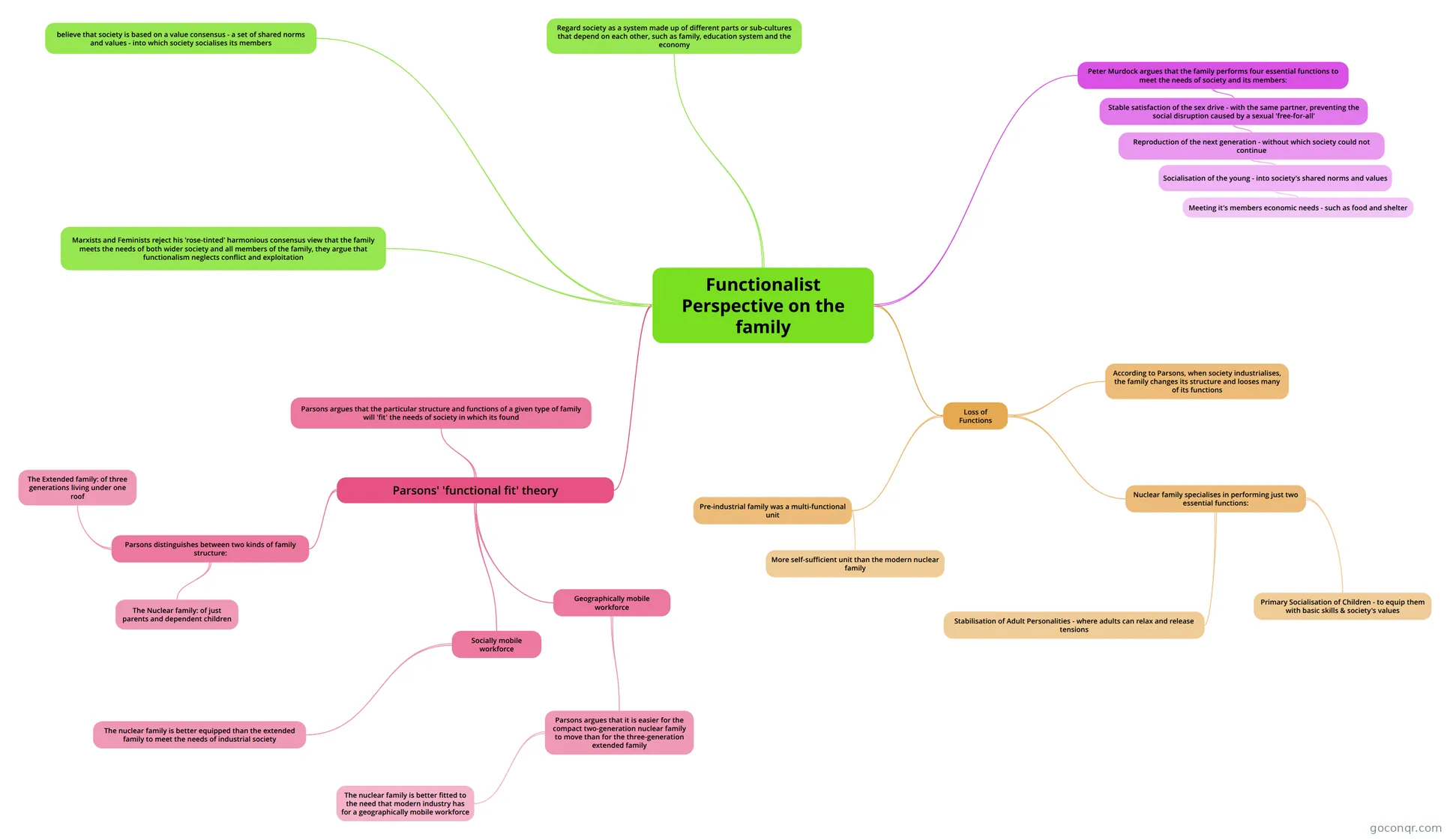
Mind map: Functionalist perspective on the family
Contenido del mapa
Functionalist Perspective on the family
believe that society is based on a value consensus - a set of shared norms and values - into which society socialises its members
Regard society as a system made up of different parts or sub-cultures that depend on each other, such as family, education system and the economy
Peter Murdock argues that the family performs four essential functions to meet the needs of society and its members:
- Stable satisfaction of the sex drive - with the same partner, preventing the social disruption caused by a sexual 'free-for-all'
- Reproduction of the next generation - without which society could not continue
- Socialisation of the young - into society's shared norms and values
- Meeting it's members economic needs - such as food and shelter
- Socialisation of the young - into society's shared norms and values
- Reproduction of the next generation - without which society could not continue
- Stable satisfaction of the sex drive - with the same partner, preventing the social disruption caused by a sexual 'free-for-all'
Marxists and Feminists reject his 'rose-tinted' harmonious consensus view that the family meets the needs of both wider society and all members of the family, they argue that functionalism neglects conflict and exploitation
Parsons' 'functional fit' theory
- Parsons distinguishes between two kinds of family structure:
- The Nuclear family: of just parents and dependent children
- The Extended family: of three generations living under one roof
- Parsons argues that the particular structure and functions of a given type of family will 'fit' the needs of society in which its found
- Geographically mobile workforce
- Parsons argues that it is easier for the compact two-generation nuclear family to move than for the three-generation extended family
- The nuclear family is better fitted to the need that modern industry has for a geographically mobile workforce
- Parsons argues that it is easier for the compact two-generation nuclear family to move than for the three-generation extended family
- Socially mobile workforce
- The nuclear family is better equipped than the extended family to meet the needs of industrial society
- Parsons distinguishes between two kinds of family structure:
Loss of Functions
- Pre-industrial family was a multi-functional unit
- More self-sufficient unit than the modern nuclear family
- According to Parsons, when society industrialises, the family changes its structure and looses many of its functions
- Nuclear family specialises in performing just two essential functions:
- Primary Socialisation of Children - to equip them with basic skills & society's values
- Stabilisation of Adult Personalities - where adults can relax and release tensions
- Pre-industrial family was a multi-functional unit
Información
- Descripción
- A-Levels Sociology - Family Mapa Mental sobre Functionalist Perspective on the family, creado por orlaghemmett el 04/05/2013.
- Creado por
- orlaghemmett
- Visitas
- 465
- Etiquetas
- Valoración