
Mapa mental
Situation ethics
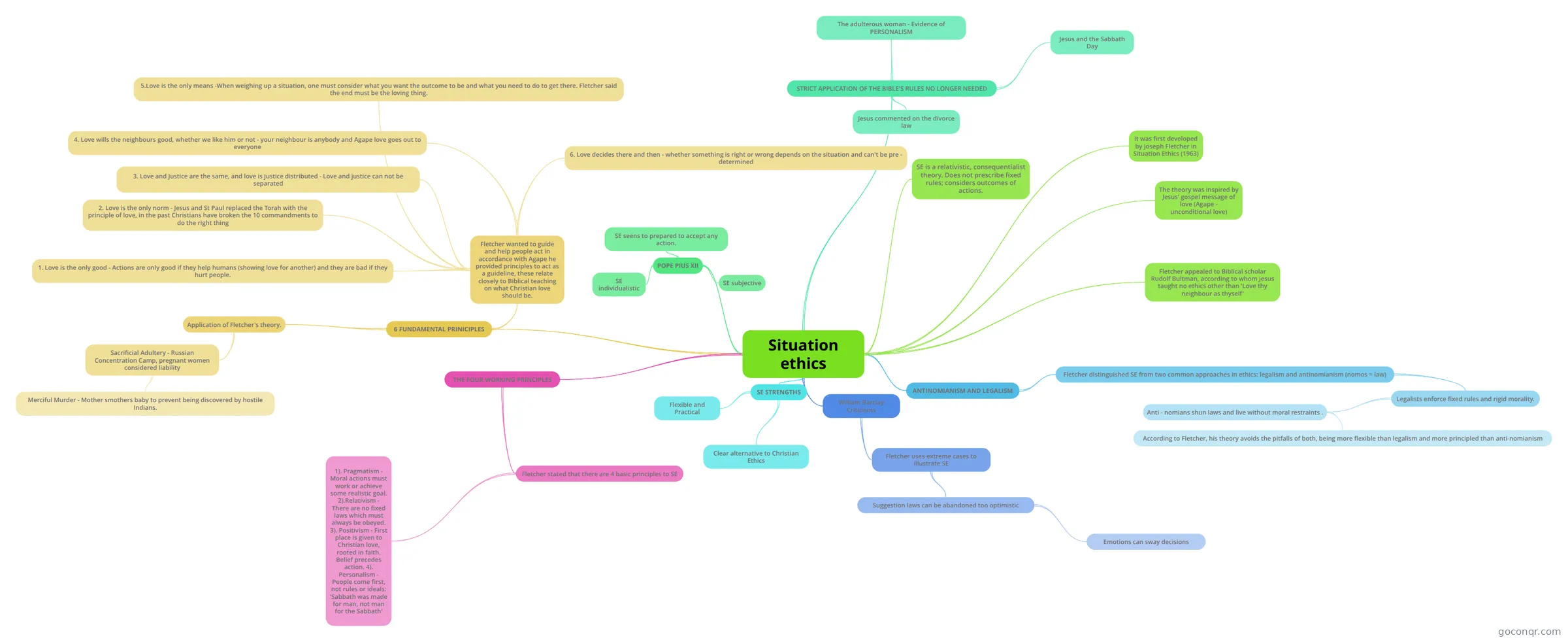
Mind map: Situation ethics
Contenido del mapa
Situation ethics
SE is a relativistic, consequentialist theory. Does not prescribe fixed rules; considers outcomes of actions.
It was first developed by Joseph Fletcher in Situation Ethics (1963)
The theory was inspired by Jesus' gospel message of love (Agape - unconditional love)
Fletcher appealed to Biblical scholar Rudolf Bultman, according to whom Jesus taught no ethics other than 'Love thy neighbour as thyself'
ANTINOMIANISM AND LEGALISM
- Fletcher distinguished SE from two common approaches in ethics: legalism and antinomianism (nomos = law)
- Legalists enforce fixed rules and rigid morality.
- Anti - nomians shun laws and live without moral restraints .
- According to Fletcher, his theory avoids the pitfalls of both, being more flexible than legalism and more principled than anti-nomianism
- Anti - nomians shun laws and live without moral restraints .
- Legalists enforce fixed rules and rigid morality.
- Fletcher distinguished SE from two common approaches in ethics: legalism and antinomianism (nomos = law)
THE FOUR WORKING PRINCIPLES
- Fletcher stated that there are 4 basic principles to SE
- 1). Pragmatism - Moral actions must work or achieve some realistic goal. 2).Relativism - There are no fixed laws which must always be obeyed. 3). Positivism - First place is given to Christian love, rooted in faith. Belief precedes action. 4). Personalism - People come first, not rules or ideals: 'Sabbath was made for man, not man for the Sabbath'
- Fletcher stated that there are 4 basic principles to SE
6 FUNDAMENTAL PRINICIPLES
- Fletcher wanted to guide and help people act in accordance with Agape he provided principles to act as a guideline, these relate closely to Biblical teaching on what Christian love should be.
- 1. Love is the only good - Actions are only good if they help humans (showing love for another) and they are bad if they hurt people.
- 2. Love is the only norm - Jesus and St Paul replaced the Torah with the principle of love, in the past Christians have broken the 10 commandments to do the right thing
- 3. Love and Justice are the same, and love is justice distributed - Love and justice can not be separated
- 4. Love wills the neighbours good, whether we like him or not - your neighbour is anybody and Agape love goes out to everyone
- 5.Love is the only means -When weighing up a situation, one must consider what you want the outcome to be and what you need to do to get there. Fletcher said the end must be the loving thing.
- 6. Love decides there and then - whether something is right or wrong depends on the situation and can't be pre - determined
- Application of Fletcher's theory.
- Sacrificial Adultery - Russian Concentration Camp, pregnant women considered liability
- Merciful Murder - Mother smothers baby to prevent being discovered by hostile Indians.
- Sacrificial Adultery - Russian Concentration Camp, pregnant women considered liability
- Fletcher wanted to guide and help people act in accordance with Agape he provided principles to act as a guideline, these relate closely to Biblical teaching on what Christian love should be.
STRICT APPLICATION OF THE BIBLE'S RULES NO LONGER NEEDED
- The adulterous woman - Evidence of PERSONALISM
- Jesus and the Sabbath Day
- Jesus commented on the divorce law
POPE PIUS XII
- SE individualistic
- SE subjective
- SE seens to prepared to accept any action.
William Barclay Criticisms
- Fletcher uses extreme cases to illustrate SE
- Suggestion laws can be abandoned too optimistic
- Emotions can sway decisions
- Suggestion laws can be abandoned too optimistic
- Fletcher uses extreme cases to illustrate SE
SE STRENGTHS
- Clear alternative to Christian Ethics
- Flexible and Practical
Información
- Descripción
- Mapa Mental sobre Situation ethics, creado por ahlamomar2010 el 06/04/2014.
- Creado por
- ahlamomar2010
- Visitas
- 51
- Etiquetas
- Valoración