
Mapa mental
Eating Behaviours
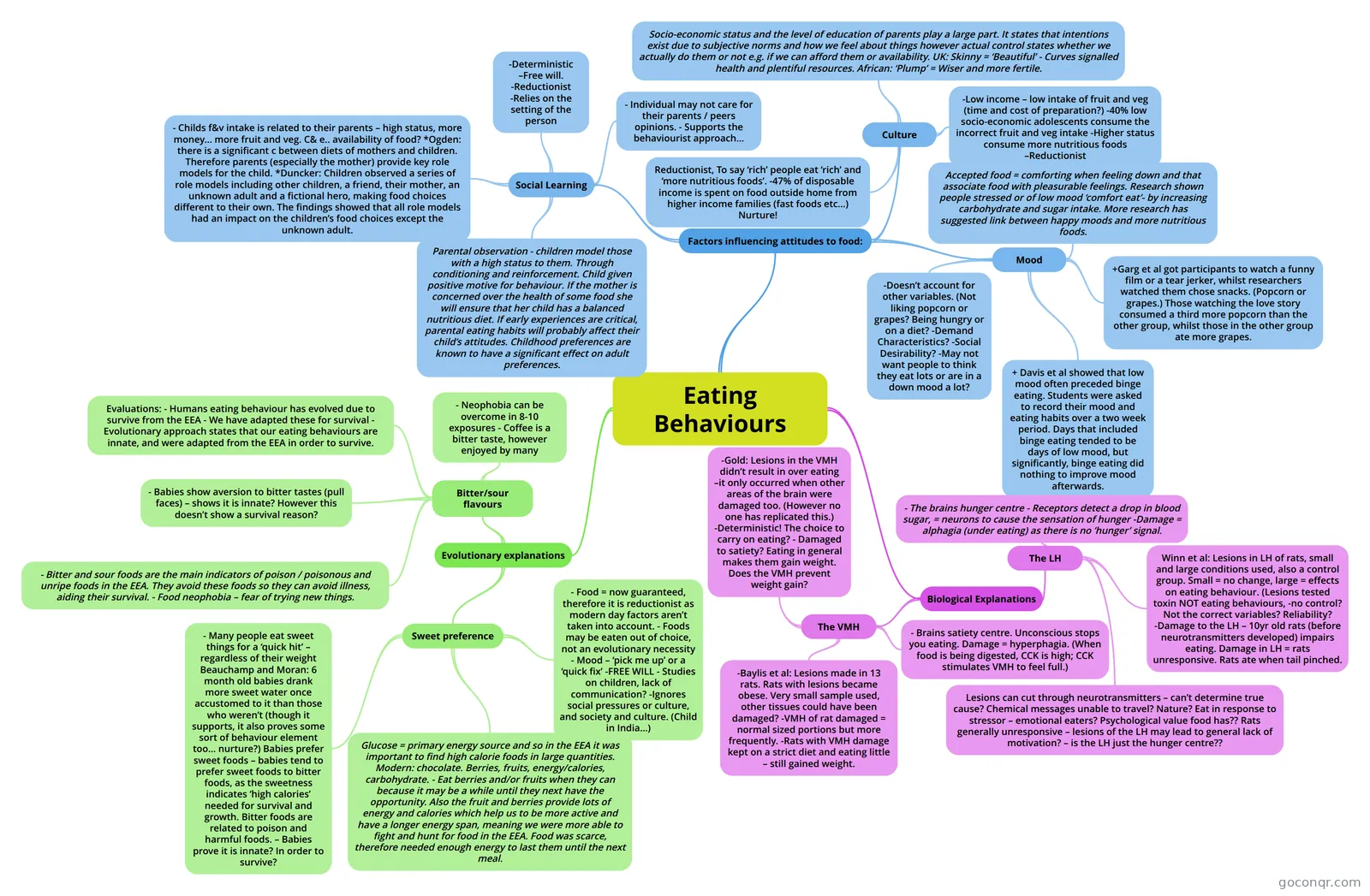
Mind map: Eating behaviours
Contenido del mapa
Eating Behaviours
Factors influencing attitudes to food:
- Social Learning
- Parental observation - children model those with a high status to them. Through conditioning and reinforcement. Child given positive motive for behaviour. If the mother is concerned over the health of some food she will ensure that her child has a balanced nutritious diet. If early experiences are critical, parental eating habits will probably affect their child’s attitudes. Childhood preferences are known to have a significant effect on adult preferences.
- - Childs f&v intake is related to their parents – high status, more money... more fruit and veg. C& e.. availability of food? *Ogden: there is a significant c between diets of mothers and children. Therefore parents (especially the mother) provide key role models for the child. *Duncker: Children observed a series of role models including other children, a friend, their mother, an unknown adult and a fictional hero, making food choices different to their own. The findings showed that all role models had an impact on the children’s food choices except the unknown adult.
- -Deterministic –Free will. -Reductionist -Relies on the setting of the person
- - Individual may not care for their parents / peers opinions. - Supports the behaviourist approach…
- Culture
- Socio-economic status and the level of education of parents play a large part. It states that intentions exist due to subjective norms and how we feel about things however actual control states whether we actually do them or not e.g. if we can afford them or availability. UK: Skinny = ‘Beautiful’ - Curves signalled health and plentiful resources. African: ‘Plump’ = Wiser and more fertile.
- -Low income – low intake of fruit and veg (time and cost of preparation?) -40% low socio-economic adolescents consume the incorrect fruit and veg intake -Higher status consume more nutritious foods –Reductionist
- Reductionist, To say ‘rich’ people eat ‘rich’ and ‘more nutritious foods’. -47% of disposable income is spent on food outside home from higher income families (fast foods etc…) Nurture!
- Mood
- Accepted food = comforting when feeling down and that associate food with pleasurable feelings. Research shown people stressed or of low mood ‘comfort eat’- by increasing carbohydrate and sugar intake. More research has suggested link between happy moods and more nutritious foods.
- +Garg et al got participants to watch a funny film or a tear jerker, whilst researchers watched them chose snacks. (Popcorn or grapes.) Those watching the love story consumed a third more popcorn than the other group, whilst those in the other group ate more grapes.
- + Davis et al showed that low mood often preceded binge eating. Students were asked to record their mood and eating habits over a two week period. Days that included binge eating tended to be days of low mood, but significantly, binge eating did nothing to improve mood afterwards.
- -Doesn’t account for other variables. (Not liking popcorn or grapes? Being hungry or on a diet? -Demand Characteristics? -Social Desirability? -May not want people to think they eat lots or are in a down mood a lot?
- Social Learning
Biological Explanations
- The LH
- - The brains hunger centre - Receptors detect a drop in blood sugar, = neurons to cause the sensation of hunger -Damage = alphagia (under eating) as there is no ‘hunger’ signal.
- Winn et al: Lesions in LH of rats, small and large conditions used, also a control group. Small = no change, large = effects on eating behaviour. (Lesions tested toxin NOT eating behaviours, -no control? Not the correct variables? Reliability? -Damage to the LH – 10yr old rats (before neurotransmitters developed) impairs eating. Damage in LH = rats unresponsive. Rats ate when tail pinched.
- Lesions can cut through neurotransmitters – can’t determine true cause? Chemical messages unable to travel? Nature? Eat in response to stressor – emotional eaters? Psychological value food has?? Rats generally unresponsive – lesions of the LH may lead to general lack of motivation? – is the LH just the hunger centre??
- The VMH
- - Brains satiety centre. Unconscious stops you eating. Damage = hyperphagia. (When food is being digested, CCK is high; CCK stimulates VMH to feel full.)
- -Baylis et al: Lesions made in 13 rats. Rats with lesions became obese. Very small sample used, other tissues could have been damaged? -VMH of rat damaged = normal sized portions but more frequently. -Rats with VMH damage kept on a strict diet and eating little – still gained weight.
- -Gold: Lesions in the VMH didn’t result in over eating –it only occurred when other areas of the brain were damaged too. (However no one has replicated this.) -Deterministic! The choice to carry on eating? - Damaged to satiety? Eating in general makes them gain weight. Does the VMH prevent weight gain?
- The LH
Evolutionary explanations
- Sweet preference
- Glucose = primary energy source and so in the EEA it was important to find high calorie foods in large quantities. Modern: chocolate. Berries, fruits, energy/calories, carbohydrate. - Eat berries and/or fruits when they can because it may be a while until they next have the opportunity. Also the fruit and berries provide lots of energy and calories which help us to be more active and have a longer energy span, meaning we were more able to fight and hunt for food in the EEA. Food was scarce, therefore needed enough energy to last them until the next meal.
- - Many people eat sweet things for a ‘quick hit’ – regardless of their weight Beauchamp and Moran: 6 month old babies drank more sweet water once accustomed to it than those who weren’t (though it supports, it also proves some sort of behaviour element too… nurture?) Babies prefer sweet foods – babies tend to prefer sweet foods to bitter foods, as the sweetness indicates ‘high calories’ needed for survival and growth. Bitter foods are related to poison and harmful foods. – Babies prove it is innate? In order to survive?
- - Food = now guaranteed, therefore it is reductionist as modern day factors aren’t taken into account. - Foods may be eaten out of choice, not an evolutionary necessity - Mood – ‘pick me up’ or a ‘quick fix’ -FREE WILL - Studies on children, lack of communication? -Ignores social pressures or culture, and society and culture. (Child in India…)
- Bitter/sour flavours
- - Bitter and sour foods are the main indicators of poison / poisonous and unripe foods in the EEA. They avoid these foods so they can avoid illness, aiding their survival. - Food neophobia – fear of trying new things.
- - Babies show aversion to bitter tastes (pull faces) – shows it is innate? However this doesn’t show a survival reason?
- - Neophobia can be overcome in 8-10 exposures - Coffee is a bitter taste, however enjoyed by many
- Evaluations: - Humans eating behaviour has evolved due to survive from the EEA - We have adapted these for survival - Evolutionary approach states that our eating behaviours are innate, and were adapted from the EEA in order to survive.
- Sweet preference
Información
- Descripción
- Mapa Mental sobre Eating Behaviours, creado por g.lawton96 el 01/05/2014.
- Creado por
- g.lawton96
- Visitas
- 17
- Valoración