
Mapa mental
American Lit 1
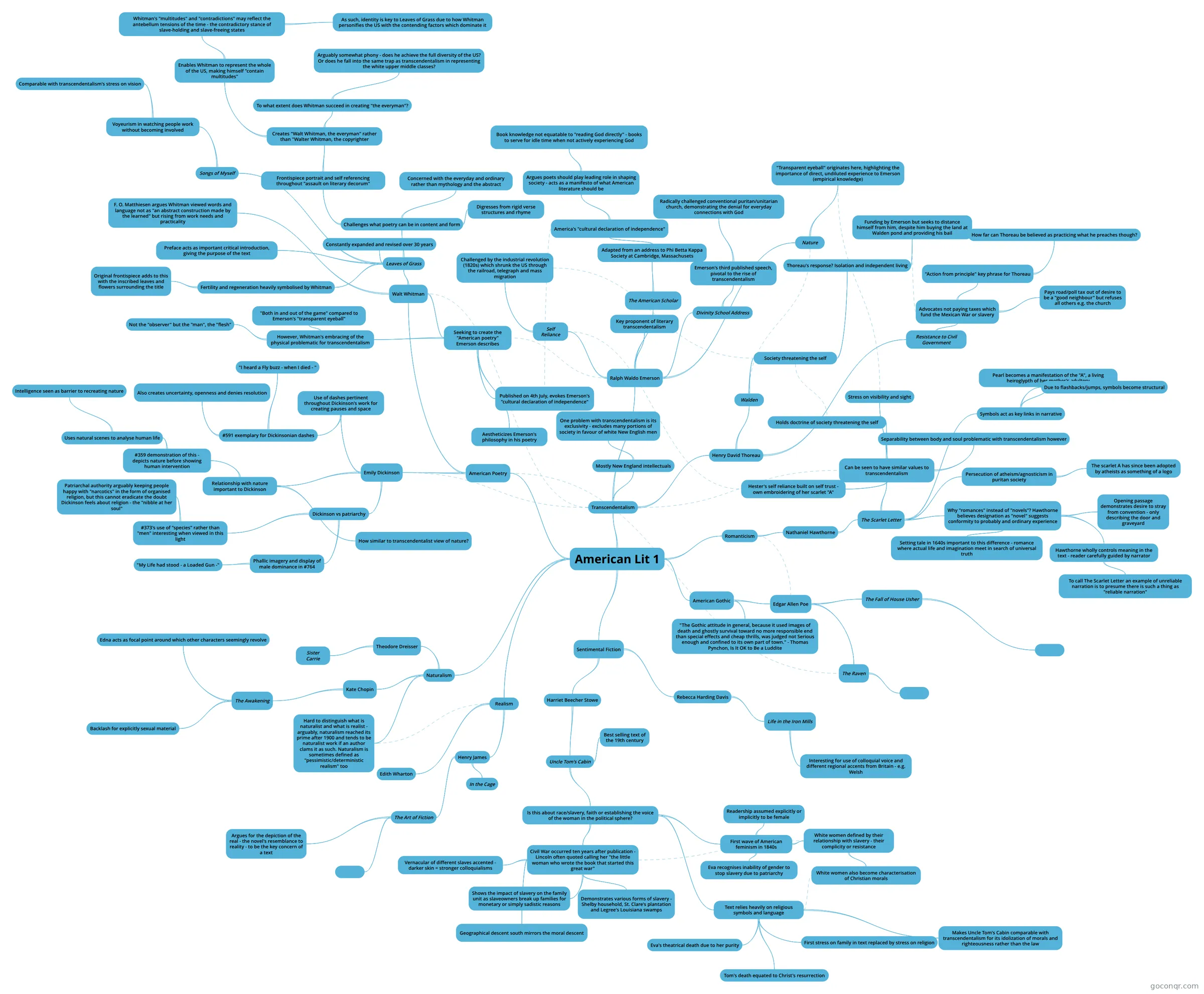
Mind map: American literature movements
Contenido del mapa
American Lit 1
Transcendentalism
- Ralph Waldo Emerson
- Key proponent of literary transcendentalism
- The American Scholar
- Adapted from an address to Phi Betta Kappa Society at Cambridge, Massachusets
- America's "cultural declaration of independence"
- Argues poets should play leading role in shaping society - acts as a manifesto of what American literature should be
- Book knowledge not equatable to "reading God directly" - books to serve for idle time when not actively experiencing God
- Argues poets should play leading role in shaping society - acts as a manifesto of what American literature should be
- America's "cultural declaration of independence"
- Adapted from an address to Phi Betta Kappa Society at Cambridge, Massachusets
- Self Reliance
- Challenged by the industrial revolution (1820s) which shrunk the US through the railroad, telegraph and mass migration
- Nature
- "Transparent eyeball" originates here, highlighting the importance of direct, undiluted experience to Emerson (empirical knowledge)
- Divinity School Address
- Emerson's third published speech, pivotal to the rise of transcendentalism
- Radically challenged conventional puritan/unitarian church, demonstrating the denial for everyday connections with God
- Emerson's third published speech, pivotal to the rise of transcendentalism
- Henry David Thoreau
- Walden
- Society threatening the self
- Thoreau's response? Isolation and independent living
- Funding by Emerson but seeks to distance himself from him, despite him buying the land at Walden pond and providing his bail
- Thoreau's response? Isolation and independent living
- Society threatening the self
- Resistance to Civil Government
- Advocates not paying taxes which fund the Mexican War or slavery
- "Action from principle" key phrase for Thoreau
- How far can Thoreau be believed as practicing what he preaches though?
- Pays road/poll tax out of desire to be a "good neighbour" but refuses all others e.g. the church
- "Action from principle" key phrase for Thoreau
- Advocates not paying taxes which fund the Mexican War or slavery
- Walden
- Mostly New England intellectuals
- One problem with transcendentalism is its exclusivity - excludes many portions of society in favour of white New English men
- Ralph Waldo Emerson
Sentimental Fiction
- Harriet Beecher Stowe
- Uncle Tom's Cabin
- Best selling text of the 19th century
- Is this about race/slavery, faith or establishing the voice of the woman in the political sphere?
- First wave of American feminism in 1840s
- Readership assumed explicitly or implicitly to be female
- Eva recognises inability of gender to stop slavery due to patriarchy
- White women defined by their relationship with slavery - their complicity or resistance
- White women also become characterisation of Christian morals
- Civil War occurred ten years after publication - Lincoln often quoted calling her "the little woman who wrote the book that started this great war"
- Demonstrates various forms of slavery - Shelby household, St. Clare's plantation and Legree's Louisiana swamps
- Shows the impact of slavery on the family unit as slaveowners break up families for monetary or simply sadistic reasons
- Geographical descent south mirrors the moral descent
- Vernacular of different slaves accented - darker skin = stronger colloquialisms
- Text relies heavily on religious symbols and language
- Tom's death equated to Christ's resurrection
- First stress on family in text replaced by stress on religion
- Eva's theatrical death due to her purity
- Makes Uncle Tom's Cabin comparable with transcendentalism for its idolization of morals and righteousness rather than the law
- First wave of American feminism in 1840s
- Uncle Tom's Cabin
- Rebecca Harding Davis
- Life in the Iron Mills
- Interesting for use of colloquial voice and different regional accents from Britain - e.g. Welsh
- Life in the Iron Mills
- Harriet Beecher Stowe
American Gothic
- Edgar Allen Poe
- The Fall of House Usher
- The Raven
- The Fall of House Usher
- "The Gothic attitude in general, because it used images of death and ghostly survival toward no more responsible end than special effects and cheap thrills, was judged not Serious enough and confined to its own part of town." - Thomas Pynchon, Is It OK to Be a Luddite
- Edgar Allen Poe
Naturalism
- Kate Chopin
- The Awakening
- Edna acts as focal point around which other characters seemingly revolve
- Backlash for explicitly sexual material
- The Awakening
- Theodore Dreisser
- Sister Carrie
- Hard to distinguish what is naturalist and what is realist - arguably, naturalism reached its prime after 1900 and tends to be naturalist work if an author clams it as such. Naturalism is sometimes defined as "pessimistic/deterministic realism" too
- Kate Chopin
American Poetry
- Walt Whitman
- Leaves of Grass
- Preface acts as important critical introduction, giving the purpose of the text
- Songs of Myself
- Voyeurism in watching people work without becoming involved
- Comparable with transcendentalism's stress on vision
- Voyeurism in watching people work without becoming involved
- Constantly expanded and revised over 30 years
- Challenges what poetry can be in content and form
- Concerned with the everyday and ordinary rather than mythology and the abstract
- Digresses from rigid verse structures and rhyme
- Frontispiece portrait and self referencing throughout "assault on literary decorum"
- Creates "Walt Whitman, the everyman" rather than "Walter Whitman, the copyrighter
- Enables Whitman to represent the whole of the US, making himself "contain multitudes"
- Whitman's "multitudes" and "contradictions" may reflect the antebellum tensions of the time - the contradictory stance of slave-holding and slave-freeing states
- As such, identity is key to Leaves of Grass due to how Whitman personifies the US with the contending factors which dominate it
- Whitman's "multitudes" and "contradictions" may reflect the antebellum tensions of the time - the contradictory stance of slave-holding and slave-freeing states
- To what extent does Whitman succeed in creating "the everyman"?
- Arguably somewhat phony - does he achieve the full diversity of the US? Or does he fall into the same trap as transcendentalism in representing the white upper middle classes?
- Enables Whitman to represent the whole of the US, making himself "contain multitudes"
- Creates "Walt Whitman, the everyman" rather than "Walter Whitman, the copyrighter
- Fertility and regeneration heavily symbolised by Whitman
- Original frontispiece adds to this with the inscribed leaves and flowers surrounding the title
- Seeking to create the "American poetry" Emerson describes
- Aestheticizes Emerson's philosophy in his poetry
- Published on 4th July, evokes Emerson's "cultural declaration of independence"
- However, Whitman's embracing of the physical problematic for transcendentalism
- Not the "observer" but the "man", the "flesh"
- "Both in and out of the game" compared to Emerson's "transparent eyeball"
- F. O. Matthiesen argues Whitman viewed words and language not as "an abstract construction made by the learned" but rising from work needs and practicality
- Leaves of Grass
- Emily Dickinson
- Use of dashes pertinent throughout Dickinson's work for creating pauses and space
- #591 exemplary for Dickinsonian dashes
- Also creates uncertainty, openness and denies resolution
- "I heard a Fly buzz - when I died - "
- #591 exemplary for Dickinsonian dashes
- Relationship with nature important to Dickinson
- How similar to transcendentalist view of nature?
- #359 demonstration of this - depicts nature before showing human intervention
- Uses natural scenes to analyse human life
- Intelligence seen as barrier to recreating nature
- Uses natural scenes to analyse human life
- Dickinson vs patriarchy
- #373's use of "species" rather than "men" interesting when viewed in this light
- Patriarchal authority arguably keeping people happy with "narcotics" in the form of organised religion, but this cannot eradicate the doubt Dickinson feels about religion - the "nibble at her soul"
- Phallic imagery and display of male dominance in #764
- "My Life had stood - a Loaded Gun -"
- #373's use of "species" rather than "men" interesting when viewed in this light
- Use of dashes pertinent throughout Dickinson's work for creating pauses and space
- Walt Whitman
Romanticism
- Nathaniel Hawthorne
- The Scarlet Letter
- Persecution of atheism/agnosticism in puritan society
- The scarlet A has since been adopted by atheists as something of a logo
- Can be seen to have similar values to transcendentalism
- Holds doctrine of society threatening the self
- Stress on visibility and sight
- Separability between body and soul problematic with transcendentalism however
- Hester's self reliance built on self trust - own embroidering of her scarlet "A"
- Why "romances" instead of "novels"? Hawthorne believes designation as "novel" suggests conformity to probably and ordinary experience
- Opening passage demonstrates desire to stray from convention - only describing the door and graveyard
- Hawthorne wholly controls meaning in the text - reader carefully guided by narrator
- To call The Scarlet Letter an example of unreliable narration is to presume there is such a thing as "reliable narration"
- Setting tale in 1640s important to this difference - romance where actual life and imagination meet in search of universal truth
- Symbols act as key links in narrative
- Pearl becomes a manifestation of the "A", a living heiroglypth of her mother's adultery
- Due to flashbacks/jumps, symbols become structural
- Persecution of atheism/agnosticism in puritan society
- The Scarlet Letter
- Nathaniel Hawthorne
Realism
- Henry James
- The Art of Fiction
- Argues for the depiction of the real - the novel's resemblance to reality - to be the key concern of a text
- In the Cage
- The Art of Fiction
- Edith Wharton
- Henry James
Información
- Descripción
- English Mapa Mental sobre American Lit 1, creado por Iwan MacBride el 12/04/2017.
- Creado por
- Iwan MacBride
- Visitas
- 2
- Valoración
Más sobre American Literary Periods and Movements