
Apuntes
Unit 2. Organisation of the Organism

Contenido del apunte (3)
Página 1
2.1 Cell Structure and Organisation
Organelles: internal membrane bound structures in cells that perform specific functions.
Organelles are surrounded by a single or double membrane.
1. Cell Membrane: protects the cell and control what enters and leave the cell
Partially permeable
Composed of lipid bilayer made of phospholipid molecules, a very thin layer of protein & fat
Proteins help materials move in and out of the cell
Some carbohydrate chains attached to proteins serve as chemical signals to help cells recognize each other or for hormones or viruses to attach
2. Cell Wall: protects and supports the cell... prevents it from bursting
Fully permeable
Plant cell wall made of cellulose , Fungal cell wall made of chitin , Bacteria cell wall made of murein or peptidoglycan
3. Cytoplasm: site of metabolic reaction
Includes everything between cell membrane and nucleus
Jelly-like substance consisted of 70% water and other dissolved substances
4. Nucleus: controls all activities of the cell , stores genetic info in DNA to make proteins
Surrounded by a double layer called the nuclear envelope containing pores
Chromatin is the long strand of DNA in the nucleus, which coils and become short and thick during cell division to make chromosomes.
Chromosomes contains information which is inherited from the parents to their offspring’s. They contain a string of genes. Genes are a length of DNA that codes for a specific protein.
Nucleolus inside the nucleus makes ribosomes and RNA. It disappears during cell division.
5. Chloroplast: site of photosynthesis , contains a green pigment called chlorophyll
Contains starch grains
Double membrane organelle with an inner system of membranous sacs called thylakoids, containing chlorophyll. Each stack of thylakoids is called Granum.
6. Mitochondria: site of aerobic respiration
Double membranes.. outer is smooth and inner has folds called cristae
Breaks down energy in glucose to ATP for cell use
Stores glycogen granules – Glycogen is the reserve fuel that it breaks down when needed
Cells with high rates of metabolism require large numbers of mitochondria to provide sufficient energy
Have their own DNA to make more when needed
7. Vacuoles: serves as a storage area for proteins, ions, wastes, and cell products
Plant cells have large, permanent vacuoles containing cell sap (solution of sugars and other products).. many contain poisons to keep animals away
A full vacuole creates turgor pressure keeping cell firm and turgid
Animal cells have small, temporary vacuole. They’ve smaller membrane bound spaces called vesicles which may contain food or water
8. Lysosomes: also called suicidal bags
Contain hydrolytic enzymes to digest materials
Lysosome vesicles are formed from sacs that pinch off from the ends of Golgi (organelle that modifies, packages, & helps secrete cell products such as proteins and hormones. It receives products made by the ER )
9. Endoplasmic Reticulum (ER): site of protein synthesis
Proteins are made by joining amino acids together in a long chain. Proteins are made based on the instructions carried on the DNA in cell’s nucleus that specify the sequence of amino acids that should be joined together to make a particular protein.
Membranous tubules and sacs that transport molecules from one part of the cell to another, also connects nucleus with cell membrane
May be free in cytoplasm or attached to RER
Rough ER has embedded ribosomes on its surfaces for making proteins
Smooth ER lacks ribosomes and helps to make lipids and fats
Ribosomes are not organelles
Página 2
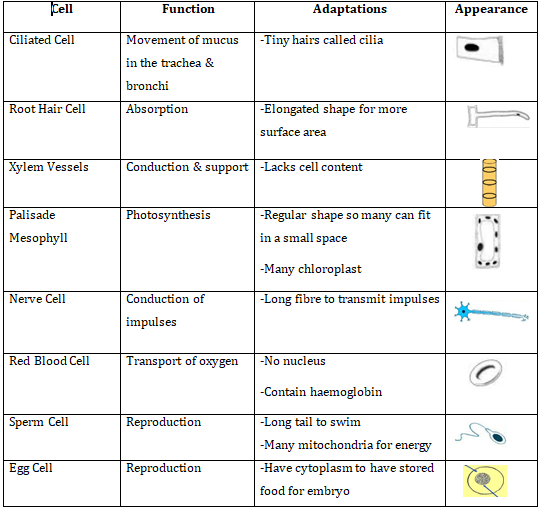
2.2 Levels of Organisation
Tissue: a group of cells with similar structures working together to perform a shared function
Organ: a structure made up of a group of tissues, working together to perform specific functions
Organ System: a group of organs with related functions, working together to perform body functions
Página 3
2.3 Size of Specimens
Magnification = Size of Image ÷ Size of Actual Length
Magnification is written in ‘times’ or with ‘X’ sign
Length or size should be measured in micrometres ( μm ) or in millimeters ( mm ) , but not in centimeters ( cm ) .
1 cm =10 mm, 1cm= 10000 μm , 1mm= 1000 μm , 1 μm = 10-4 cm 1 μm = 10-3 mm
Información
- Descripción
- IGCSE Biology Apunte sobre Unit 2. Organisation of the Organism, creado por Alisar Younes el 20/11/2017.
- Creado por
- Alisar Younes
- Visitas
- 63
- Valoración