
Apuntes
Topic 8
Contenido del apunte (12)
Página 1
Synapses
What is a synapse?
ROLES: CONTROL AND COORDINATION
Synapses are gaps between neurons and neurotransmitters cross the synaptic cleft. Neurotransmitter receptors are linked to ligand-gated channels.
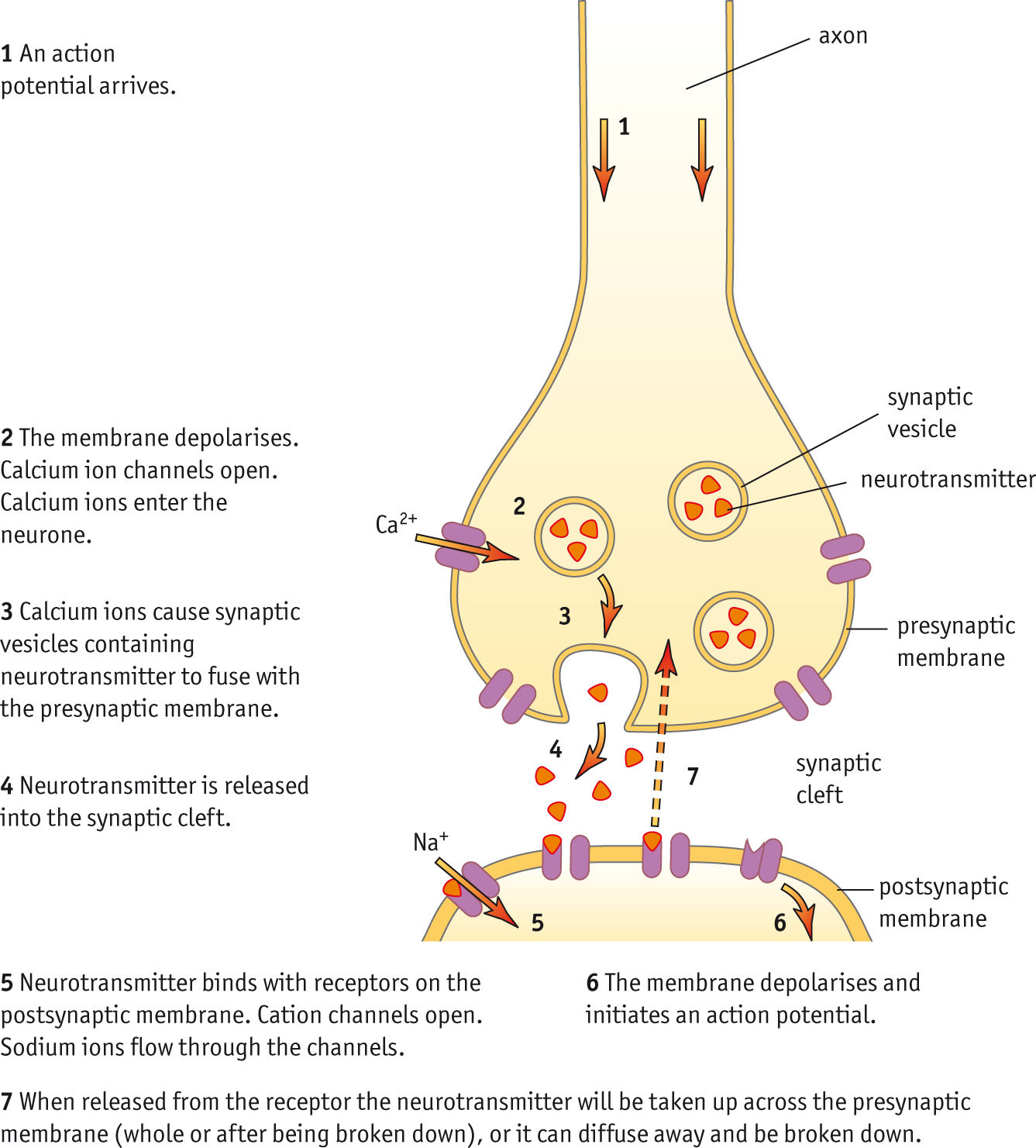
SYNAPTIC TRANSMISSION PROCESS
1. Nerve impulse arrives at the synapse
2. Voltage-gated calcium channels open and Ca2+ ions flow into the presynaptic neuron down a concentration gradient
3. Increased Ca2+ concentration causes vesicular fusion with the membrane and neurotransmitter diffuses across the cleft
4. Neurotransmitter binds with a receptor on the membrane with the postsynaptic neuron
5. Binding of the neurotransmitter to the receptor causes ligand-gated Na2+ channels to open. Sodium flows into the postsynaptic neuron due to the concentration gradient.
6. An action potential is generated.
The neurotransmitter is broken down by esterase enzyme and the by products are taken up by the presynaptic membrane and reused. If not, there will be a constant action potential triggered.
There are two types of synapses: Excitatory and Inhibitory
Inhibitory synapses decrease the likelihood of the firing action potential of a cell while excitatory synapses increase its likelihood. Excitatory synapses cause a positive action potential in neurons and cells
Excitatory synapses make the postsynaptic membrane more permeable to sodium ions. They produce EPSP which are defined as a change in membrane voltage of a postsynaptic cell following a Na+ influx and depolarization occurs.
Inhibitory synapses cause the neurotransmitter in the postsynaptic membrane to depolarise, an example is GABA. They produce IPSP which make the postsynaptic membrane less likely to depolarise and so an AP is less likely due to a greater potential difference across the membrane.
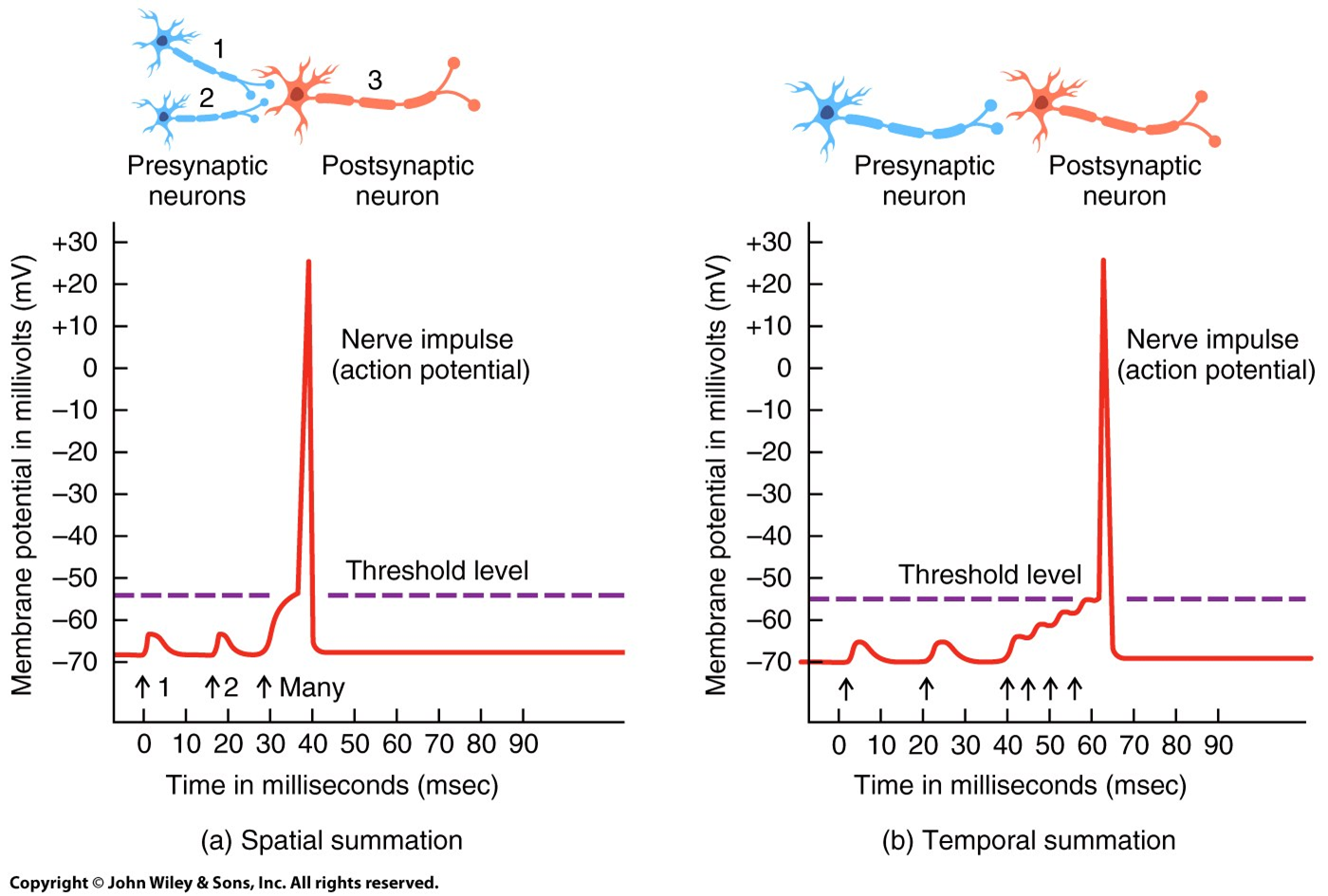
Summation is the additive effect of several impulses on a neuromuscular junction, a junction between a nerve cell and a muscle cell. There are two types of summation;
Spatial Summation
Temporal Summation
SPATIAL SUMMATION
In spatial summation the impulses are from different synapses, usually from different neurons. EPSP and IPSP are received at one time to the postsynaptic cell from different neurons.
TEMPORAL SUMMATION
In temporal summation several impulses arrive at the synapse having traveled along a single neuron one after another. The combined release of neurotransmitter generates an action potential in the postsynaptic membrane.
Página 2
Phytochromes - Plant Photoreceptors
A phytochrome molecule consists of a protein component bonded to a non-protein component which is a light-absorbing pigment molecule.
The non-protein component exists in 2 forms which are different isomers:
Pr - phytochrome red, absorbs red light.
Pfr - phytochrome far-red, absorbs far-red light
The two isomers are photoreversible. Plants synthesize Pr which absorbs red light and this converts it to Pfr. Absorption of far-red light converts Pfr back into Pr.
In sunlight, the Pr into Pfr dominates because more red than far red is absorbed.
Pfr accumulate in the light
In the dark, any Pfr dominates because more red than far red is absorbed.
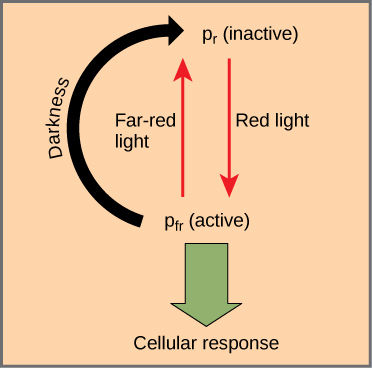
Active form (Pfr) ultimately affects the expression of genes to bring about physiological changes:
seed germination
leaf expansion
flowering
photomorphogenesis
stem elongation
Página 3
Pupil Reflex
Controlling pupil size:
High light levels striking photoreceptors in retina cause nerve impulses to pass along the optic nerve to sites in CNS
Impulses from sources in midbrain are sent along parasympathetic motor neurons to circular muscles of iris causing them to contract, radial muscles relax
This constricts pupil, reducing the amount of light entering the eye
The purpose of the pupil reflex is to prevent damage to the retina from high-intensity light and to ensure maximum light reaches the retina in dim lighting.
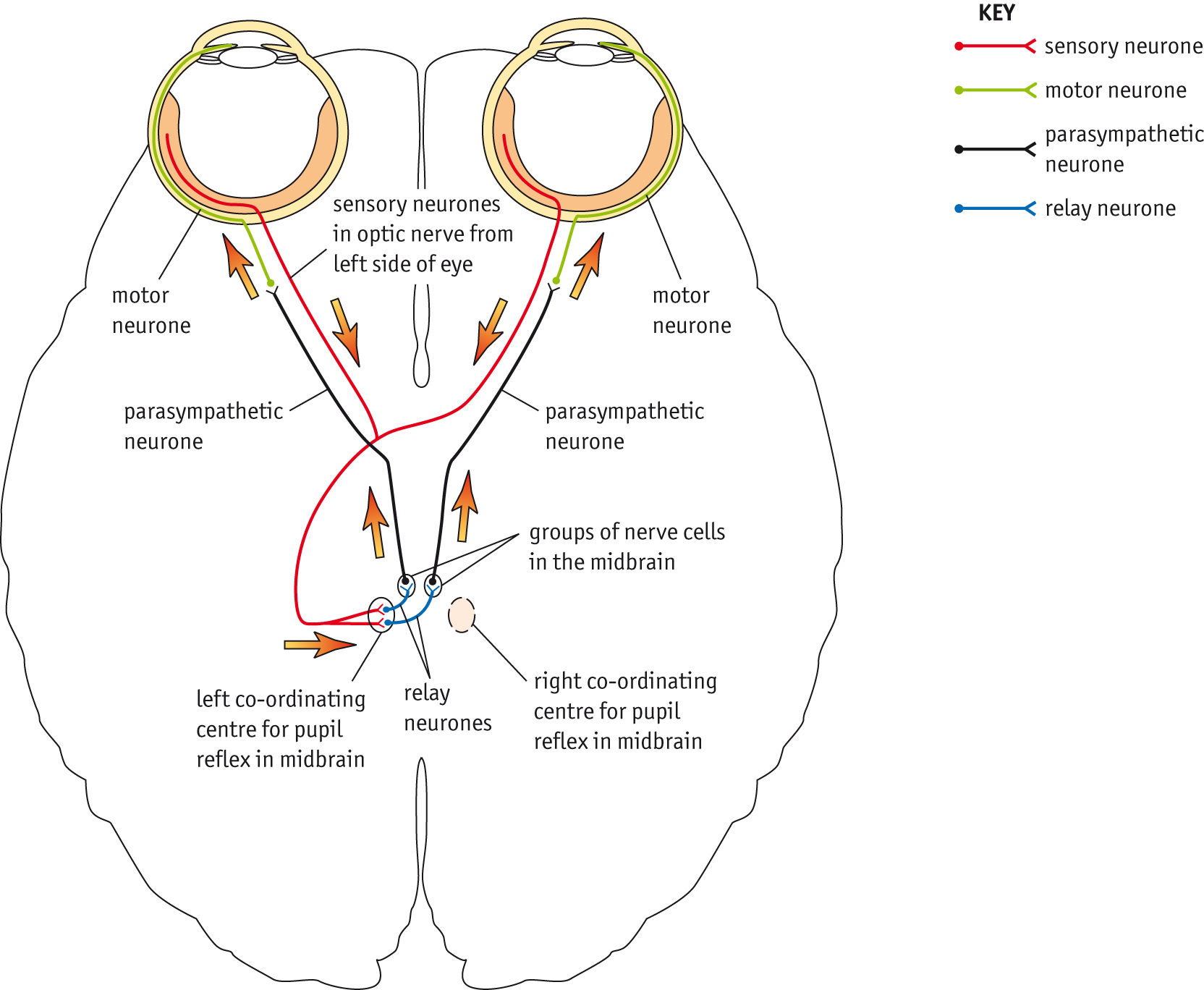
Pupil Constricted ----> circular muscles contracted, radial muscles relaxed
Pupil Dilated ------> radial muscles contracted, circular muscles relaxed
Página 4
Formation of Resting Potential
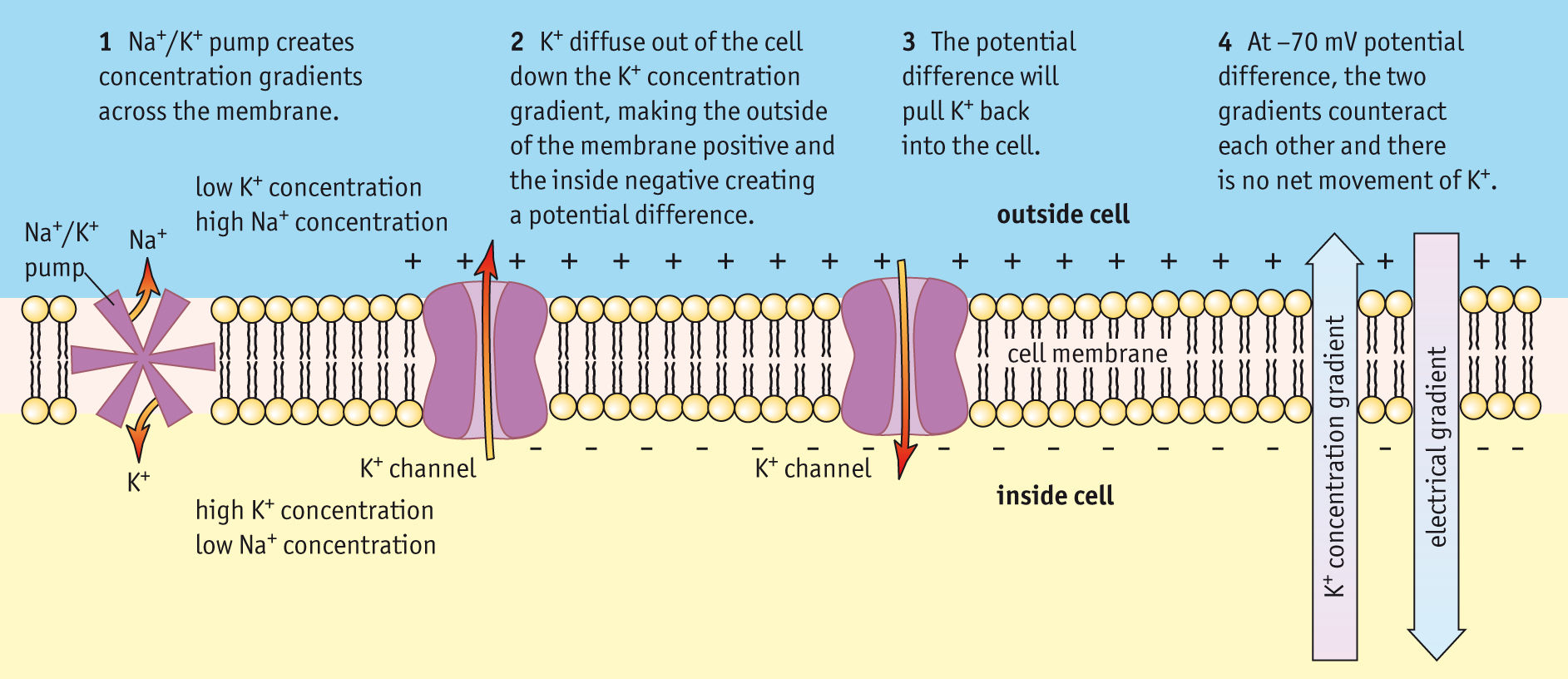
Sodium and potassium ions across the cell surface membrane of a neuron lead to the formation of a resting potential, this is -70 mV. At -70mV, further movement of K+ out of the cell due to the concentration gradient is opposed by the electrical gradient across the cell surface membrane, this pulls more K+ into the cell.
Potential Difference & Resting Potential
Na+/K+ pump creates concentration gradients across the membrane
K+ ions diffuse out of the cell, down the concentration gradient, making the outside of the membrane positive and the inside negative. Potential difference created
The potential difference will pull K+ back into the cell through channels
At -70mV potential difference, the two gradients counteract each other and there is no net movement of K+
The membrane is described as polarised because there is a potential difference across it.
What is a resting potential?
A nerve cell is pumping Na+ ions out through channel proteins to maintain the concentration gradient. Positive charge outside cell, negative charge inside the cell.
Pumping of these ions is pushing against an electrical and a chemical gradient so requires ATP for energy in Active Transport.
Página 5
Nerve Impulse Propagation
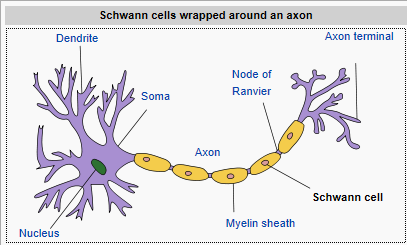
Myelinated neurons have special cells growing around the axon called Schwann cells; the lipid membrane of these cells created a fatty sheath around the axon.
The myelinated sheath insulates the axons from electrical activity in nearby cells which speeds up the nerve impulse.
The myelin sheath insulates the axon and prevents currents passing through the membrane, except in the gaps between Schwann cells - nodes of Ranvier.
Nodes of Ranvier are the only areas of the membrane that can become depolarised, this forces a current/action potential to jump from one gap to the next. This is saltatory conduction.
Depolarisation at one node causes a chemical change as Na channels open. This negative charge is picked up at the next node and voltage-gated channels here open. -----> This results in a faster transmission of an action potential than non-myelinated neurons.
Página 6
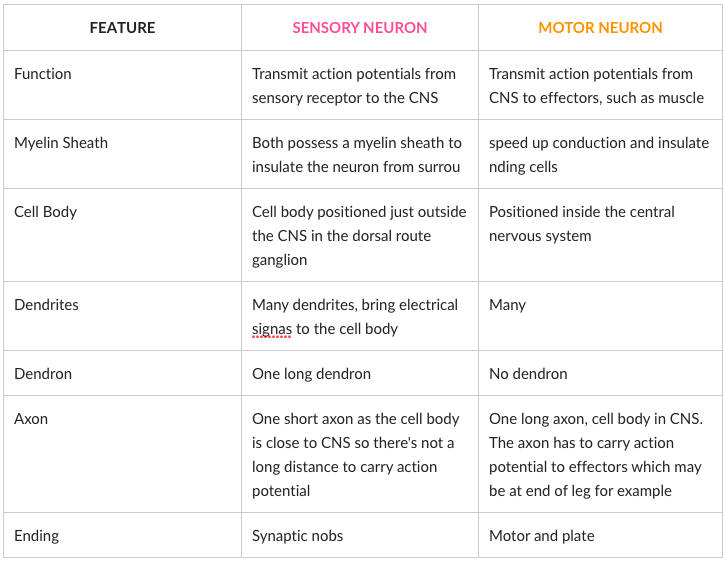
Sensory & Motor Neurons
Action Potential in Neurons
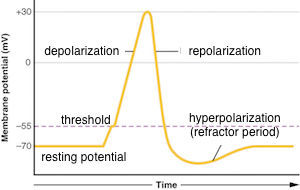
When a neuron is stimulated is becomes depolarised because of voltage-gated Na+ channels allow sodium ions to flow into the cell by facilitated diffusion.
As a result, the inside of the cell is now less negatively charges and if enough sodium ions flow into the cell, it reaches a threshold potential so more Na channels open - positive feedback.
After Na ions enter the cell, K channels open to allow K ions to move out of the cell, returning it to the -70mV resting potential. This is called re-polarisation.
The membrane briefly falls below resting potential, this is hyperpolarisation.
Página 7
Nervous & Hormonal Coordination
Understanding how coordination is brought about through nervous and hormonal control in plants and animals.
Nervous Control
Electrical transmission by nerve impulses and chemical transmission at synapses
FAST ACTING
ABUNDANT
A response is often very local, such as a specific muscle or gland, short-term changes
Action potentials carried by neurons with connections to specific cells
Hormonal Control
Chemical transmission through the blood
SLOWER ACTING
Can control long-term changes such as growth
Not local, blood carries hormones to all cells but only target cells can respond
Auxins
Plants lack a nervous system so must rely on chemicals to coordinate growth, development, and response to the environment.
IAA is an auxin, a chemical messenger in plants. One of its major functions is to stimulate growth such as cell elongation.
Auxins such as IAA are synthesized in actively growing root and shoot tips (meristems) and in developing leaves, seeds, and fruit. They are transported long distances in the phloem.
How do auxins work?
Bind to protein receptors in target cells
This activated intracellular secondary messenger signal molecules which activate transcription factors
These control transcription of auxin-regulated genes and the proteins produced to bring about metabolic changes that result in responses such as cell expansion, division, and differentiation
Cell expansion: loosening of the cell wall, auxin would cause acidification of the cell wall by stimulating the activity of proton pumps that move H+ ions out of the cytoplasm into the cell wall. Low pH activates proteins called expansions, these disrupt bonds that hold microfibrils together. Slippage of polysaccharides, bonds form in new places.
IAA (auxin) and Animal Hormones
Similarities:
Both chemicals
Both produced in cells
They move from the site of production
Both cause long-term/permanent effects
Both involved in gene activation
Página 8
The Cerebral Hemispheres
To know the locations and functions of the cerebral hemispheres, hypothalamus, cerebellum and medulla oblongata in the human brain.
The brain is divided into two cerebral hemispheres, each of which are composed of:
Frontal Lobe - concerned with higher brain functions such as decision making and consciousness of emotions. Combines information from rest of the cortex. Includes primary motor cortex.
Parietal Lobe - orientation, movement, sensation, some types of recognition and memory.
Temporal Lobe - processing auditory information.
Occipital Lobe - this is the visual cortex. Concerned with processing information from the eye including vision, color, shape recognition, and perspective.
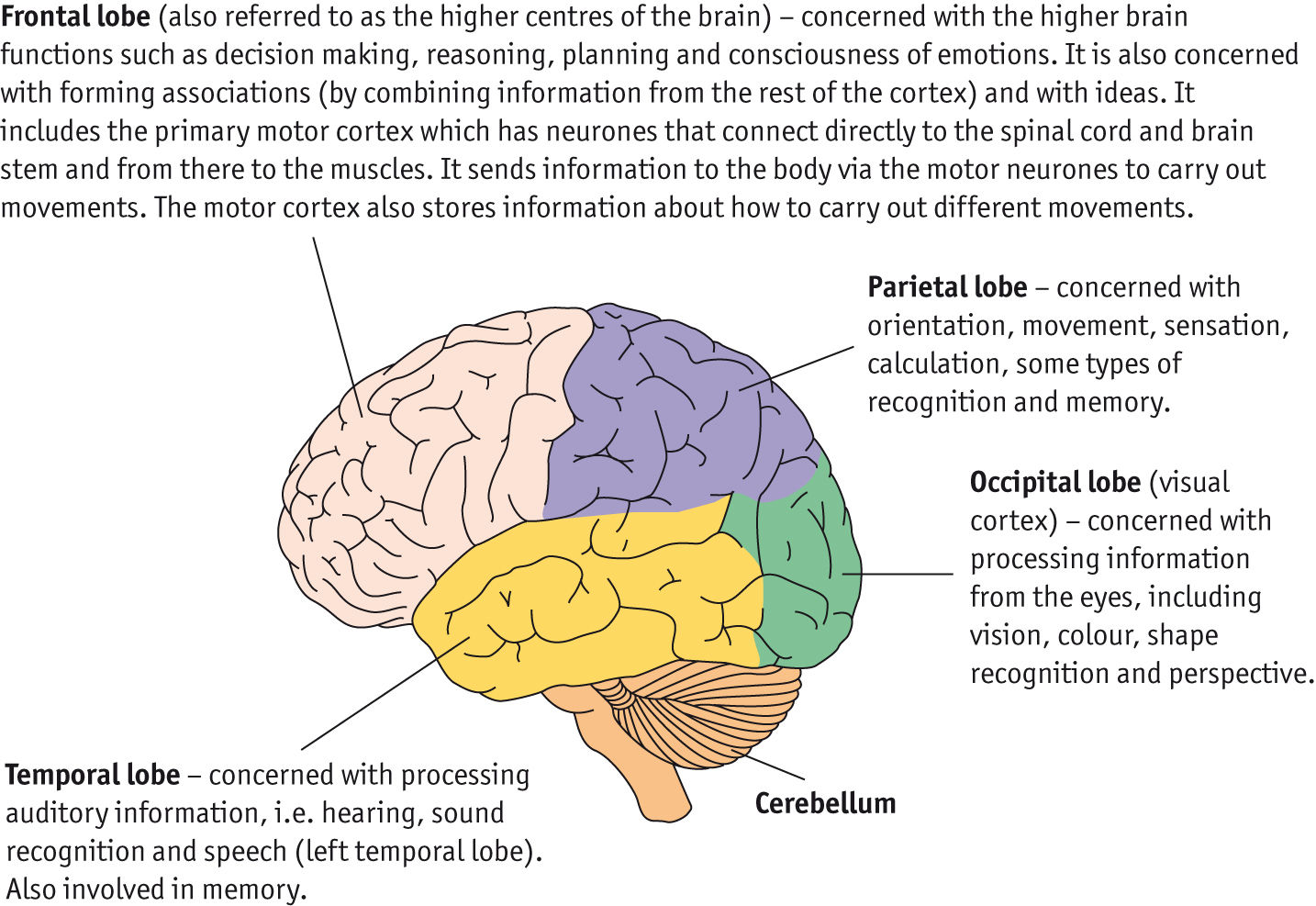
The two hemispheres are connected by the corpus callosum, below this there is;
Thalamus: responsible for routing all incoming sensory information to correct area of the brain via axons.
Hypothalamus: contains the thermoregulatory center which monitors core body temperature and skin temperature. It initiates correct actions to restore body temperature. Other centers that control sleep, thirst, and hunger are here. Acts as endocrine gland which secretes hormones.
Hippocampus: involved in laying down long-term memory
Cerebellum and Brain Stem
Cerebellum
Responsible for balance
coordinates movement as it's carried our, receiving info from the primary motor cortex
Medulla Oblongata: regulates body processes that we don't consciously control such as breathing, heart rate, and blood pressure.
Página 9
Habituation
Habituation is the desensitization to a stimulus. It gives the animal the ability to ignore unimportant, repetitive stimulus so that limited sensory, attention and memory resources can be concentrated on more threatening or rewarding stimuli.
How is habituation achieved?
With repeated stimulus, Ca2+ channels become less responsive so less calcium can cross the presynaptic membrane.
Less neurotransmitter is released
There is less depolarization of the postsynaptic membrane so no action potential is triggered in the motor neuron
The amount of neurotransmitter crossing the synapse between the sensory and motor neuron is decreased with habituation.
Página 10
How Drugs Affect Synaptic Transmission
There are several ways drugs can affect synaptic transmission:
a chemical with a similar structure to a neurotransmitter may bind to receptors on the postsynaptic neuron and trigger an action potential
others may block or open ion channels and inhibit neurotransmitter release
others may inhibit a breakdown enzyme in the synapse
Understanding the mode of action of MDMA in ecstasy
What does MDMA affect?
It can affect the hypothalamus which is where the thermoregulatory center is
Clouded thinking, agitation, disturbed behavior
Can cause hyperthermia and thirst
MDMA increases the concentration of serotonin in the synaptic cleft
It binds to the molecules in the presynaptic membrane
These are responsible for transporting serotonin back to the cytoplasm of the presynaptic neuron
It prevents reuptake from the synaptic cleft thus a constant action potential is triggered
Seratonin and Depression
A lack of the neurotransmitter serotonin is linked to depression
Depression is a multifactorial condition as it has environmental and genetic influences
Alleles of many loci are thought to be involved in the inheritance of this condition - polygenic inheritance
In depression, fewer nerve impulses are transmitter around the brain; this may be due to low neurotransmitter production. Seratonin pathways also have a number of abnormalities.
Selective Serotonin Reuptake Inhibitors (SSRI's)
These inhibit the reuptake of serotonin from the synaptic cleft so that there is more available to the postsynaptic neuron to induce an action potential.
Prozac is an SRI which maintains high levels of serotonin and so increases the rate of nervous impulses in serotonin pathways. This has the effect of reducing some symptoms of depression.
Gene 5-HTT is known to influence susceptibility to depression
Página 11
Action Potentials
Example question: i) Suggest an explanation for the change in potential difference across the membrane between 1.00 ms and 1.50 ms
Membrane permeability to sodium ions increases
Voltage dependent Na channels open
Na moves into the neurone down the concentration gradient
Stimulates more Na channels to open through positive feedback, this is due to excess sodium within the neurone
Página 12
Structure of the eye
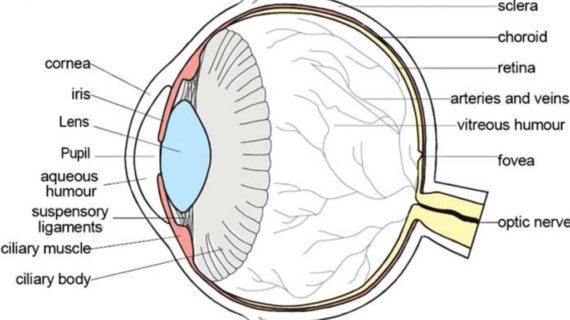
Photoreceptors
These are two types of photoreceptors sensitive to light within the human retina; rods and cones.
Cones: allow color vision in bright light
Rods: only allow black and white but work in bright and dim light
In the retina, rods and cones synapse with bipolar neurons