
Apuntes
Amino Acids
Contenido del apunte (1)
Página 1
Interaction of amino acids in a peptide:
Hydrogen bonds
Hydrophobic interactions
disulphide bonds
Ionic interation (salt bridge)
Common amino acids: all have -COOH and -NH2 groups. 7 of the 20 have really ionisable side chains
Amide Function (neutral): Asparagine, Glutamine
Basic/necleophillic: Histidine, Lysine, Arginine
Acidic: Tyrosine, Aspartic acid,GLutamic acid
Hydrophobic: Phenylanine, Valine, Leucine, isoleucine, methidinine, Proline, Alanine
Nucleophillic: Serine, theronine, cysteine
Measuring pH using a combination glass electrode: pH = -log[H+]
A combination electrode is a glass electrode and a calomel electrode combined usually in a single probe. A glass electrode consist's of an Ag-AgCl electrode in a reference solution of HCl in a glass membrane which is selectively permeable to hydrogen ions therefore used to measure the pH of a solutions. It does as a potential develops across the membrane depending on the [H+] of the test solution compared with reference solution inside the electrode, the potential is measured against a reference calomel electode. There is an almost linear relationship between potential and pH over the pH range 2-10.
Amino Acids in solution:
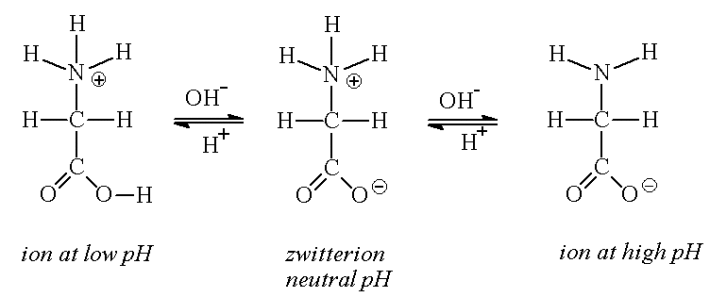
When in a solotion aminoacids tend to be in dipolar zwitterionic form rather than their neutral unionized form. The nature of the species present depends on the pH (see image), the isoionic point is where the zwitterion predominates which in amino acids is equal to the isoelectric point as the molecule will carry no net charge.
pKa1 + pKa2 = pI pKa=-log of ka (acid dissociation constant, usually very small)
2
Glycine's isoionic point is 6.0, at pH values below this the cation and zwitterion will coexist in equilibrium in a ratio determined by the henderson-hasselbalch equation. At pH values above 6.0 the zwitterion and anion will coexist in equilibrium.
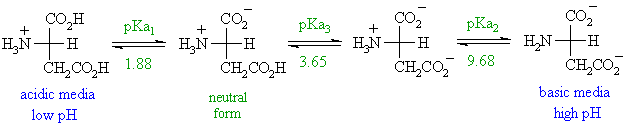
Ionisation of Amino Acids:
R' - COOH COO- + H+
R' - NH3+ NH2 + H+
if [conjugate base] = [acid] then = log(1) = 0 so pH = pKa. The lower the pKa the greater dissociating ability.
Amino acids with ionisable side chains give complex titration curves.
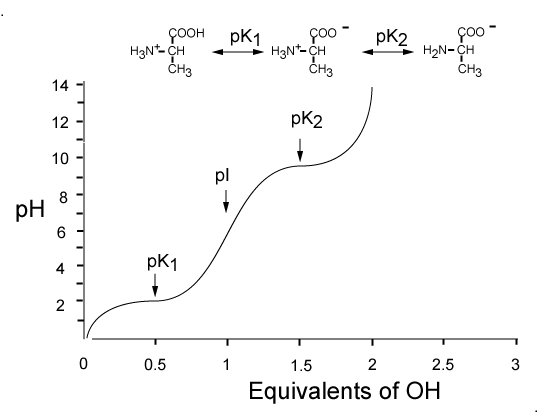
pH 2 alanine is titrated with NaOH. Buffering action is shown between pH 0 -3 and pH 9 - 14. At pI equal amounts of forms 1 and 2 are formed. If the pH is BELOW pI value = net POSITIVE charge. If the pH is ABOVE pI = net NEGATIVE charge.
Información
- Descripción
- University Biochemistry Apunte sobre Amino Acids, creado por Beckie Thorne el 13/04/2015.
- Creado por
- Beckie Thorne
- Visitas
- 3
- Valoración