
Themes in TKAM
Diapositivas del conjunto (11)
-
- Courage
- Education
- Family
- Childhood
- History
- Law
- Mockingbird
- Prejudice
- Religion
- Understanding
- Violence
-
- There are several kinds of courage in the book such as overcoming childhood fears (like running past the Radley place and Jem retrieving his pants). Atticus shows a similar courage even when he faces the mad dog even though he has a gun.
- Atticus teaches his children moral courage, like not retaliating when people call Atticus names. The most difficult type of courage is doing something even when you know it will fail, like Atticus does with Tom Robinson's trial and when Mrs Dubose beats her morphine addiction.
- Atticus calls Mrs Dubose "the bravest person" he ever knew because he wants to teach Jem and Scout that courage is not jut a man holding a gun or violence. An example of a man like this is Bob Ewell, who instead of having the moral courage to admit that it was him at fault and not Tom Robinson, Bob tries to hurt the children as revenge on Atticus.
-
- Because of the size and location of Maycomb, the same families have lived in there for hundreds of years. This is why people felt that a certain families have certain characteristics; like Ewells were always dishonest and Cunnighams could always be trusted. This led to social divisions and it became very important to mix with the right family. Aunt Alexandra was prone to this snobbery whereas Atticus prefers to judge the person and not the name.
- There are two obvious contrasts in the families in Maycomb. One is the Cunnighams, who may be poor but are very honest by always paying everything back, even if they cant do it with money.
- Cunningham disperses the mob outside the jail because Scout talks to him makes him feel like a person and not a member of the mob.
- The other family is the Ewells, who are the bad poor. Bob Ewell spends his doll on green whisky and his children don't eat because of it so he is allowed to illegally hunt to feed his kids. His children are filthy and refuse to go to school. They live by the town dump and Atticus said "They are humans but they live like animals."
-
- Because of the way the book is narrated, we get a view of the world through Scout's innocent eyes. We see the children's innocence, frankness and humour as well as seeing them grow up. The children tell the story in all its honestly as they take people on face value, they lack the prejudice and pretense of their elders and they also stick to their childish codes. Their fresh innocent outlook on events contrasts with the prejudice ideas of the people around them.
- The book shows us the children's growing awareness of the nature of the adult world. Their fresh outlook on life contrasts with that in Maycomb, which is a 'tired old town'.
- We are shown the children's growing awareness of the adult world and their awareness of how they should behave. This is shown when Jem no longer wants to play with Scout and Dill. Even though he wants to be art of the adult world, the verdict of Tom Robinson's trail confuses him about the adult word and how they could allow that injustice.
- Scout also matures and learns to understand he Aunt Alexandra and Boo Radley. She begins to shed her tomboy ways and realizes the importance of acting with dignity and 'like a lady'.
- Atticus and Alexandria have different views on how Jem and Scout should be brought up. Atticus expects the children to be polite, respectful, sympathetic and to think using reason and not emotion. He doesn't force the children into being people they aren't and he is accepting of Scout's tomboy ways whereas Alexandria wants her to curb her characteristics.
-
- History is important in the novel as the past shapes the attitudes and thoughts of the people in Maycomb - such as Mrs Dubose.
- The Civil War (1861-1865) occurred when some southern states (like Alabama) formed the confederate states of America. One of the reasons the Civil War broke out was the freedom of the slaves. Even though they were equals, the Negroes still lived separate lives as inferiors. Even thought the book is set 70 years after the war, nothing had changed.
- The novel is set during the Great Depression and the events of the novel span 3 years. The events of the book happen before the Civil rights movement but after the Ku Klux Klan.
- Nothing has changed in Maycomb for years so the ways of the people in Maycomb are very set and they have not been exposed to many twentieth inventions - cars are very few in Maycomb.
- Everybody knows everybody and people want Negroes to stay separated and people who not behave in the way that society deems acceptable, like Mr Dolphus Raymond are regarded as an oddity.
- The town is so removed from the rest of the world and nothing really happens so major events, such as Tom's trial, are regarded as a day out.
-
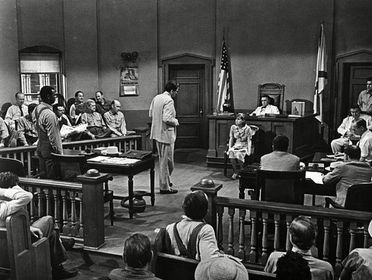
- In theory all Negroes have had equal rights since the end of the Civil War in 1865, but this does not mean that they get justice. Harper Lee emphasizes how wrong Tom's verdict was through Jem's innocent inexperienced eyes. Atticus upholds his belief in the law, even though he does believe improvements to be made.
- One thing that needs to change is people's attitudes. The law does work but justice can't be given until this happens. People must apply the law to create justice.
- Judge Taylor does his best to help Tom Robinson by appointing Atticus to defend him. He is perceptive and often makes the right choice.
-
- The image of the Mockingbird appears frequently in the book. The children are warned not to kill mockingbirds because all they do if make music and don't harm anyone. Boo Radley and Tom Robinson can be compared to the mockingbird as they are both gentle people who never harmed anybody and tried to help people. In different ways their lives are a mockery of the intolerant white society around them.
- Like the mockingbird, Boo and Tom should be protected and not hunted by the mob who are full of false courage, ignorance and shallow pride like the children shooting songbirds. They are both persecuted, Tom by the jury and Boo by the gosspis of Maycomb.
- The Mockingbird symbol is applied to two themes; justice and childhood. Justice is called when the jury ignore true evidence due to prejudices. The innocence of the children dies when they see the cruelness of the world through Tom's trial.
-
- A dominant theme in the novel is the cruelty inflicted upon others by preformed ideas. Dolphus Raymond calls it 'the simple hell people give each other.'
- There is not just deep racial prejudice in Maycomb but the intolerant, rigid, narrow minded codes of society that the people of Maycomb want to impose on each other. This bigotry is depicted as normal by many characters in the book. People such as Boo Radley, Dolphus Raymond and to some extent, Miss Maudie are persecuted because they do not conform. Tom Robinson is found guilty because of prejudice and because he went against societies rules by feeling sorry for a white woman.
- The racial prejudice is so deeply ingrained in the people of Maycomb that it makes them hypocrites. Harper Lee shows us this during Aunt Ale xandra's missionary tea circle when the women are sympathising with the Mruna tribe in Africa but condemn the Negroes in their own town. Mr Underwood despises blacks but hates injustice.
- The Radley's are the Finches neighbours and they are a endless source of fear and fascination to the children. They hear frightening stories and rumours of Boo from the neighbours. When Mr Radley dies, Calpurnia describes him as 'the meanest man God ever blew breath into'.
- In contrast to Tom's trial (which we can guess the outcome of), Boo's story is full of mystery and suspense. We are affected by the children's fears and suspicions about the Radley place. The mystery of Boo continues through until the very end of the book, though we are gradually given clues (like during the fire), that Boo is not as bad as the children believe him to be.
- Dolphus Raymond is regarded as an oddity in Maycomb because he is white and he chooses to live amongst Negroes. He has a reputation of being a drunkard but he tells the children that it is a pretence. He loathes the society that makes whites and blacks live separately.
-
- Most people in Maycomb are either baptist or Methodist. Baptists are stricter ones, they interpret the Bible in a very narrow way which denies people any pleasure in life even innocent pleasures like growing flowers which is why they tell Miss Maudie that she is going to hell when they see her gardening. The rigid rules of their religion often causes people to act in an unchristian way - like the way Mr Radley treats Boo.
- This narrow view of religion, with its emphasis on behaviour rather than compassion adds to intolerant atmosphere of Maycomb.
- In a contrast to the attitude of most of the whites, notice how the blacks are welcoming when Jem and Scout attend First Purchase.
-
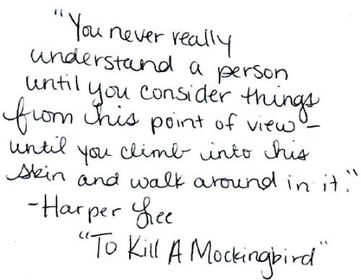
- One of the main lessons Atticus teaches Jem and Scout the importance of understanding another person's point of view. He urges them to put themselves in other people's shoes to understand them better. We see how successful Atticus is when the children learn to look with sympathy at Mrs Dubose, Boo and Mayella Ewell. Scout learns to tolerate Jem's behaviour ans he begins to grow up and learns to understand her Aunt.
- The book pleas for racial tolerance through understanding, and the idea that understanding is the key to equality between blacks and whites.
-
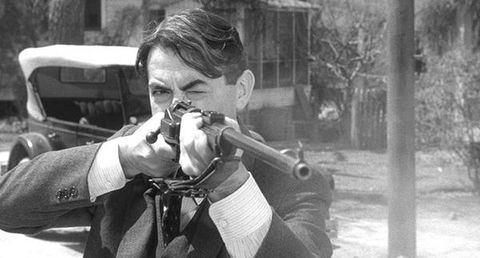
- There is a lot of hatred and fear in Maycomb which can spark off violence. An example of this is the mob outside the jail, which was made up of reasonable, respectable men who were prepared to kill.
- Bob Ewell's hatred of Atticus almost causes the death of Jem and Scout. Atticus understands the violence in Maycomb which may explain his reluctance to show off his skills with a gun. He does not want his children his expertise with a gun and by pleading tolerance and understanding instead, Atticus hopes to show the children that the causes of violence can be removed. Atticus is too idealistic here because he does not see how much Bob Ewell hates him.
Información
- Descripción
- GCSE (TKAM) English Diapositivas sobre Themes in TKAM, creado por Eve Gilks el 06/12/2015.
- Creado por
- Eve Gilks · dic 2015
- Actualizado
- 6 abr 2018
- Visitas
- 11
- Valoración