
Test
W6 Nematodes Strongyloides and Trichostrongyloidea-I
Este test tiene tipos de pregunta que se abren en el reproductor de siempre.
Preguntas del test (19)
1The relevant genus's of order Rhabditida include
- AStrongyloides, Rhabditis, & Micronema
- BCoccidia, Rhabditis & Ransomi
- CPseudophyllidea & Cyclophyllidea
- DSpiruroids, Filarioids, & Enoplids
2The important orders of phylum Nematoda include
- ARhabditids & Strongylids
- BAscarids & Oxyurids
- CSpiruroids & Filarioids
- DEnoplids
- EPseudophyllidea & Cyclophyllidea
3The following image is a parasite of order Rhabditida. Identify the following features of the worm: Corpus, Isthmus, Bulb
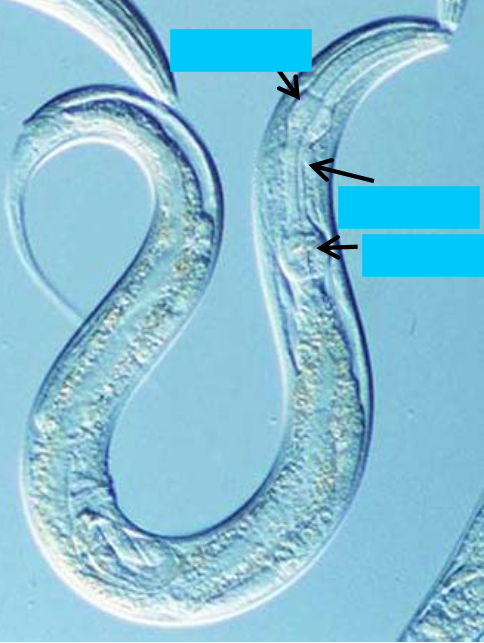
- ACorpus
- BIsthmus
- CBulb
4Match the following spicules with their correct species of Trichostrongylus species.
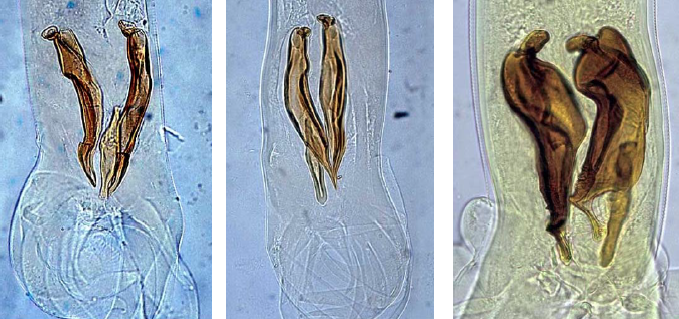
- AT. colubriformis
- BT. vitrinus
- CT. rugatus
- DT. axei
- EBarb-like tip
- FDissimilar and unequal
- GTapering end
- HThick and dissimilar
5These spicules belong to which species of Trichostrongylus and how would you describe their morphology?
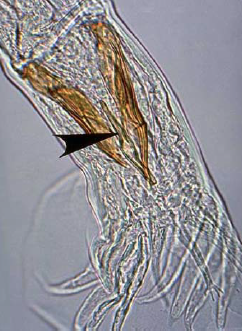
- AT. colubriformes, with a barb like tip on the spicules
- BT. vitrinus, with a barb like tip on the spicules
- CT. rugatus, with dissimilar and unequal spicules
- DT. axei, with dissimilar and unequal spicules
6The life cycle of Trichostrongylus involves a host stage, a [blank_start]dung[blank_end] stage, and a pasture stage. Dung containing worm eggs is passed from the sheep onto the pasture. At this stage eggs develop through L1 and L2 stages to the L3 stage. The L3 stage is known as the [blank_start]infective[blank_end] stage. Generally development to the infective stage is markedly reduced at temperatures below [blank_start]10˚[blank_end] and above [blank_start]35˚[blank_end]. During the pasture phase the L3 larvae migrate into [blank_start]moisture[blank_end] where they wriggle, some onto pasture, where they will then be consumed by the host. During the pasture phase the [blank_start]cuticle[blank_end] of L2 is retained by [blank_start]L3[blank_end] and acts to protect it from harsh conditions in the environment. After the L3 larvae is consumed it is [blank_start]exsheathed[blank_end] in the [blank_start]rumen[blank_end]. Infective larvae become adult that live for many months within the sheep's gut to reproduce and lay eggs. The minimum time from L3 to egg laying is [blank_start]18[blank_end] days.
- Adung
- Binfective
- C10˚
- D35˚
- Emoisture
- Fcuticle
- GL3
- Hexsheathed
- Irumen
- J18
7Name the strongyloid species that affect the mammalian hosts below. For example S. stercoalis is a strongyloid of dogs, cats and humans.
Ruminants = [blank_start]S. papillosus[blank_end]
Pigs = [blank_start]S. ransomi[blank_end]
Horses = [blank_start]S. westeri[blank_end]
Cat = [blank_start]S. cati[blank_end]
[blank_start]Primates[blank_end] = S. fuelleborni- AS. papillosus
- BS. ransomi
- CS. westeri
- DS. cati
- EPrimates
8The parasitic strongyloides are all found in the stomach, with the exception of the kangaroo species which can be found in the small intestines.
- AVerdadero
- BFalso
9Which of the following statements is false regarding the lifecycle of S. papillosus?
- AOnly female worms have been found parasitising the host
- BThere is a homogonic lifecycle and a heterogonic lifecycle
- CThe heterogonic lifecycle is free living and has a rhabditiform oesophagus
- DAt temperatures above 34˚C the parasitic lifecycle is triggered.
- EThe L1 and L2 larvae of the homogonic lifecycle have the oesophageal morphology of a filariform
10Ivermectin and Oxibendazole are appropriate treatments for Strongyloides.
- AVerdadero
- BFalso
11Which of the following techniques can be used to diagnose a strongyloid infection
- AEggs - faecal flotation
- BLarvae - Baermann technique
- CIn vitro culture
- DSerodiagnosis - ELISA
- EA streak culture on HB agar
12This is the eggs of [blank_start]S. westeri[blank_end], the strongyloid of the [blank_start]horse[blank_end].
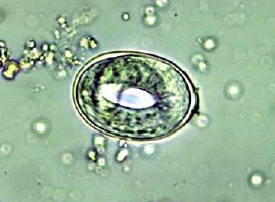
- AS. westeri
- Bhorse
13This larva is the larvae [blank_start]S. ransomi[blank_end], it was found in colostrum. These are the strongyloides of the [blank_start]pig[blank_end].
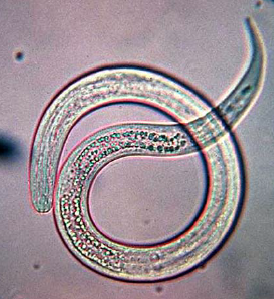
- AS. ransomi
- Bpig
14The Trichostrongyles of ruminants are
- AHaemonchus
- BOstertagia
- CTrichostrongylus
- DCooperia
- ENematodirus
- FDictyocaulus
- GFaciola
- HStrongyloides
15Trichostrongyles of ruminants that are found in the [blank_start]small intestine[blank_end] include;
"Black scour worm" = [blank_start]Trichostrongylus[blank_end]
"Wire worm" = [blank_start]Cooperia[blank_end]
"Thin-necked intestinal worm" = [blank_start]Nematodirus[blank_end]- Asmall intestine
- BTrichostrongylus
- CCooperia
- DNematodirus
16Trichostrongylus species can cause the signs seen in this image.
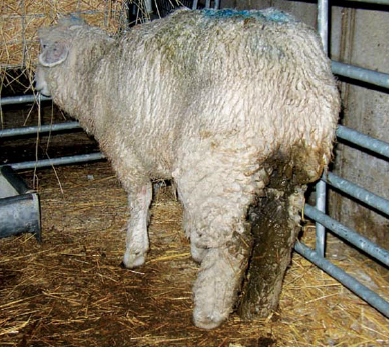
- AVerdadero
- BFalso
17What are the most important nematode of sheep in south-east Australia?
- AStrongyloides
- BTrichostrongylus
- CHaemonchus
- DOstertagia
18What are the main pathogenic affects of Trychostrongylus?
- AVillus atrophy
- BPneumonia
- CProtein loss
- DReduced absorption of Ca and PO4
- EObesity
- FAnorexia
- GDiarrhoea
- HAbortion
- IUlceration around the mouth and sole of the foot
19Winter Rainfall Zones:
- [blank_start]summer too hot and dry[blank_end]
- [blank_start]autumn moist, larvae develop[blank_end]
- [blank_start]winter moist, grass short[blank_end]
- [blank_start]spring “flush” dilutes larvae[blank_end]
- rising temperatures shorten survival time
Summer Rainfall Zones
- [blank_start]winter too cold or dry[blank_end]
- [blank_start]larvae develop in spring[blank_end]
- [blank_start]maximum numbers in summer[blank_end]
Northern Hemisphere (temperate)
- [blank_start]winters too cold[blank_end]
- [blank_start]development occurs in spring[blank_end]
- [blank_start]reaches maximum in autumn[blank_end]- Asummer too hot and dry
- Bwinter too cold or dry
- Cwinters too cold
- Dsummer too wet
- Eautumn moist, larvae develop
- Flarvae only develop in spring
- Gwinter moist, grass short
- Hwinter dry, grass short
- Iwinter dry, grass long
- Jwinter moist, grass long
- Kspring “flush” dilutes larvae
- Lspring "flush" increased number of larva
- Mwinter too cold or dry
- Nsummer too hot or too wet
- Olarvae develop in spring
- Plarvae develop in summer
- Qlarvae develop in winter
- Rlarvae develop in autumn
- Smaximum numbers in summer
- Tmaximum numbers in spring
- Uwinters too cold
- Vautumn too dry
- Wspring too wet
- Xdevelopment occurs in spring
- Ydevelopment occurs only in summer
- Zdevelopment occurs only in autumn
- AAreaches maximum in autumn
- ABreaches maximum in summer
- ACreaches maximum in spring
Información
- Descripción
- Masters Degree (Nematodes) Parasitology Test sobre W6 Nematodes Strongyloides and Trichostrongyloidea-I, creado por Emma Gray el 12/04/2016.
- Autor
- Emma Gray
- Idioma
- English
- Visitas
- 278
- Historial
- Creado el 12 abr 2016 · actualizado el 6 abr 2018
- Etiquetas
- Valoración
- 5,0 de 5 · 1 valoración Valora este test