
Apuntes
Haloalkanes
Contenido del apunte (1)
Página 1
Haloalkanes
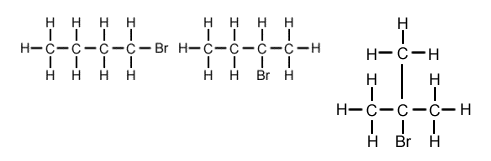
Haloalkanes are alkanes with halogen functional groups
The general formula is CnH2n+1X
They are often used in the production of synthetic products such as PVC, as a solvent in dry cleaning and
When reacting, it is nearly always the C-X bond that breaks
The C-X bond is polar as the carbon is partially positive and the halogen partially negative due to the nature of the halogens electro-negativities.
The C-X bond is however not polar enough to dissolve in water so it is insoluble.
It is the bond polarity as well as the bond enthalpy that determines the reactivity of a haloalkane.
The most reactive of the haloalkanes are those that contain a C-I (iodine) bond as the bond enthalphy of C-I is the lowest, so is most easily broken releasing the iodine.
The C-F bond would be the most polar due to the high electronegativity of the fluorine atom (the most electronegative atom)
The main IMF are dipole-dipole forces and Van der Waals
The mpt's and bpt's of haloalkanes increase with chain length, and as you go down halogen group. However, with increased branching bpt/mpt decrease.
Nucleophilic Substitution - Is a good way of introducing new functional groups into compounds.
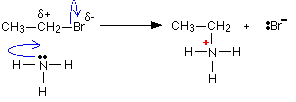
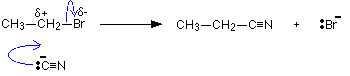
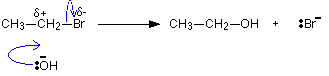
Nucleophile: An electron pair donor e.g hydroxide ion (:OH-), cyandide ion (:CN-), ammonia (:NH3)
Substitution: The nucleophile replaces an atom/group of atoms, in this case the halogen atom
Leaving Group: In the case of haloalkanes this is the halide ions
Curly Arrows: Show the movement of electrons in organic mechanisms.
When hydroxide group is introduced alcohols are formed
When cyandide groups are introduced nitriles are formed
When ammonia groups are introduced amines are formed

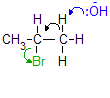
Elimination
Elimination = OH acting as base, in warm ethanolic conditions
Results in an alkene
Substitution= OH acting as nucleophile, in cool aqueous conditions
Primary haloalkanes favour substitution
Tertiary haloalkanes favour elimination
Secondary will do both
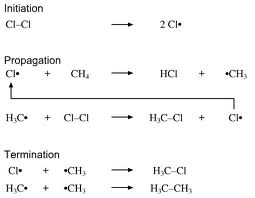
Free Radical Substitution - Synthesis of Haloalkanes
3 stage process:
Initiation - UV light is necessary to break covalent bond homolytically (one electron goes to each atom in the bond). This results in the formation of free radicals (highly reactive species with an unpaired electron)
Propogation - This is the chain part of the reaction, the free radical is constantly regenerated
Termination - Two free radicals react together to form a stable compound ending the reaction
CFC's cause the depletion of the ozone layer because of the Chlorine free radicals reacting and removing O3 in the upper atmosphere.
CF2Cl2 ->CF2Cl. + Cl.
Cl. + O3 -> ClO. + O2
ClO.
+ O3 ->2O2 + Cl.
New Page
Información
- Descripción
- AQA Chemistry UNIT 2
- Creado por
- Tamzin Hull · feb 2014
- Actualizado
- 22 dic 2016
- Visitas
- 188
- Etiquetas
- Valoración