
Apuntes
Chapter 1
Contenido del apunte (5)
Página 1
1.1: How Should We Think About Development?
Development: systematic changes and continuities in the individual that occur between conception and death (from "womb to tomb")
Physical development: The growth of the body and its organs, the functions of physiological systems including the brain, physical signs of aging, changes in motor abilities, and so on.
Growth of body and organs, physiological functioning
Cognitive development: Changes and carryover in personal and interpersonal aspects of development, such as motives, emotions, personality traits, interpersonal skills and relationship, and notes played in the family and in the larger societies
Personal and interpersonal - emotions, personality
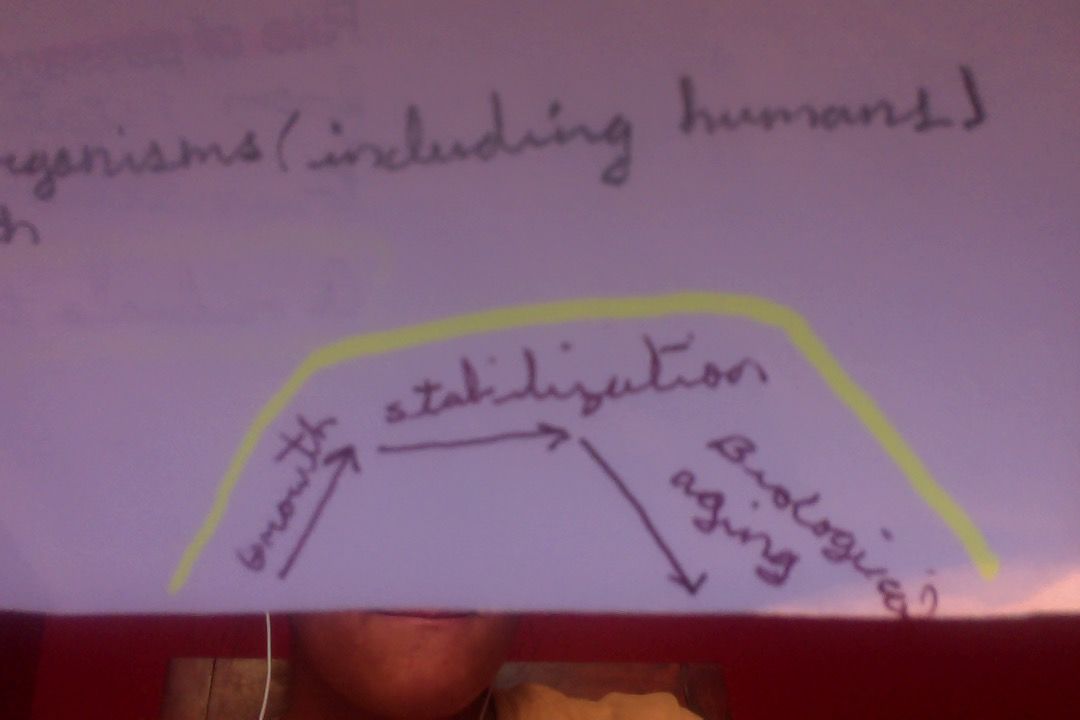
Growth: the physical changes that occur from conception to maturity
Biological, physical changes that occur as we mature
Biological aging: the deterioration of organisms (including humans) that leads inevitably to their death
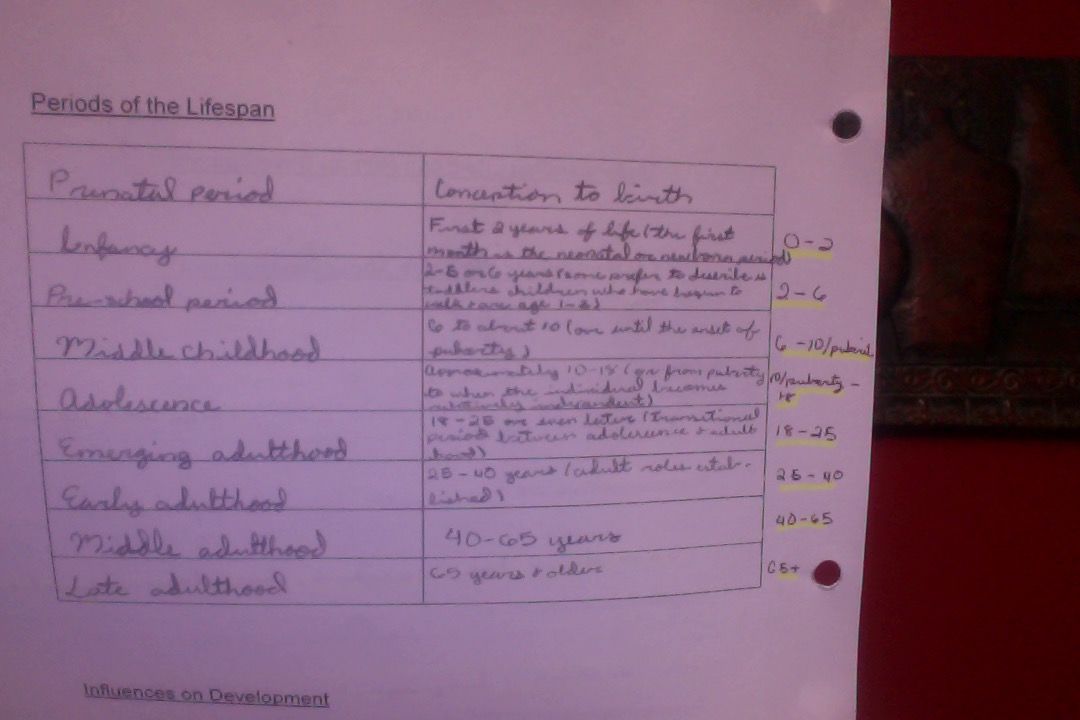
Periods of the Lifespan
Parental period - conception to birth
Infancy - 0-2yrs
Pre-school period - 2-6yrs
Middle childhood - 6-10/puberty
Adolescence - 10/puberty - 18
Emerging adulthood - 18-25yrs
Early adulthood - 25-40yrs
Middle adulthood - 40-65yrs
Late adulthood - 65+yrs
Influences on Development Culture
Age grade: age stratum - is assigned different statuses, index, privileges and responsibilities
Socially defined age group/stage
Right of passage: a ritual that marks a person's passage from 1 status to another, usually in reference to the transition from childhood
A ritual that marks the passage from 1 stage to the next
Age norms: society's way of telling people how to act their age
Unwritten rules that state what society expects us to do at our given age
Social clock: A person's sense of when things should be done and when he or she is ahead of or behind the schedule dictated by age norms
A person's individual sense of when they should be accomplishing things at each age
Socioeconomic status (SES): standing in society based on such indicators as occupational prestige, education, and income
Measure of income and education level
Different SES groups differ in norms
Historical Period
The nature and meanings of periods of the life span also change from one historical period to another
Emerging adulthood: Transition between adolescence and adulthood from age 18-25
Life expectancy: the average number of years a newborn bee is expected to llive
Average number of years a newborn is expected to live
The Nature-Nurture Issue
The question of how biological forces and environmental forces act ind interact to make us what we are
Nature: emphasize the influences of heredity, universal maturation processes guided by genes, biologically based or innate predispotions produced by evolution, biological influences such as hormones and neurotransmitters
Maturation - the biological unfolding of the individual according to the blueprint contained in the genes
Genes - the heredity material passed from parent to child @ conception
Nurture: emphasize change in response to environment
Environment - events or conditions outside the person that are presumed to influence and be influenced by the individual
Learning - the process through which experience brings about relatively permanent changes in thoughts, feelings, and behaviors
Nature plus Nurture
Nature - we would expect all children to have basically similar developmental milestones at similar times because of maturation
Nurture - we would generally except human development to take a variety of pathways depending on each individual's life experiences
Página 2
1.2 What is the Science of Life-Span Development?
Goals of Studying Development
Describing
Predicting
Explaining
Early Beginnings
Baby Biographies: carefully recorded observations of the growth and development of children by their parents over a period; the first scientific investigations of development
The Modern Life-Span Perspective
1. Development is lifelong process
2. Development is multidirectional
3. Development involves both gain and loss
4. Development is a characterized by lifelong plasticity
Neuroplasticity - the brain's remarkable ability to change in response to experience throughout the life span
5. Development is shaped by its historical cultural context
6. Development is multiple influenced
7. Development must be studied by multiple disciplines
Página 3
1.3: How is Development Studied?
Scientific method: a belief that investigators should allow their systematic observations to determine the merits of their thinking
Theory: a set of concepts and propositions intended to describe and explain certain phenomena
Hypotheses: specific predictions regarding a particular set of observations
A good theory should be...
1) Internally consistent - its different parts and propositions should hang together and should not generate contradictory hypothesis
2) Falsifiable - it can be proved wrong
3) Supported by data - can be confirmed by research results
Sample Selection
Sample: the group of individuals studied
Population: a well defined group
Random sample: a sample formed by identifying all members of the larger population and then, by a random means, selecting a portion of that population to study
Data Collection
3 major methods of collecting
Verbal reports
Behavioral observations
Physiological measurements
Verbal reports: Interviews, written questionnaires or surveys, ability and achievement tests, and personality scales all involve asking people questions, either about themselves or about someone else
Interviews, surveys, or test that ask a person to report about themselves or someone else
Naturalistic observations: observing people in their every day surroundings
Observing people in the environment when a behavior naturally occurs
Structured observation: they create special stimuli-task, or situations designed to elicit the behavioral of interest
Type of naturalistic observation where you create a certain situation to see how people respond
Physiological Measurements
fMRI (functional magnetic resonance imaging): a brain scanning technique that use magnetic forces to measure the increase in blood flow to an area of the brain area is active
Use magnets to measure blood flow in the brain
Case study: an in-depth examination of an individual, typically carried out by compiling and analyzing info from a variety of sources, such as observations, testing and interviewing the person or people who know her
In-dept observations of 1 participant, usually used for rare circumstances
Experiment: an investigator manipulates or alters some aspect of the environment to see how this affects the behavior of the sample of individuals studied
Measures how changing the environment leads to a change in behavior
Independent variable (IV): the variable manipulated so that its casual effects can be assessed
Variable the experiments control and change
Dependent variable (DV): have a different effects on the behavior expected to be affected
The effect/ results, depends on the IV
Critical Features of an Experiment
Random assignments: of participants to different experimental conditions helps ensure that the treatment groups are similar in all respects at the outset
Manipulation of the independent variable: investigators must arrange for different groups to have different experiences so that the effects of those experiences can be assessed (playing people into experimental control groups)
Experimental control: all factors other than the independent variable are controlled or held constant so that they cannot contribute to differences among the treatment groups (other variables are controlled)
Quasi-experiment: participants are not randomly assigned to groups
Correlational Method: involves determining whether 2 or more variables are related in a systematic way
Examines the relationship between 2 or more things to see if they vary together (no actual cause)
Correlation coefficient: an index of the extent to which individuals scores on one variable are systematically associated with their scores on another variable
The degree that 1 variable influences another
Positive +1.0 Negative -1.0
Directionality problem: the direction of the cause-effect relationship could be the reverse of what researcher thinks it is
Are my results because A caused B? Or did B cause A
Third variable problem: the association between the 2 variables of interest may be caused by some variable
Are my results related to an outside variable
Meta-analysis: the results of multiple studies the same questions can be synthesized to produce overall conclusion
Combining the results of several different studies to get an overall average
Developmental Research Designs
3 types research
Cross-section design
Longitudinal design
Sequential study
Cross-sectional design: the performances of people of different age groups or cohorts, are compared
Different age groups are compared @ the same time to see how they differ
Cohort: a group of individuals born @ the same time, either in the same year or within a specified span of years
Group of people born @ the same time
Age effects: the relationship between age and a particular aspects of development
Relationships between age and development
Cohort effect: the effects of being born as a member of a particular cohort or generation in a particular historical context
Unable to tell if it's actually their age that's causing the difference/ something they experience as a generation
Longitudinal Design: one cohort of individuals is assessed repeatedly over time
Same group of individuals is followed over, helps you see how individuals change over time
Time of Measurement Effect: the effects of historical events and trends occurring when the data are collected
Unable to tell if it's something that actually changes with age, or something that would happen over time
Sequential design: combines the cross-section approach and the longitudinal approach in a single study
Combines the 2 approaches - takes group of people in several cohorts and follows them over time
Página 4
1.4: What Special Challenges do Developmental Psychologists Face?
Ethnocentrism: the belief that one's own group and its culture are superior
Research ethics: the standards of conduct that investigators are ethically bound to honor to protect their research participants from
Informed consent: researchers generally should inform potential participants of all aspects of the research that might affect their decision to participate
Debriefing: researchers generally tell participants about the purposes of the study in advance, but in some causes doing so wound ruin the study
Protection from harm: researchers are bound not to harm research participants either physically or psychologically
Confidentiality: researchers also have an ethical responsibility to keep confidential the information they collect
Página 5
Extra notes
Correlation method
Study of the relationship between 1 variable and another (without investigators manipulation and control of people experiences)
No random assignments (so comparison groups may not be similar in all respects
Lack of control over extraneous variables
Can suggest but not firmly establish that one variable causes another owing to directionality and 3rd variables
Can be used to study many imports issues that cannot be studied experimentally for ethical reasons
Can study multiple influences operating in natural settings (findings may generalize better to the "real world")
Información
- Descripción
- Understanding Life-span Human Development
- Creado por
- Nicole Villaruz · ene 2017
- Actualizado
- 30 ene 2017
- Visitas
- 8
- Valoración