
Apuntes
Muscles
Contenido del apunte (1)
Página 1
Muscles
Properties:
Excitable - responds to an external stimulus.
Conductivity - can pass stimuli on.
Contractility - ability to shorten.
Elasticity - ability to return to original shape.
Functions:
Create movement - by contracting.
Stabilises joints.
Maintains posture.
Maintains body temperature.
External conformation.
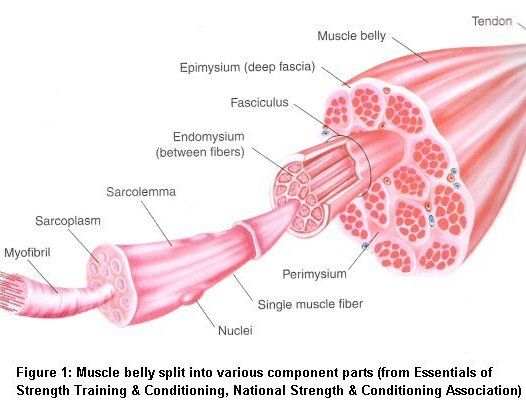
Muscle
Muscle Injury:
Known as myopathies (can by exertional or non-exertional). See flash cards.
Muscle Repair:
3 stages:
Inflammation
- Seen as heat, pain, loss of function and swelling.
- Damaged tissues release histamines which increase the blood flow to the area.
- The histamines cause the capillaries to leak, releasing phagocytes and clotting factors into the wound.
- Phagocytes engulf bacteria, dead cells and cell debris.
- Platelets move out of the capillaries to seal the wound area.
- Haematomas result when the venous return system becomes blocked.
Proliferation
- The process by which new capillaries are created.
- Endothelial cells produce new blood vessels.
- Fibroblasts produce collagen for strength.
- Fibroblasts and the new capillaries produce granular tissue.
Remodelling
- The process by which the tissue returns to normal.
It can take 1 - 2 months for the muscle to appear normal (morphologically) however the new tissue will not have as high a tensile strength for up to 6 weeks following apparent recovery. Must be taken into account during rehabilitation.
Muscle can return to it's preinjury state if:
- It is not restricted by haematoma.
- The base membrane is not damaged.
New Page
Información
- Descripción
- Muscles - Properties, Function, Structure, Injury, Repair.
- Creado por
- emily_massey · may 2014
- Actualizado
- 4 oct 2016
- Visitas
- 74
- Etiquetas
- Valoración