
Test
Supersecondary Structures & Energy Changes
Crea una cuenta gratis para terminar este test
Guarda tu progreso y consulta tu resultado final.
¿Ya tienes cuenta? Inicia sesión
Preguntas del test (27)
1Alpha helices are a helix-helix structure
- AVerdadero
- BFalso
2Which of the following best describes an alpha helix?
- ARidges are formed by side chains with troughs in between
- BRidges are formed by the peptide bonds and the amino acid side chains form the troughs
3Helix-helix packing can be shown by highlighting every _ residues?
- A1st
- B4th
- C3rd
- D2nd
4Alpha helices must follow particular rules when packing together
- AVerdadero
- BFalso
5Describe the ridges of the following proteins
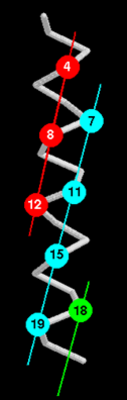
- Ai + 4
- Bi + 2
- Ci + 3
6The angle between two packed helices depends on which type of ridges pack into which troughs.
- AVerdadero
- BFalso
7The troughs of one alpha helix will be filled by the 'backbone' of another
- AVerdadero
- BFalso
8Beta sheets twist slightly _ each other
- AAway from
- BTowards
9The angle between two beta sheets is approx....?
- A30 degrees
- B60 degrees
- C90 degrees
10Where in the plane is each color (ignore green)
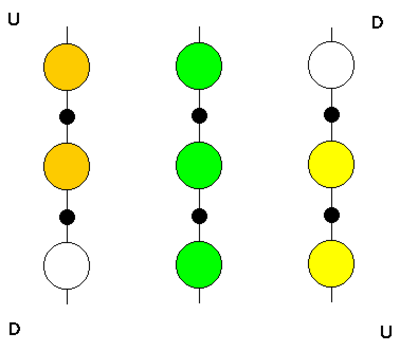
- AYellow- above plane
White- below plane - BWhite- above plane
Yellow- below plane - CThe amino acids will point in opposite directions
- AYellow- above plane
11The strands of beta sheets are held together by backbone hydrogen bonding
- AVerdadero
- BFalso
12The angle between sheets is determined by their...
- ARight handed twist
- BLeft handed twist
- CLength
- DAmino acid side chains
13How are the aa side chains arranged in beta sheets?
- AThe amino acid residue side chains of one beta sheet pack between the spaces between side chains on the adjacent beta sheet
- BThe amino acids on one beta sheet will have no residue where the other beta sheet has one (they're removed)
- CThe amino acids with residues attached will alternate between beta sheets
14When an alpha helix and a beta sheet pack together, the groove the beta sheet lies in tends to be made by amino acids how far apart?
- A4n
- B6n
- C3n
- D2n
15Name three things that can be used in protein folding to encourage correct folding?
- ANon-native interactions (as long as they are reversible)
- BPinching (isolates subdomains for folding)
- CThe removal of a domain for folding, before it's re-addition
16Negative Free Energy is less favorable
- AVerdadero
- BFalso
17Concerning entropy- less order is more favorable
- AVerdadero
- BFalso
18Which of the following is the equation for the free energy change of a folded protein
- AΔG = ΔH - TΔS
- BΔH = ΔG x TΔS
- CTΔS = ΔH + ΔG
- AΔG = ΔH - TΔS
19Hydrogen bonds are the least common type of bond in proteins
- AVerdadero
- BFalso
20What's the enthalpy change of a H bond formation?
- A-4 to -30 kJmol
- B-4 to -3 kJmol
- C-40 to -30 kJmol
21A hydrophobic core in water is entropically favorable
- AVerdadero
- BFalso
22Why is hydrophobic cores in water _favorable?
- AThey make the water molecules more ordered, decreasing entropy
- BThey make the water molecules less ordered, increasing entropy
23Why do hydrophobic proteins fold?
- AFolded proteins have a reduced surface area, leading to a reduced number of organised water molecules, leading to a lower decrease of entropy
- BFolded proteins have a reduced surface area, leading to a reduced number of organised water molecules, leading to a lower increase of entropy
24As water ordering decreases, entropy decreases
- AVerdadero
- BFalso
25Why is energy needed to maintain the folding of a (hydrophobic) protein (i.e. from hydrogen bonds etc.)?
- ABecause the unfolded state of the protein is more entropically favorable than the folded state
- BBecause though the folded protein is more entropically favorable, it's folding decreases entropy, which is unfavorable
- CSo energy must be produced to maintain the fold
26Heating denatures a protein because it breaks the bonds required to offset the negative change in entropy caused by the protein folding i.e, it makes ΔH less negative
- AVerdadero
- BFalso
27In protein folding, ΔH is negative, and -TΔS is positive
- AVerdadero
- BFalso
Información
- Descripción
- (Protein Folding) Structural Basis for Biological Function Test sobre Supersecondary Structures & Energy Changes, creado por gina_evans0312 el 19/12/2013.
- Autor
- gina_evans0312
- Idioma
- English
- Visitas
- 558
- Etiquetas
- Valoración
- Aún sin valoraciones Valora este test