
Test
B3 Quiz
Este test tiene tipos de pregunta que se abren en el reproductor de siempre.
Preguntas del test (54)
1Osmosis is the movement of [blank_start]water molecules[blank_end] across a [blank_start]partially permeable membrane[blank_end] from an area of high concentration to an area of low concentration.
- Apartially permeable membrane
- Bwater molecules
2In the body, how does osmosis work within cells?
- ATissue fluid surrounds cells and is composed of water, glucose and oxygen. It comes from the blood capillaries and supplies the body with water it needs by allowing water to move in and out of cells, depending on concentration.
- BTissue fluid surrounds cells and is composed of water, glucose and carbon dioxide. It comes from the blood capillaries and supplies the body with water it needs by allowing water to move in and out of cells, depending on concentration.
- CTissue fluid surrounds the cells and is composed of water and glucose. It comes from the blood capillaries and supplies the body with water it needs by allowing water to move in and out of cells, depending on concentration.
3Active transport is the movement of substances against a concentration gradient.
- AVerdadero
- BFalso
4In root hair cells, the concentration of minerals is usually higher in the cell than in the soil surrounding it. Active transport allows the plant to absorb minerals from a very dilute solution. This is essential for the plant [blank_start]to grow.[blank_end]
- Ato grow.
5When there's a higher concentration of glucose and amino acids in the gut they diffuse naturally [blank_start]into the blood[blank_end]. If there is a lower concentration of nutrients in the [blank_start]blood[blank_end] than in the [blank_start]gut[blank_end], active transport is necessary to [blank_start]prevent us from starving.[blank_end]
- Ainto the blood
- Bblood
- Cgut
- Dprevent us from starving.
6How are exchange surfaces adapted?
- Aare thick
- Bare thin
- Clarge surface area
- Dsmall surface area
- Emaintain a high temperature
- Fin animals, they have lots of blood vessels
- Gare ventilated
- Hdon't allow oxygen in or out
7Active transport is a passive process.
- AVerdadero
- BFalso
8In leaves, carbon dioxide diffuses into the air spaces within the leaf and then into the cells in which [blank_start]photosynthesis[blank_end] happens. The cell walls increase [blank_start]surface area[blank_end] so carbon dioxide is more likely to get through. The bottom of the leaf is covered in [blank_start]stomata[blank_end] which the carbon dioxide diffuses through. Leaves are flat to [blank_start]increase[blank_end] this exchange surface area. Guard cells close the stomata if water is being [blank_start]lost too quickly[blank_end]. [blank_start]Oxygen and water[blank_end] diffuse out through the stomata. Water vapour evaporates from leaf cells and escapes by diffusion.
- Aphotosynthesis
- Brespiration
- Creplication
- Dsurface area
- Esize
- Ftemperature
- Gstomata
- Hpigmented green colours
- Istems that act as veins
- Jincrease
- Kdecrease
- Lmaintain
- Mlost too quickly
- Nabsorbed too quickly
- Olost too slowly
- POxygen and water vapour
- QCarbon dioxide and oxygen
- RGlucose and water
9Label the respiratory system.
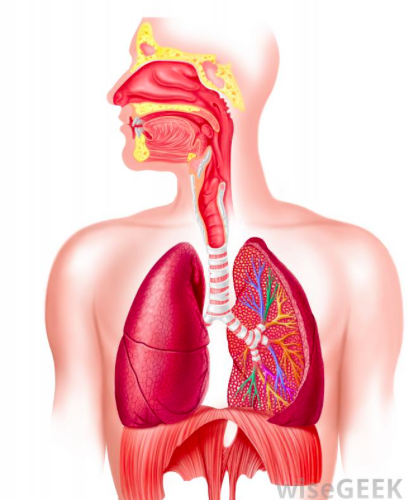
- Atrachea
- Boesophagus
- Cbronchus
- Dbronchiole
- Ealveoli
- Fdiaphragm
10What happens when you breathe in?
- Aintercostal muscles and diaphragm contract
- Bintercostal muscles and diaphragm relax
- Cthorax volume increases
- Dthorax volume decreases
- Epressure increases
- Fpressure decreases
- Gair is drawn in
11What happens when you breathe out?
- Aintercostal muscles and diaphragm contract
- Bintercostal muscles and diaphragm relax
- Cthorax volume increases
- Dthorax volume decreases
- Epressure increases
- Fpressure decreases
- Gair is forced out
12Artificial ventilators pump air out of the case causing pressure to drop, lungs to expand and air to be drawn in.
- AVerdadero
- BFalso
13New ventilators pump air into the lungs causing the ribcage to expand, air to be drawn in. To breathe out, the ribcage relaxes.
- AVerdadero
- BFalso
14Which system could interfere with blood flow to the lower body?
- AIron lung
- Bnew ventilators
15[blank_start]New ventilators[blank_end] could cause damage, for example they could burst alveoli, if the lungs can't cope with artificial air flow.
- ANew ventilators
- BIron lungs
16The alveoli are small air sacs inside your [blank_start]lungs[blank_end]. Inside them, gas exchange takes place wherein [blank_start]oxygen[blank_end] is transferred to the blood and [blank_start]carbon dioxide[blank_end] is removed. They are adapted for efficient diffusion as they have a large [blank_start]surface area[blank_end], moist [blank_start]lining[blank_end], [blank_start]thin[blank_end] walls and good [blank_start]blood[blank_end] supply.
- Alungs
- Boxygen
- Ccarbon dioxide
- Dsurface area
- Elining
- Fthin
- Gblood
17The small intestine is covered in millions of projections called [blank_start]villi[blank_end]. They increase the small intestine's [blank_start]surface area[blank_end] in order to speed up [blank_start]digestion[blank_end]. The have a [blank_start]single[blank_end] layer of surface cells so there isn't long for food to diffuse through, and a good [blank_start]blood supply[blank_end] for quick absorption.
- Avilli
- Bsurface area
- Cdigestion
- Dsingle
- Eblood supply
18Which plant vessel is made of columns of living cells that transports food from leaves to growing regions and storage organs in both directions?
- AXylem
- BPhloem
19Xylem vessels are dead cells joined end to end with no middle that carry water and minerals from the roots to the stem and leaves in the transpiration stream.
- AVerdadero
- BFalso
20What is transpiration?
- AWhen plants lose water by active transport and diffusion.
- BWhen plants transfer water throughout their organs.
- CWhen plants lose water by evaporation and diffusion.
- DWhen plants receive more water by osmosis.
21The transpiration stream happens through [blank_start]xylem[blank_end] vessels when there is a [blank_start]water[blank_end] shortage in a plant and it is therefore necessary for these vessels to replace it.
- Axylem
- Bwater
22Describe the double circulatory system:
[blank_start]Deoxygenated[blank_end] blood is pumped to the lungs to receive [blank_start]oxygen[blank_end].
The newly [blank_start]oxygenated[blank_end] blood returns to the heart.
This oxygenated blood is pumped to [blank_start]all other body organs[blank_end].
It gives up its oxygen at the [blank_start]body[blank_end] cells and becomes [blank_start]deoxygenated[blank_end].
The system repeats in a cycle.- ADeoxygenated
- BOxygenated
- Coxygen
- Dcarbon dioxide
- Eoxygenated
- Fdeoxygenated
- Gall other body organs
- Hthe kidney, the liver and some muscles.
- Ithe lungs.
- Jbody
- Kblood
- Ldeoxygenated
- Moxygenated
23How does the heart work?
Blood flows into the [blank_start]atria[blank_end] from the [blank_start]vena cava[blank_end] and the [blank_start]pulmonary vein[blank_end].
The [blank_start]atria[blank_end] contract which pushes blood into the [blank_start]ventricle[blank_end].
The [blank_start]ventricles[blank_end] contract which forces blood into the [blank_start]pulmonary artery[blank_end] and the [blank_start]aorta[blank_end] and out of the [blank_start]heart[blank_end].
Blood flows to organs through [blank_start]arteries[blank_end].
Blood returns to the heart through [blank_start]veins[blank_end].
The [blank_start]atria[blank_end] fill again and the cycle repeats.- Aatria
- Bvena cava
- Cpulmonary vein
- Datria
- Eventricle
- Fventricles
- Gpulmonary artery
- Haorta
- Iheart
- Jarteries
- Kveins
- Latria
24Which blood vessel has thick layers of muscle for strong walls due to high blood pressure, as well as elastic fibres for this same reason?
Hint: it carries blood away from the heart.- Aarteries
- Bcapillaries
- Cveins
25Which blood vessel supplies food/oxygen to your cells whilst removing waste like carbon dioxide, all by diffusion?
Hint: it has permeable walls and is usually only one cell thick.- Aarteries
- Bcapillaries
- Cveins
26Which blood vessel has low blood pressure so has walls which aren't very thick, but despite this has a big lumen to help the blood flow through?
Hint: it takes blood back to the heart and contains valves so blood flows in the right direction.- Aarteries
- Bcapillaries
- Cveins
27Red blood cells carry oxygen from the lungs to all other cells in your body, so the more you've got, the more oxygen can get to your cells. How are red blood cells adapted for their function?
- Acaved in shape to give them a large surface area to absorb more oxygen
- Bno nucleus so more oxygen can be carried
- Cthe nucleus is suited to carry oxygen
- Dred pigment called haemoglobin which combines with oxygen in the lungs to become oxyhaemoglobin (happens reverse in body tissues as oxyhemoglobin splits up into haemoglobin and oxygen so the oxygen can be released into your cells)
28White blood cells have a nucleus. How do they defend against disease?
- Achange shape to engulf foreign microorganisms
- Bproduce antibodies to fight microorganisms
- Cproduce antitoxins to neutralise toxins produced by microorganisms
29Platelets are small fragments of cells without a nucleus. They help to clot your blood. What can a lack of platelets in your blood lead to?
- AYour blood wouldn't be able to clot so you could bleed out and microorganisms could get in.
- BYour blood wouldn't be able to clot so you could spread disease easily.
- CYour blood wouldn't be able to clot so it would be more likely for you to get cut in the future.
30Plasma carries a lot of stuff in your blood. It is a pale straw coloured liquid. What does it carry?
- ARed blood cells
- BWhite blood cells
- CPlatelets
- Dcarbon dioxide from the organs to the lungs.
- Eurea from the liver to the kidneys.
- Fhormones
- Gantibodies and antitoxins produced by the white blood cells
- Hnutrients such as glucose and amino acids which are soluble products of digestion, absorbed from the gut and taken in the plasma to the cells of the body.
31What is the purpose of artificial blood?
- Ato replace the lost volume of blood
- Bto replace the function of the red blood cells
- Cto replace the function of the white blood cells
32Artificial blood is often used in [blank_start]emergency[blank_end] situations wherein a patient is [blank_start]losing[blank_end] a lot of blood. It buys the patient time to produce new [blank_start]blood cells[blank_end] so the heart can continue pumping. It is relatively safe, as long as there are no [blank_start]air bubbles[blank_end] present in the artificial blood.
- Aemergency
- Blosing
- Cblood cells
- Dair bubbles
33Sometimes patients need to receive an artificial heart. Tick what is correct.
- Aan artificial heart is a mechanical device that pumps blood when a person's heart fails
- Bthey are always temporary-patients only have an artificial heart whilst waiting for a donor
- Cthey are less likely to be rejected by the patient's immune system than donor hearts
- Dthey're made of metal or plastic
- Esurgery can lead to bleeding and infection
- Fthey've been designed so their parts never wear out
- Gpatient's need to take blood thinners because blood doesn't flow through as smoothly
34Deffective heart valves can be replaced with [blank_start]mechanical valves[blank_end]. Although it is a less drastic procedure than a [blank_start]heart[blank_end] transplant, it is still major surgery and there is a risk of [blank_start]blood clots[blank_end].
- Amechanical valves
- Bstents
- Cartificial hearts
- Dheart
- Eblood
- Fartery
- Gblood clots
- Hrejection
- Ithem being ineffective
35[blank_start]Stents[blank_end] are tubes inserted into the arteries to keep blocked arteries open so [blank_start]blood[blank_end] can pass through and the heart can continue beating. They are used to prevent heart attacks in people with [blank_start]coronary heart[blank_end] disease (fatty deposits blocking arteries) however if [blank_start]scar tissue[blank_end] forms due to stent irritation, the artery can narrow again. Drugs are needed to prevent [blank_start]blood clots[blank_end].
- AStents
- Bblood
- Ccoronary heart
- Dscar tissue
- Eblood clots
36Homeostasis is the maintenance of [blank_start]a constant internal environment[blank_end].
- Aa constant internal environment
37Homeostasis controls many things in your internal body environment, including temperature. Tick the boxes that describe what happens when your body gets too hot. Do not tick the boxes that describe what happens when your body gets too cold.
- Ahairs lie flat
- Bsweat glands produce sweat which evaporates
- Cblood vessels supplying the skin dilate so more blood can flow close to the surface
- Dhairs stand up
- Eblood vessels supplying skin capillaries constrict to close off skin's blood supply
- Fyour body uses methods which require respiration which in turn produces energy
38Homeostasis maintains a constant internal environment in your body by controlling the following six things. What do the kidneys do in relation?
- AMaintain body temperature
- BAdjust water content as necessary
- CAdjust ion content as necessary
- DKeep the blood sugar level within certain limits
- ERemove carbon dioxide
- FRemove Urea
39Your kidneys regulate the water content in your body. Water is taken in by [blank_start]food[blank_end] and [blank_start]drink[blank_end], and lost in [blank_start]urine[blank_end], [blank_start]sweat[blank_end] and the air we breathe out. On a cold day you don't sweat so you produce [blank_start]more[blank_end] urine which is [blank_start]pale[blank_end] and [blank_start]dilute[blank_end]. On a hot day you do sweat so you produce [blank_start]less[blank_end] urine which is [blank_start]dark coloured[blank_end] and [blank_start]concentrated[blank_end].
- Afood
- Bdrink
- Curine
- Dsweat
- Emore
- Fpale
- Gdilute
- Hless
- Idark coloured
- Jconcentrated
40Your kidneys regulate the ion content in your body. Ions are taken in in [blank_start]food[blank_end] and absorbed into the [blank_start]blood[blank_end]. If there is an incorrect balance of water and ions in your body, the wrong amount of water will be drawn into your cells by [blank_start]osmosis[blank_end] which can [blank_start]damage[blank_end] your cells or make them not work as well. Your kidneys remove excess sodium from the [blank_start]blood[blank_end]. Some ions are lost in [blank_start]sweat[blank_end].
- Afood
- Bblood
- Cosmosis
- Ddamage
- Eblood
- Fsweat
41Your kidneys remove urea from your body. Urea is produced as a waste product in the reaction of [blank_start]proteins[blank_end] being converted to [blank_start]fats[blank_end] and [blank_start]carbohydrates[blank_end] to be stored. This reaction takes place in the [blank_start]liver[blank_end]. Urea is poisonous. The [blank_start]liver[blank_end] first releases it into the [blank_start]bloodstream[blank_end], then the kidneys filter out the [blank_start]blood[blank_end] and temporarily store it in the [blank_start]bladder[blank_end] in urine to be excreted from the body.
- Aproteins
- Bfats
- Ccarbohydrates
- Dliver
- Eliver
- Fbloodstream
- Gbladder
- Hblood
42[blank_start]Nephrons[blank_end] are the filtration units in the kidneys.
- ANephrons
43The kidneys act as a filter in three stages. These are [blank_start]ultrafiltration[blank_end], [blank_start]reabsorption[blank_end] and the [blank_start]release of wastes[blank_end].
- Aultrafiltration
- Breabsorption
- Crelease of wastes
44During filtration, a high pressure squeezes water, [blank_start]urea[blank_end], [blank_start]ions[blank_end] and sugar out of the blood and into the [blank_start]Bowman's capsule[blank_end]. [blank_start]Big[blank_end] molecules cannot get through so proteins and blood cells stay in the blood.
- ABowman's capsule
- Burea
- Cions
- DBig
45During reabsorption, [blank_start]useful[blank_end] substances are reabsorbed into the blood. These include all [blank_start]sugars[blank_end] and sufficient [blank_start]ions[blank_end] (both by [blank_start]active transport[blank_end]), as well as sufficient [blank_start]water[blank_end].
- Auseful
- Bsugars
- Cions
- Dactive transport
- Ewater
46During the release of wastes in the kidneys, [blank_start]remaining[blank_end] substances (including [blank_start]urea[blank_end]) continue out the nephron, into the ureter and down to the bladder as [blank_start]urine[blank_end].
- Aremaining
- Burea
- Curine
47Dialysis is one way to treat kidney failure. The person's blood flows along a [blank_start]selectively permeable[blank_end] barrier surrounded by dialysis fluid. It acts like the [blank_start]membranes[blank_end] in the kidneys by being permeable to things like [blank_start]ions[blank_end] and waste substances, but not allowing [blank_start]big[blank_end] molecules through. Dissolved ions and glucose aren't lost from the blood during dialysis because the dialysis fluid has the [blank_start]same[blank_end] concentration of them as healthy blood. Waste substances and excess ions/water can [blank_start]diffuse[blank_end] across the barrier. Although this saves lives, it's a hassle as patients go three times a week for hours. Dialysis can cause [blank_start]blood clots[blank_end] or infections.
- Aselectively permeable
- Bbig
- Cions
- Dsame
- Ediffuse
- Fblood clots
- Gmembranes
48A kidney transplant will [blank_start]cure[blank_end] kidney failure. A donor who has died suddenly or is on the organ donor register gives a healthy kidney to a patient with kidney failure. The donor kidney could be [blank_start]rejected[blank_end] by the patient's immune system as the patient's [blank_start]antibodies[blank_end] attack the donor kidney's foreign [blank_start]antigens[blank_end]. This can be prevented if the donor's tissue type [blank_start]closely matches[blank_end] the patient's tissue type, or if the patient takes [blank_start]immune-suppressing drugs[blank_end]. These make them [blank_start]more[blank_end] susceptible to illness. Dialysis [blank_start]is not[blank_end] necessary with a kidney transplant.
- Acure
- Brejected
- Cantibodies
- Dantigens
- Eclosely matches
- Fimmune-suppressing drugs
- Gmore
- His not
49What removes blood glucose from the blood? If not ticked, it adds glucose the blood.
- Aeating foods containing carbohydrate
- Bthe normal metabolism of cells
- Cvigorous exercise
50What happens when the blood glucose level is too high?
- Ainsulin is secreted by the pancreas
- Bglucagon is secreted by the pancreas
- Cglucose is added by the liver
- Dglucose is removed by the liver
- Ethe liver turns glucose into glycogen
- Fthe liver turns glycogen into glucose
51When the blood glucose level is too high, [blank_start]insulin[blank_end] is secreted by the [blank_start]pancreas[blank_end]. Glucose is therefore [blank_start]removed[blank_end] by the [blank_start]liver[blank_end] as insulin caused the [blank_start]liver[blank_end] to turn [blank_start]glucose[blank_end] into [blank_start]glycogen[blank_end].
- Ainsulin
- Bglucagon
- Cpancreas
- Dliver
- Eremoved
- Fadded
- Gliver
- Hpancreas
- Iliver
- Jpancreas
- Kglucose
- Lglycogen
- Mglycogen
- Nglucose
52When the blood glucose level is too low, [blank_start]glucagon[blank_end] is secreted by the pancreas. Glucose is therefore [blank_start]added[blank_end] by the liver as [blank_start]glucagon[blank_end] caused the liver to turn [blank_start]glycogen[blank_end] into [blank_start]glucose[blank_end].
- Aglucagon
- Binsulin
- Cadded
- Dremoved
- Eglucagon
- Finsulin
- Gglycogen
- Hglucose
- Iglucose
- Jglycogen
53Type 1 Diabetes is caused when the pancreas doesn't produce enough [blank_start]insulin[blank_end] so blood glucose levels can [blank_start]rise[blank_end] to a deathly level.
- Ainsulin
- Brise
54How can we control Type 1 Diabetes?
- Aliver transplant
- Blimiting simple carbohydrates
- Ceating more sugary foods
- Dregular exercise
- Einjecting insulin several times a day
- Fpancreas transplant
Información
- Descripción
- GCSE (B3) biology Test sobre B3 Quiz, creado por Tess Brockway el 26/03/2016.
- Autor
- Tess Brockway
- Idioma
- English
- Visitas
- 796
- Etiquetas
- Valoración
- 3,3 de 5 · 3 valoraciones Valora este test