
Polymer Breakdown
Diapositivas del conjunto (3)
-
- Starch and many other polysaccharides are too large to penetrate the cell membrane, they must be digested extracellularly before entering the cell.
- Binding proteins and hydrolase enzymes are bound to the membrane, holding the polysaccharide in place while it is digested into oligosaccharides, whereby it is sequestered into the periplasm. Within the periplasm amylase digests the oligosaccharides into mono/disaccharides which are actively transported into the cytoplasm.
- Starch is a complex of amylose (1,4 glycosidic bonds) and amylopectin (1,4 and 1,6 glycosidic branched) glucose monomers.
- Alpha amylase digests 1,4
- Pullulanase digests 1,6
-
- Cellulose consists of beta 1,4 linked D glucose monomers.
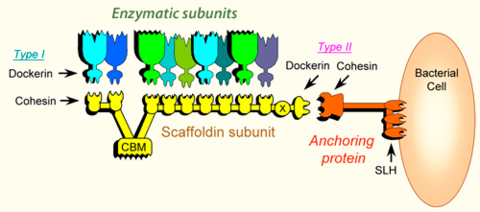
- Cellulose is sequestered into the cell by a similar mechanism to starch, however it required a multienzyme, multicomponant structure called a cellulosome, produced only by cellulytic (gram positive) bacteria.
- The cellulosome maximises synergy between different binding and enzymatic activities, also preventing the loss of diffusible breakdown products.
- The cellulosome consists of:
- dockerins
- cohesins
- CBM
- enzymatic subunits
- scaffoldin subunit
- anchoring protein to conect to bacteria
- Enzymes used are endo and exoglucanases (cleft and tunnel sites respectively)
-
- Bacteria are diverse in their use of metabolites:
- polysaccharides
- lipids
- proteins
- nucleic acids