
Flashcards
Mechanisms flashcards
Cards in this deck (20)
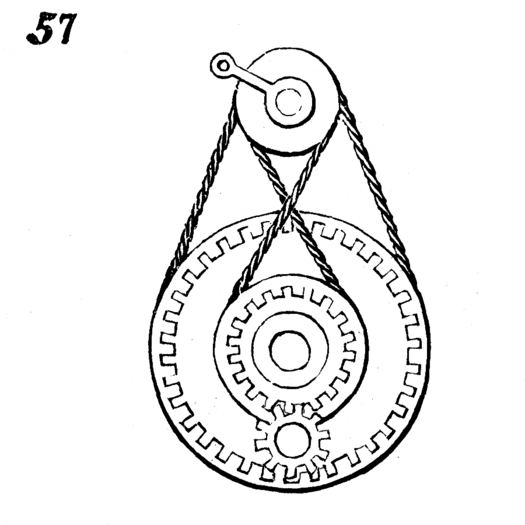
- 1—Differencial movement:
The small pulley at the top being the driver, the rest of the gears, will be driven in opposite directions by the bands, and at the same time will impart motion to the intermediate pinion at the bottom. - 2—Differential movement:
Different velocity given to two gears, A and C, on the same shaft, by the pinion, B.
- 3—Differential movement:
Mangle or star-wheel, for producing an alternating rotary motion.
- 4—Differential movement:
The vertical shaft is made to drive the horizontal one. The gears on the horizontal shaft are loose, and are driven in opposite directions by the third gear, which is made to rotate either to the right or left.
- 5—Differential movement:
This is a kind of universal joint that allows to join two non-coaxial axes. Its objective is to transmit the rotation movement from a conductive axis to another driven one, even though they are not collinear.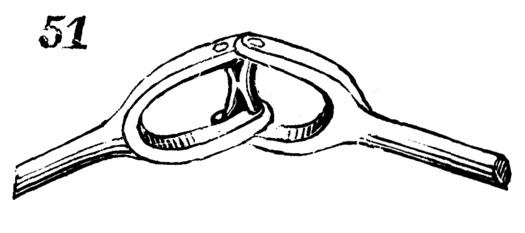
- 6—Eccentric movement:
A method of working a reciprocating pump by rotary motion. A rope, is attached to the wheel A, which runs loosely upon the shaft. The shaft carries a cam, C, and has a continuous rotary motion.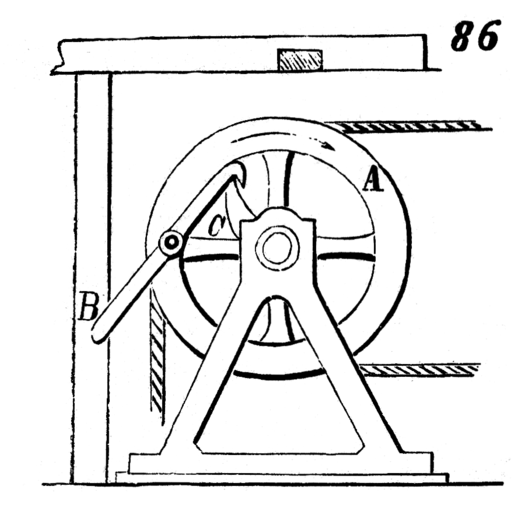
- 7—Eccentric movement:
Continuous rotary converted into intermittent rotary motion. On continuous rotary motion being given, when the same motion is repeated on gears B, C and D.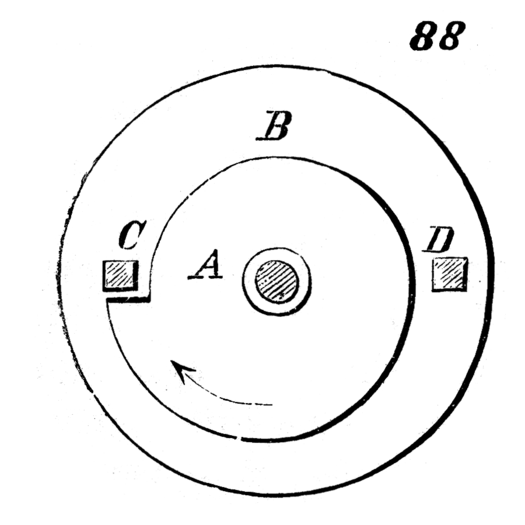
- 8—Eccentric movement:
An eccentric generally used on the crank-shaft for communicating the reciprocating rectilinear motion to the valves of steam engines, and sometimes used for pumping.
- 9—Eccentric movement:
An elongated yoke being substituted for the circular strap, to obviate the necessity for any vibrating motion of the rod which works in fixed guides.
- 10—Eccentric movement:
Triangular eccentric, giving an intermittent reciprocating rectilinear motion, usually used for the valve motion of steam engines.
- 11—Epicyclic train:
The wheel at one end of such a train, if not those at both ends, is always concentric with the revolving frame.
- 12—Epicyclic train:
A very simple form of the epicyclic train, in which The arm is formed into an axle in order to produce aggregate motion of the other wheel.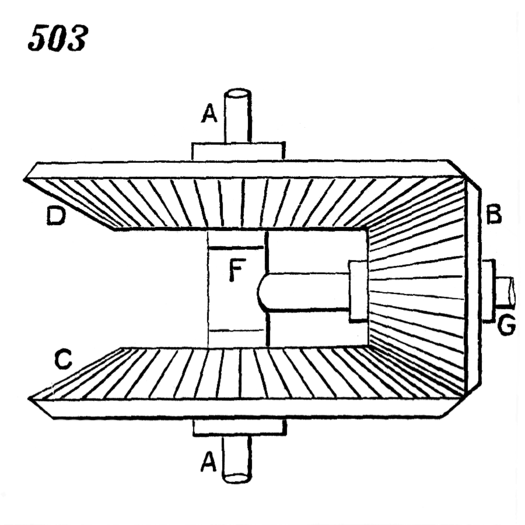
- 13—Epicyclic train:
designed to show a curious property of the epicyclic train.
- 14—Epicyclic train:
Another simple form of the epicyclic train, in which the arm, may be stationary, and the revolution of the arm and pinion will give motion to the other wheel.
- 15—Epicyclic train:
Another epicyclic train in which neither the first nor last wheel is fixed, which carries the two wheels, secured together, but rotating upon the arm itself.
- 16—Treadles:
On motion being given to the two treadles, a nearly continuous motion is imparted, through the vibrating arms.
- 17—Treadle:
Reciprocating curvilinear motion of the treadle gives a circular motion to the disk. A crank may be substituted for the disk.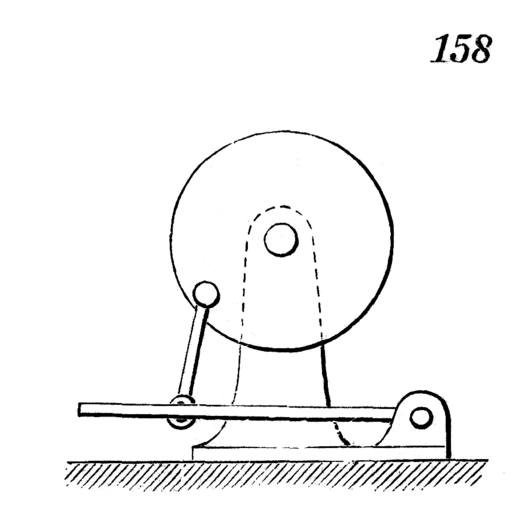
- 18—Treadle:
A modification of 158, a cord and pulley being substituted for the connecting rod.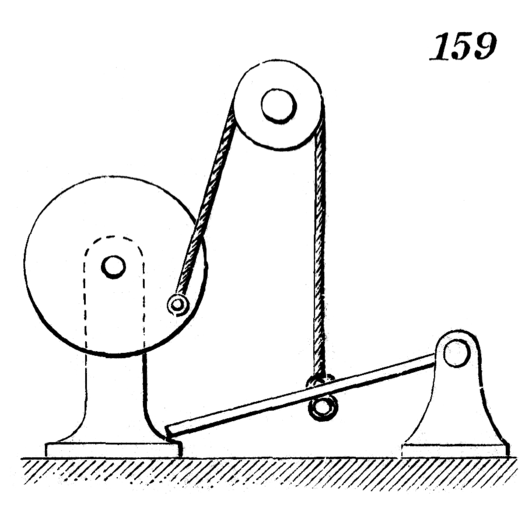
- 19—Treadle:
Alternating curvilinear motion into alternating circular, the connecting band passes once round the pulley, to which it gives motion.
- 20—Treadle:
Rotary motion of shaft from treadle by means of an endless band running from a roller on the treadle to an eccentric on the shaft.
Information
- Description
- 20 flashcards about the different mechanisms that can be found in the mental map.
- Created by
- sandra garcia arias
- Views
- 9
- Rating