
Flashcards
Renal Structure and Function 1
Cards in this deck (40)
- 11. Outline the general organisation of the kidney, ureter, bladder and urethra. 2. Identify the parts of the nephron and describe the role of each component in the physiologic processes involved in urine production. 3. Describe the vasculature of the kidney, relating its unique features to the physiology of urine production and nourishment of the nephron. 4. Identify the components of the juxtaglomerular apparatus and describe its role in regulation of blood and urine volumes and renal homeostasis. 5. Explain the ‘clearance concept’ and how this is used to measure glomerular filtration rate (GFR). State the properties of suitable marker substances and show how clearance, and hence GFR, are calculated. State normal values for the GFR.X
- 2Where do the renal arteries branch from? What is the function of the ureter? What is the function of the urethra?1) The abdominal aorta
2) Carries urine from the kidneys to the bladder
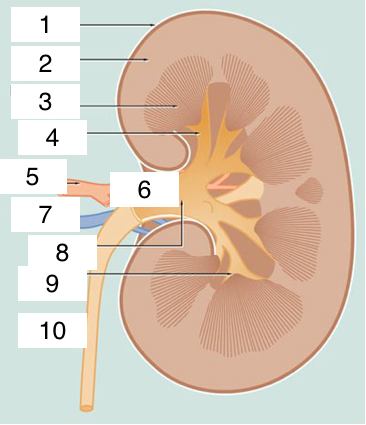
3) Carries urine from the bladder to outside the body - 3—1) Capsule
2) Cortex
3) Medullary pyramid
4) Calyx
5) Renal Artery
6) Hilum
7) Renal vein
8) Renal pelvis
9) Calyx
10) Ureter - 4What do renal arteries become?Pass into interlobar vessels within the medullary pyramids before become arcuate (arch shaped) vessels in the renal cortex
- 5What do the renal arteries* terminate as?Clumps of capillaries called a glomerulus.
*Small arteries - not arterioles - 6What is the Bowman's Capsule? What happens here?1) Bag of tissue/fluid which encloses the capillary glomerulus.
2) First stage of urine production - filtering of plasma into the Bowman's space which then leaves via the proximal convoluted tubule - 7Describe the blood supply to the glomerulus.Afferent and efferent arterioles - no vein.
- 8How much of the blood plasma is filtered at the Bowman's capsule? Why is this value important? How is the filtration pressure generated?1) 20%
2) If the filtration were higher the haematocrit concentration in the efferent arteriole would be too high and the plasma would be too viscous.
3) The afferent arteriole has a wider diameter than the efferent so there is a pressure drop between the two - 9Describe the structure of renal capillaries.Fenestrated and have podocytes on the capsular side of the epithelium.
- 10What is the function of the podocytes? What is the underlying mechanism of glomerular inflammation and how can it be tested for?1) Podocytes have slits in between them which form the filtration mechanism
2) Inflammation of the podocytes widens the slits between them which allows more and larger solutes to pass through - mainly more proteins, hence proteinuria is a sign of glomerular inflammation - 11What are the components of a nephron (in physiological order)?1) Capsule
2) Proximal convoluted tubule
3) Loop of Henle
4) Distal convoluted tubule
5) Collecting duct - 12Where are the distal convoluted tubules located? What does the collecting duct drain into?1) Medulla
2) The ureter - 13What is the juxtaglomerular apparatus?Where the distal convoluted tubule enters the cortex adjacent to the afferent and efferent arteriole.
- 14Where are the glomerulus and proximal convoluted tubules located? The loop of Henle?1) Cortex
2) Medulla - 15What are the various things that can happens to materials between the Bowman's capsule and peritubular capillaries?1) Fluid passes from glomerulus to Bowman's capsule/proximal convoluted tubule.
2) Filtered materials can be reabsorbed from the PCT into the peritubular capillaries.
3) Substance can be secreted from the peritubular capillaries back into the tubular fluid - 16What is the total amount of substance excreted equal to? What happens to glucose?1) Total amount secreted minus the amount reabsorbed
2) Almost all glucose is reabsorbed into the peritubular capillaries - 17How is filtration of water into the capsule regulated?By constriction of the afferent and efferent arterioles
- 18What are the different sources of pressure between the glomerulus and the Bowman's capsule (and their average values)? What therefore is the normal/healthy net filtration pressure?1) Plasma/blood hydrostatic pressure (55 mmHg)
2) Blood colloid oncotic pressure (30 mmHg)
3) Capsular hydrostatic pressure (15 mmHg)
4) Capsular colloid oncotic pressure - negligible due to lack of proteins
Net filtration pressure is therefore ~10 mmHg - 19What fraction of systemic cardiac output goes to the kidneys? What are the actual rough values then?1) 1/4
2) 5L per min for CO - therefore renal blood flow is ~1.2L/min - 20What is the average glomerular filtration rate (total amount through both kidneys, all glomeruli in a healthy adult)?120-125ml/min
- 21What is renal plasma flow equal to (assuming a haematocrit of 45%)?Renal plasma flow = Renal blood flow*amount of plasma
=1.25*0.55
=680ml/min - 22Given a GFR of 120 ml/min how much urine would you be producing every 10 minutes? What is the actual amount of urine flow? Why is this the case?1) 1.2 litres - that's a full bladder every 2 to 3 minutes
2) 1ml/min - 1.45-1.5L/day
3) Most of the fluid which has been filtered is reabsorbed - less than 1% enters the urine - 23What is a GFR of less than 100ml/min indicative of? What proportion of RPF is GFR?1) Kidney failure
2) A tenth - 24What fraction of water filtered in the glomerulus is reabsorbed into the proximal tubules? How is this achieved?1) 2/3
2) Na+/K+ ATPase pump is located on the basal surface of the proximal tubule epithelial cells (i.e. towards interstitial fluid and peritubular capillaries). This generates a Na+ concentration gradient. Na+ then enters the proximal tubule cell from the tubular filtrate down its concentration gradient via apical channels. Glucose is cotransported. This sodium gradient results in water being reabsorbed down an osmotic gradient from the tubule into the interstitial fluid. - 25What is clearance? What are its units?1) Clearance is the amount of a substance in the blood which is removed per unit of time (per minute) - it is a measure of glomerular filtration rate.
2) Litres per minute - 26Where does the proportion of plasma which is not filtered end up? What will its concentration be compared to plasma elsewhere?1) The blood which enters the efferent arteriole - will then enter the venous blood
2) Same concentration as normal compared to other blood because there is still some material in the renal venous blood. - 271. What happens to the clearance if 100% of a blood component is filtered through the glomerulus (and none is reabsorbed)? 2. If all the material is reabsorbed? 3. If none of the material is reabsorbed and all the material from the efferent arteriolar blood is secreted?1) Clearance of substance will equal GFR (~125ml/min), equal to the rate at which water passes through the glomeruli.
2) Clearance will be 0 (nothing removed by kidney)
3) Clearance will be equal to renal plasma flow - i.e. all of the substance which is passing through the kidney is being completely cleared - 28What usually happens to GFR and RPF is the kidneys are damaged?GFR usually decreases while RPF may remain the same
- 29What is the equation for clearance?Clearance = (Urine concentration/plasma concentration)*urine flow
- 30What is inulin?Polysaccharide - completely filtered from the plasma and not reabsorbed. Gold standard for measuring clearance but has to be infused over a period of hours etc. so is used for research purposes only.
- 31What is creatinine? What is creatinine's margin of error? How is the test performed?1) Product of breakdown of creatine - commonly used to measure GFR as is freely filtered by the glomerulus but actively secreted by the peritubular capillaries
2) 10-20% overestimation (but still used because much easier to do than inulin)
3) 24 hour urine collection (empty bladder on first morning). Blood creatine also taken (steady state). - 32If you can't get a urine sample/measurement of urinary excretion of creatinine how can creatinine clearance be estimated?By using blood creatinine concentration
- 33How can clearance be used to measure renal plasma flow? What substance is used?1) Clearance = urine conc/plasma conc * urine flow
If a substance is completely filtered, not reabsorbed and secreted from the efferent arteriole so that nothing remains in the venous blood this will be equal to renal plasma flow.
2) Para-amino-hippuric acid - 34Whats the normal GFR range? Normal PFR? Normal creatinine clearance in women? Men?1) 120-125 ml/min
2) 600-700 ml/min
3) 88-128 ml/min
4) 97-137 ml/min - 35What does autoregulation of the GFR mean? How is oxygen carrying capacity of the blood calculated?1) Over a wide range of blood pressures (80-180), GFR stays the same
2) RPF and metabolic rate of the kidney is constant - pO2 in the kidney interstitium is a measure of O2 delivery to the kidney and thus oxygen carrying capacity of the blood. - 36Where are erythropoietin releasing cells located?In the kidney
- 37How is filtration pressure raised?Further constriction of the efferent arteriole and relaxation of the afferent. Vice versa to lower the filtration pressure.
- 38What controls the balance between the constriction of the afferent and efferent arterioles?The juxtaglomerular apparatus
- 39Where are macula densa cell located? Juxtaglomerular? Extraglomerular?1) In the wall of the distal convoluted tubule
2) Adjacent to but outside the distal tubule, also surround afferent arteriole
3) Inferior to juxtaglomerular cells - 40Explain how the JGA autoregulates GFRCells in macula densa of distal convoluted tubule detect sodium concentration - if the sodium concentration in the tubular fluid is too low then GFR is low. Macula densa cells secrete hormones (renin) which result in the relaxation of the afferent arteriole. This increases net filtration pressure and thus increases GFR. If GFR is too high then factors released by the macula densa secretes factors which cause constriction of the afferent arteriole and a drop in filtration pressure, reducing GFR.