
Renal Physiology and the Urinary System
109 resources created by 73 users
This Renal Physiology and the Urinary System page on GoConqr gathers community-made quizzes, mind maps, flashcards, notes and flowcharts, from nephron structure and glomerular filtration to urine concentration, hormones and acid-base handling. It's built for university students and professional candidates practising renal topics, and for teachers after ready-made material. There are over 800 resources here, including more than 180 quizzes, over 250 mind maps and over 300 flashcards. Pick a topic, try a quiz to find your gaps, then make your own revision sets.
Top Renal Physiology and the Urinary System resources
-
33 cardsBRS Renal and Acid-Base Physiology Secretion of K+ by the distal tubule will be decreased by
-
Mind map Urine concentration AHS1. Renal Physiology. Countercurrent multiplier and distal tube/collecting duct. Frankie 4/6.
-
69 questionsRenal Physiology- Physiology PMU- 2nd Year, 2nd Semester Renal Physiology- Physiology PMU- 2nd Year, 2nd Semester
-
34 questionsThe Kidney: Filtration, Reabsorption and Secretion Label this image to describe the gross anatomy of the kidney.
-
54 questionsChapter 23 In life-threatening starvation, the kidneys synthesize glucose by
-
31 cardsOCR F214 - Excretion What is excretion?
-
Mind map Hormones of the kidney AHS1. Renal physiology. Hormones of the kidney. Frankie 5/6
-
10 questionsHMB Peer Teaching - Tubular reabsorption and secretion In the normal body, how much glucose is passed in the urine per day (i.e. not reabsorbed into the bloodstre...
Quizzes
See all 28 quizzes-
69 questionsRenal Physiology- Physiology PMU- 2nd Year, 2nd Semester Renal Physiology- Physiology PMU- 2nd Year, 2nd Semester
-
34 questionsThe Kidney: Filtration, Reabsorption and Secretion Label this image to describe the gross anatomy of the kidney.
-
54 questionsChapter 23 In life-threatening starvation, the kidneys synthesize glucose by
-
10 questionsHMB Peer Teaching - Tubular reabsorption and secretion In the normal body, how much glucose is passed in the urine per day (i.e. not reabsorbed into the bloodstre...
-
26 questionsExcretion and the Kidney
-
43 questionsLecture 2 - updated - glomerular filtration What is the filtration barrier formed by?
-
19 questionsRenal Physiology Lecture 2 Which of the following is not a normal parameter in human adults?
-
7 questionsREPRO/NEPHRO BLOCK - Week 4: More Kidneys Part II How are acid-base disorders diagnosed?
Mind maps
See all 31 mind maps-
Urine concentration AHS1. Renal Physiology. Countercurrent multiplier and distal tube/collecting duct. Frankie 4/6.
-
Hormones of the kidney AHS1. Renal physiology. Hormones of the kidney. Frankie 5/6
-
Glomerular filtration, tubularReabsorption and tubular Secretion
-
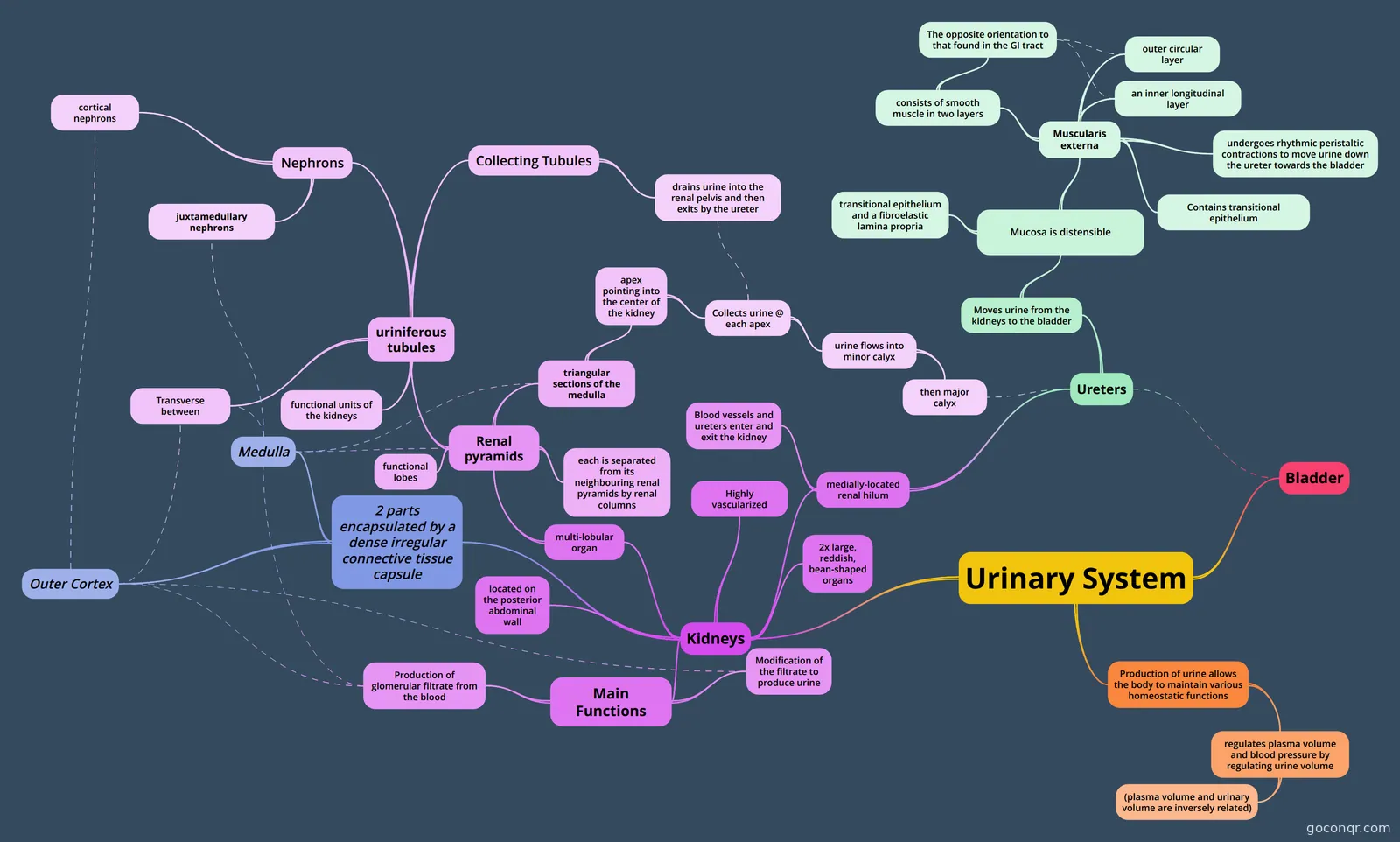 Urinary System
-
Acute Kidney Injury
-
ADH - Anti-Diuretic Hormone
-
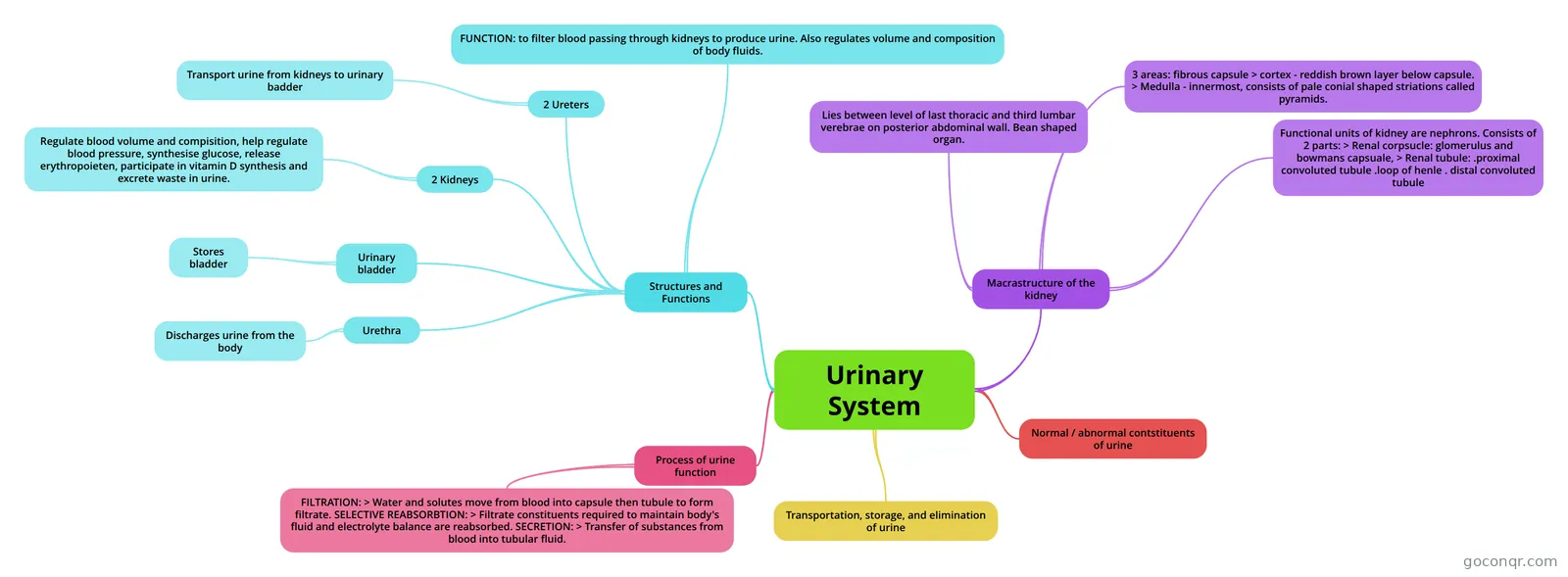 Urinary System
-
Regulation of Water Balance ( Osmolarity )
Flashcards
See all 44 flashcards-
33 cardsBRS Renal and Acid-Base Physiology Secretion of K+ by the distal tubule will be decreased by
-
31 cardsOCR F214 - Excretion What is excretion?
-
98 cardsTopic XV What are the functions of the kidneys?
-
69 cardsAspects of Renal Physiology From the 12/11/13 Human Physiology lecture.
-
40 cardsRenal Structure and Function 1 1. Outline the general organisation of the kidney, ureter, bladder and urethra. 2. Identify the parts of th...
-
63 cardsUrine Concentration What acts as counter-current multipliers?
-
28 cardsWeek 3 What is the key function of the thick ascending limb?
-
25 cardsBMS11-1038 Kidney Function IV: Regulation of Acid Base status Where are the three locations of renal acid/base handling?
Notes
-
GFR, Renal Clearance and Autoregulation of Renal Blood Flow Gomerular Filtration Rate'product of net filtration pressure across the glomerular filter and the filtration co-efficient (Kf)'Filtration co-efficient = product of fluid permeability of glomerular filter and the area ...
-
Aspects of Renal Physiology (12/11/13 lecture) Aspects of Renal Physiology (12/11/13 lecture) Kidneys are Roles of the kidneys include: excretion of waste products (e.g. urea); excretion of foreign compounds (e.g. xenobiotics); control of erythrocyte number via er...
-
Kidneys - created from Mind Map * The kidneys perform essential functions of removing waste products in the body. Regulation of the water, electrolyte and acid base balance Excretions of products of protein and nucleic acid metabolism - urea, creati...
-
Renal Data Handling Exercise (18/11/13 prac) Renal Data Handling Exercise (18/11/13 prac) · In place of creatinine, inulin can be used to determine glomerular filtration rate. It is more accurate than creatinine be...
-
Renal Hormones 1. ADH changes the water permeability in the convoluted tubules and collecting duct walls whilst aldosterone causes the convoluted tubules to reabsorb more sodium ions and decrease the reabsorption of potassium ions.2...
-
BP and the RAAS System BP = CO (HR x SV) x TPR From K & C p566.
More Physiology topics
About Renal Physiology and the Urinary System
GoConqr OriginalWhat this unit covers
The resources follow the kidney from gross anatomy to fine control of body fluids. The mind map structure of nephron separates cortical from juxtamedullary nephrons and describes the peritubular capillaries. Glomerular filtration, tubularReabsorption and tubular Secretion then links the three processes that make urine.
Where to start
Begin with the basics. The mind maps Urinary System and Overview of renal physiology give you the layout, and the quiz The Kidney: Filtration, Reabsorption and Secretion asks you to label the kidney, the nephron and the renal corpuscle. Next, move to the flashcard decks on glomerular filtration and on reabsorption and secretion.
Water, hormones and electrolytes
Once the nephron makes sense, turn to control. The Urine concentration mind map covers the loop of Henle, the countercurrent multiplier and variable reabsorption of water. Regulation of Water Balance ( Osmolarity ) explains why sodium content is not the same as osmolarity, using an isotonic saline drip as an example. ADH - Anti-Diuretic Hormone and Hormones of the kidney cover vasopressin and the renin-angiotensin-aldosterone system, and several flowcharts show the RAAS pathway, ANP and aldosterone control of sodium and potassium. The mind maps on Na+, K+ and Ca2+ in the kidney deal with each ion in turn.
Using quizzes and maps together
- Read a mind map first, then close it and take a quiz on the same topic.
- Note the questions you miss and return to the matching map or notes.
- Use flashcards such as BRS Renal and Acid-Base Physiology for practice questions on potassium secretion and water loads.
- Finish with a longer paper, such as the quiz Renal Practice Exam.
Where it fits
This unit sits in the strand Renal Physiology, Fluids and Acid-Base, within Physiology. It includes resources on acid handling in the kidney and on renal function tests. Choose one topic today, try a quiz, and then build a map or deck of your own.
Frequently asked questions
Which resource should I open first?
Start with the mind map Urinary System for the overall structure, then take the quiz The Kidney: Filtration, Reabsorption and Secretion. It asks you to label the kidney, the nephron and the renal corpuscle, so it shows quickly what you already know and what needs another look.
What do the mind maps cover?
There are over 250 of them. They cover nephron structure, urine concentration, water balance and osmolarity, ADH, the renin-angiotensin-aldosterone system, kidney hormones, sodium, potassium and calcium handling, urea and creatinine, and acute kidney injury. Several are titled Kidney and Body Fluids, with numbered parts.
Are these resources free to use?
Yes. Every resource listed here is free to open, study and take, with no account needed. They were made by GoConqr users, not by GoConqr itself. A free account also saves your quiz scores and lets you create your own quizzes, mind maps, flashcards and notes.
Who are these resources for?
Almost all of them are university level, so they suit university students and professional candidates, and teachers looking for ready-made material. One listed resource mentions the MCAT. Check the title and contents of each one to see whether it matches your course.
Is there anything on acid-base balance?
Yes. Look at the flashcard decks Acid handling in the kidney and Role of the kidneys in acid-base regulation, the quiz acid and base balance, and the notes titled Acid base kidneys. BRS Renal and Acid-Base Physiology adds practice questions.
Which resources help with revision for exams?
Try the quizzes Renal Practice Exam and Renal Exam for exam-style practice, and the flashcard deck Renal System Questions. The quiz Physiology Final Exam Part 2 also includes kidney material. Use maps beforehand to refresh the concepts.