
Flashcards
A level Physics
Cards in this deck (69)
- 1What is the charge and mass of a proton?Charge = 1.67 X 10^-19 c
Mass = 1.60 X 10^-27 kg - 2What is the mass of a neutron?1.67 X 10^-19 kg
- 3What is the mass and charge of an electron?Charge = -1.60 X 10^-19
Mass = 9.1 X 10^-31 - 4What is the role of the strong nuclear force?To keep the nucleus stable
- 5What is its attraction and repulsion range?Attraction range is 3 fm, repulsion is 0.5 fm
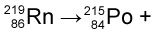
- 6—

- 7—
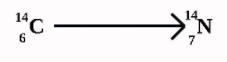
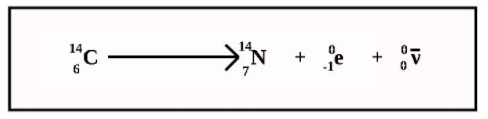
- 8—


- 9Why was the existence of the neutrino hypothesised?To account for conservation of energy in beta decay.
- 10What are the anti particles of the proton , electron ,neutron and neutrino?Antiproton ,Positron ,Antineutron , Antineutrino
- 11What occurs when a particle and an antiparticle meet?They annihilate each other and a photon is released
- 12What happens when a photon meets a nucleus?An antiparticle and a particle are released
- 13What are the four fundamental forces?gravity ,electromagnetic ,weak nuclear and strong nuclear
- 14What is the exchange particle for electromagnetic force?Virtual photon
- 15what is the exchange particle for weak nuclearW-, W+ and Z^0 bosons
- 16What is the exchange particle for strong nuclear?The pion
- 17—Electromagnetic interaction
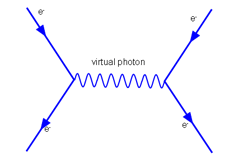
- 18—Beta minus interaction
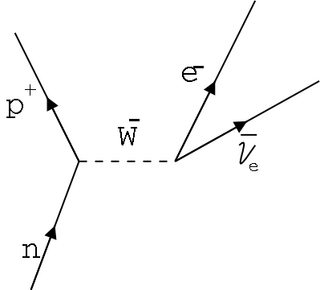
- 19—Beta plus interaction
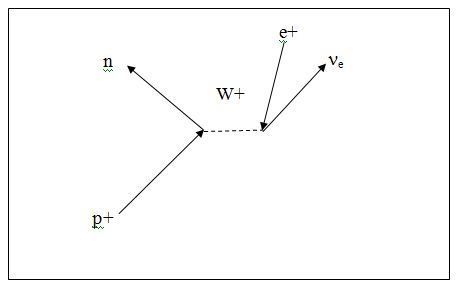
- 20—Electron capute
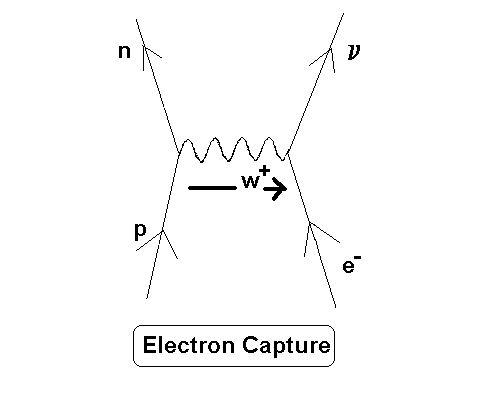
- 21—Electron proton collision
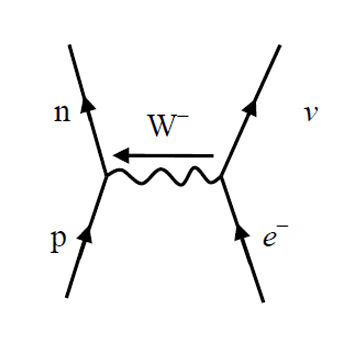
- 22What are the two classes of hadrons?Baryons and Mesons
- 23Which is the only stable baryon?The proton
- 24What do all other baryons decay into?The proton
- 25Name all the baryons including antiparticlesProton, Antiproton, neutron and antineutron
- 26Name all the mesonspion and kaon
- 27Name all the leptons including antiparticlesElectron, muon, neutrino, tau, positron, anti-muon, anti-tau and anti-neutrino
- 28What are the 4 numbers that need to be conserved in equations?Charge, Lepton number, baryon number and strangeness
- 29What are the quark compositions of the proton, neutron, antineutron, antiproton, pion and kaonProton U, U, D
neutron U, D, D
Antiproton AU, AU, AD
Antineutron AU, AD, AD
Kaon U, S
Pion U, D - 30What is the threshold frequency?Threshold frequency is defined as the minimum frequency of incident light which can cause photo electric emission
- 31What is the work function?the minimum quantity of energy which is required to remove an electron from the surface of a given solid.
- 32What is the Photoelectric equation.h f = Φ + Ek (max)
- 33What is Ek (max )The maximum kinetic energy of photoelectrons.
- 34What is ionisation and excitation in a fluorescent tube?In fluorescent tubes a gas has an electric current pass though it. This causes electrons to become excited and ionise. When electrons return towards the ground state they lose energy which is emitted as UV radiation. This radiation is absorbed by the coating in the tube which emits visible light.
- 35How do you convert eV to J1 eV = 1.60218e-19
- 36What happens in photon emission?
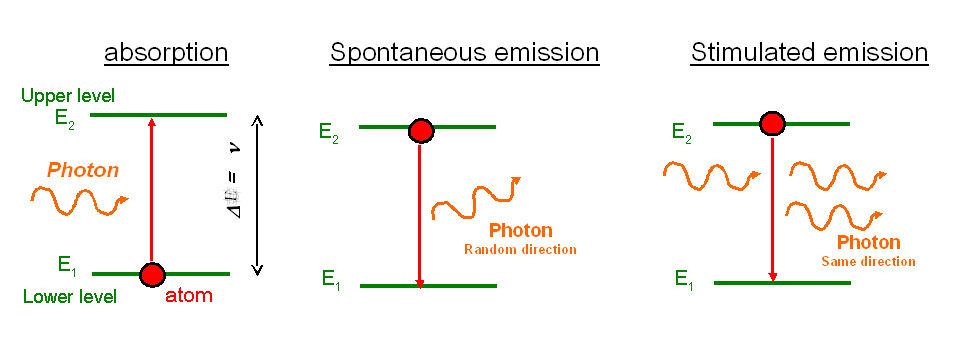
- 37What does the electron diffraction and photoelectric effect suggest?Electron diffraction suggests that
particles possess wave properties and the photoelectric effect suggests that electromagnetic waves have a
particulate nature. - 38What is the de Broglie wavelength equation?λ = h
mv
where mv is the momentum - 39What is amplitude, frequency and wavelength in terms of wavesAmplitude is the point of maximum displacement.
Frequency is the amount of waves that pass a set point per second
Wavelength is the length of a wave from two similar points e.g. peak to peak or trough to trough - 40What is Phase diffrencePhase difference is how far two points are from each other measure in degrees radians or as fractions of a cycle for example if point a is at a wave peak and point b is at a trough of the same wave then the phase difference is 180 degrees
- 41What are longitudinal and transverse waves?Longitudinal waves are waves where the oscillations are parallel to the movement of the wave
Transverse waves are waves where the oscillations are perpendicular to the movement of the wave - 42What are examples of longitudinal waves?Sounds waves and seismic P-waves (created by earthquakes and explosions).
- 43What are examples of transverse waves?vibrations in strings, ripples on water surface and electromagnetic waves.
- 44What does polarised waves mean?The vibrations occur on a single plane
- 45give aplications of polarisersPolaroid material and
the alignment of aerials for transmission and reception. - 46What are stationary waves?a vibration of a system in which some particular points remain fixed while others between them vibrate with the maximum amplitude.
- 47What are nodes and an anti nodes?nodes are the points at which there is no displacement. Anti nodes are the points where the wave is at maximum displacement.
- 48What are the equations for the first for harmonics?
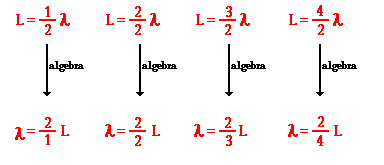
- 49How are stationary waves formed?standing wave patterns are produced as the result of the repeated interference of two waves of identical frequency while moving in opposite directions along the same medium.
- 50Give three examples of stationary wavesA piece of string with a fixed end, microwaves and sound waves
- 51What is path difference?Path difference is the difference in the total waves between a given point and two sources.
- 52What is phase difference?how many degrees or radians two points are apart from each other on a stationary wave
- 53What is coherence?coherence is when two waves have a constant wave difference and have the same frequency
- 54Give the name and power of all these prefixes : T, G, M, k, c, m, μ, n, p, fT = Terra = 10^12
G = Giga = 10^9
M = Mega = 10^6
K = kilo = 10^3
c = centi = 10^-2
m = milli = 10^-3
μ = micro = 10^-6
n = nano = 10^-9
p = pico = 10^-12
f = femto = 10^-15 - 55Name all the si units and their quantitiesMetre = length
Kilogram = Mass
seconds = time
ampere = electric current
kelvin = temperature
mole = amount of a substance - 56What is random and systematic errorRandom is error is your inaccuracy is random whilst systematic is your inaccuracy follows a pattern
- 57Define precisionPrecision is how close values are to the mean values
- 58Define repeatabillityHow easy it is for the original person who did the experiment to do it again.
- 59Define reproducibilityHow easy it is for another person to repeat the experiment
- 60Define resolutionThe smallest increment increase on the instrument being used to measure the quantity
- 61Define accuracyAccuracy is how close a value is to the true value
- 62Define uncertaintyThe range within which the true value can be expected to be.
- 63Define absolute, fractional and percentage uncertaintyThe absolute uncertainty is the half the smallest increment used on the measuring instrument this is doubled if the measurement is made at two points. The fractional uncertainty is the absolute uncertainty divided by the mean. The percentage uncertainty is the fractional uncertainty multiplied by 100
- 64What are the similarities and differences between a particle's and a antiparticle's rest mass, rest energy and chargeThey have the same rest mass and rest energy but have opposite charges
- 65What do exchange particles do?They act out forces between elementary particles
- 66Which class off subatomic particles is affected by the strong nuclear force?Hadrons
- 67What does the muon decay into?An electron
- 68What does the neutron decay into?A proton an electron and an antineutrino
- 69What is stopping potential?The potential required to stop all the electrons from getting to the other plate
Information
- Description
- Flashcards on A level Physics, created by daniel upton on 03/01/2018.
- Created by
- daniel upton
- Views
- 1
- Rating