
Flashcards
OCR Chemistry Module 2
Cards in this deck (43)
- 1IsotopeThe same element with different amount of neutrons & different masses.
- 2IonA charged particle. Cations are positive, anions negative.
- 3Relative Atomic MassThe weighted mean mass of an atom compared with 1/12th mass of carbon-12.
- 4Relative Isotopic MassThe mass of an isotope compared with 1/12th mass of carbon-12.
- 5Relative Molecular MassThe weighted mean mass of a molecule compared with 1/12th mass of carbon-12.
- 6Relative Formula MassThe weighted mean mass of a formula compared with 1/12th mass of carbon-12.
- 7How could you work out relative atomic mass experimentally?Using a mass spectrometer. Sample placed, vapourised & ionised by an electron beam (+ve ions). Ions accelerated into magnets, heavier ones harder to deflect & isotopes separated. Detected on mass spectrum as m/z. Higher abundance = higher signal.
- 8What is the equation for relative atomic mass?% abundance x mass (of all isotopes) / 100
- 9Avogadro's Constant6.02 x 10^23
- 10Mole equationsn = m / Mr
n = V / 24
n = c x v / 1000 - 11Molecular FormulaThe number of atoms of an element in a molecule.
- 12Empirical FormulaThe simplest whole number ratio of atoms in a compound.
- 13Hydrated CompoundWater molecules are part of the crystalline structure (water of crystallisation).
- 14Ideal Gas Equationp(Pa) x V(m^3) = n x R(8.314) x T(K)
- 15% yield% yield = actual / theoretical x 100
- 16Atom Economyatom economy = sum desired / sum all x 100
- 17Strong AcidReleases all H+ & completely dissociates.
- 18Weak AcidDoesn't release all H+ & only partially dissociates.
- 19How would you carry out a titration?1) Add measured vol of solution to conical flask & other to burette.
2) Add indicator & run burette into flask. Swirl to mix.
3) Stop when changes colour. Record vol in burette.
4) Work out titre & repeat until concordant. - 20Oxidation & ReductionReduction = gain of electrons & dec of oxidation number.
Oxidation = loss of electrons & inc of oxidation number. - 21Atomic OrbitalRegion around the nucleus holding up to 2 electrons with opposite spins. High probability of finding an electron.
- 22S-OrbitalSphere. 1 or 2 electrons. Each shell has 1 s-orbital. Greater shell number = greater S radius.
- 23P-OrbitalDumb-bell. 3 orbitals at right angles to each other. Each shell from n = 2 has 3 p-orbitals. Greater shell number = further from nucleus.
- 24D & F-OrbitalsD --> each shell from n = 3 has 5.
F --> each shell from n = 4 has 7. - 25How do orbitals fill?In order of inc energy. Each new sub-shell has higher energy. 3d is higher than 4s so 4s fills first then empties first. 1 elecron occupies each orbital before pairing.
- 26What is ionic bonding and what are the properties of an ionic compound?Electrostatic attraction between +ve metal ions & -ve non-metal ions. Forms a giant ionic lattice.
Have a high mp & bp, are soluble in polar solvents & don't conduct elec when solid but do when liquid/molten. - 27What is covalent bonding?The strong electrostatic attraction between a shared pair of electrons & both non-metal nuclei. It is localised.
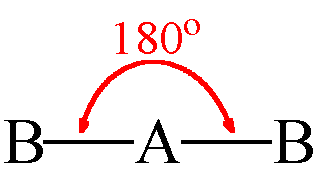
- 28Draw a linear molecule. Include bond angle & why it makes that shape.It has 2 bonding pairs of electrons that repel equally.
- 29Draw a trigonal planar molecule. Include bond angle & why it makes that shape.It has 3 bonding pairs that all repel equally.
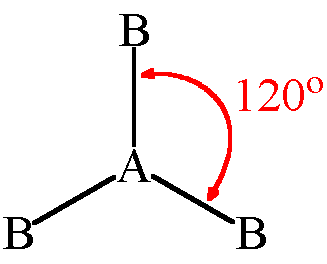
- 30Draw a tetrahedral molecule. Include bond angle & why it makes that shape.It has 4 bonding pairs that all repel equally.
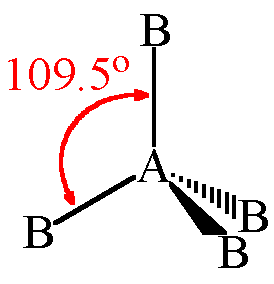
- 31Draw an octahedral molecule. Include bond angle & why it makes that shape.It has 6 bonding pairs that all repel equally.
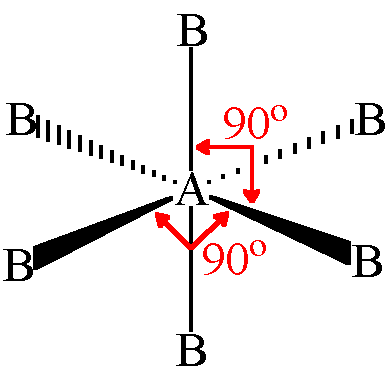
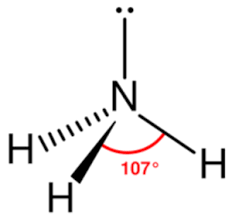
- 32Draw a pyramidal molecule. Include bond angle & why it makes that shape.It has 3 bonding pairs and 1 lone pair that repels more than the bonding pairs.
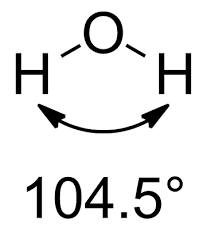
- 33Draw a non linear molecule. Include bond angle & why it makes that shape.It has 2 bonding pairs & 2 lone pairs that repel more than the bonding pairs.
- 34ElectronegativityThe ability of an atom to attract the bonding electrons in a covalent bond.
- 35When is a bond polar?When the bonding electrons are more attracted to one atom than another.
- 36When is a molecule polar?If the molecule is not symmetrical on every plane --> the dipoles reinforce each other to create a larger dipole.
- 37What are London Forces?Electrons constantly moving create an instantaneous dipole in an atom/molecule. This induces a dipole in the neighbouring atom/molecule. Further dipoles are induced & they attract each other.
- 38When are London Forces greater?When a molecule has more electrons there are larger dipoles therefore greater London Forces & stronger attraction.
- 39What are permanent dipole-dipole interactions?They act between permanent dipoles in polar molecules.
- 40What are the features of simple molecular substances?Solid --> simple molecular lattice held by weak IM forces & strong covalent bonds.
Low mp & bp as IM forces broken easily.
Non polar --> soluble in non polar solvents.
No mobile charge carriers --> don't conduct elec. - 41What is hydrogen bonding?Permanent dipole-dipole interaction between molecules with an electronegative atom with a lone pair of electrons (O, N, F) & a hydrogen atom attached to an electronegative atom (H-O, H-N, H-F).
Strongest IM force. - 42Why is ice less dense than water?H2 bonds hold water molecules apart in open lattice, less dense. 4 h2 bonds extend outwards & form an open tetrahedral lattice full of holes.
- 43Why does water have a relatively high mp & bp?It has H2 bonds as well as London forces so more energy is needed to break the H2 bonds.
Information
- Description
- Flashcards on OCR Chemistry Module 2, created by Amy Kerby on 22/02/2018.
- Created by
- Amy Kerby
- Views
- 3
- Rating