
Flashcards
Paper 1 GCSE Computing
Cards in this deck (51)
- 1What is the purpose of the CPU ?The CPU fetches instructions, decodes them and then executes them.
- 2What is meant by the term Clock Speed ?This is the number of instructions that are processed each seconds (number of complete cycles).
- 3What does the phrase quad core mean ?This means that the CPU has four independent processors within the CPU. This has benefits such as multi-tasking across cores.
- 4What is the CU (control unit) ?This controls the other components of the CPU.
- 5What is the Clock ?The clock regulates the rate at which instructions are carried out.
- 6What is the ALU (Arithmetic Logic Unit) ?This carries out arithmetic and logic based operations such as addition and subtraction and comparing different numbers.
- 7What is the Cache ?The cache stores frequently used instructions and data so that the processor does not have to take as long by transferring them from main memory.
- 8What are registers ?These are memory locations. Sometimes they perform special functions in the fetch, decode and execute cycle. Such as the memory data register (a temporary store for anything copied from memory), program counter (holds the addresses for the next instructions), accumulator (stores the results of the ALU) and the memory address register (holds the address of memory locations currently being fetched or written to).
- 9What is an embedded system ?This is a computer system built into another device to control it. These are usually for devices that only carry out a small range of tasks so does not need to be very powerful, such as a washing machine.
- 10What is the RAM ?The RAM (random access memory) is where the computer stores data and instructions for currently running applications.
- 11What is ROM ?The ROM (read only memory) stores data and instructions that don't change such as the boot up procedures for the computer.
- 12Define the term volatile ?Volatile means that the data is lost when the power is turned off. An example of this memory is RAM. An example of non-volatile is ROM.
- 13What is virtual memory ?Virtual memory is a section of the hard disk drive or solid state drive that is used as temporary memory when the RAM is full.
- 14What is and give an example of primary storage ?Primary storage is memory that the CPU can quickly access such as RAM, ROM and cache.
- 15What is an give an example of secondary storage ?This is where the OS, apps and files are stored when the system is not in use such as SSD, HDD, CD and SD cards.
- 16List the units of data in ascending order from bits to petabytes.Bit - smallest unit 0 or 1
Nibble - 4 bits / half a byte
Byte - 8 bits
Kilobyte - 1024 bytes
Megabyte - 1024 kilobytes
Gigabyte - 1024 megabytes
Terabyte - 1024 gigabytes
Petabyte - 1024 terabytes - 17What is a LAN ?A LAN or local area network cover local areas such as homes/a smaller area network.
- 18What is a WAN ?A WAN or wide area network covers a large geographical area and example of this is the internet.
- 19What is the difference between a hub and a switch ?A switch is an intelligent device which connects nodes on a network and selects what data goes to what node on the network. A hub connects the nodes to the network but shares data to all of them this is less expensive but also is a security risk.
- 20What is a client server network ?This is when the nodes in a network connect to a server which can provide benefits such as higher security, file sharing and access rights.
- 21What is a peer to peer network ?This is when the nodes in a network are connected to each other. These are easier to set up with no additional hardware needed so is also cheaper.
- 22What is bandwidth ?This is the amount of data that can be transferred between two points in a network device per second. This is measure in bits per second.
- 23What can affect bandwidth speed ?The quality of the transmission media such as wired over wireless. Or interference from external devices such as other electronic devices.
- 24What is the internet and the WWW ?The internet is the physical hardware, wifi routers, ethernet switches.
WWW (world wide web) uses the internet (the technology) to publish web pages, web servers, email. - 25What is a DNS ?Domain name server is a database of IP addresses. When you search a website through a web address the DNS translates this into the IP address of the server. This means that we don't need to know the IP address of what we are trying to connect to.
- 26What is a virtual network ?A virtual network uses software to divide a LAN into smaller groups. The LAN is still connected by cables but the virtual network is restricted from accessing other computers on the network. This can allows specific groups of users to share data.
- 27What is a virtual private network ?With the correct software this allows for virtual networks over a large geographical area. This creates a secure connection by encrypting the data packets so only people on the network can read them. This can be done over a public WAN.
- 28What is a network topology and give two examples ?This is the layout/structure of the devices in a network. Star and Mesh.
- 29How can you identify an IP address ?Is 4 bytes within the range of 0-255 separated by full stops.
- 30How can you identify a mac address ?Is 6 pairs of hexadecimal numbers separated by colons.
- 31What are network protocols ?A set of rules that determine communication over a network.
- 32What is POP ?POP - post office protocol, means emails can be downloaded and deleted from a mail server and viewed offline by an email client.
- 33What is IMAP ?IMAP - internet message access protocol. This is similar to pop however unlike pop emails remain on the server after being downloaded to another device. This allows for multiple devices to view the same emails. Advantages of this are multiple devices, flag emails (read or not) complex searches.
- 34What is SMTP ?SMTP - simple mail transport protocol. This is used the mail server to send and receive emails from all other mail servers.
- 35What is TCP ?TCP - transmission control protocol. This prepares messages for sending and reassembles received messages. This includes dividing into packets, sequence numbers (reassembly order).
- 36What is IP ?IP - internet protocol. This protocol is responsible for providing the destination and to recognise incoming packets.
- 37What is the four layer model ?Is a conceptual model that shows how the different protocols interact with each other. One layer can only interact with those immediately above and below it. This goes from network link access (layer 1), internet layer(layer 2), transport layer
(layer 3), application layer (layer 4). - 38What is packet switching ?Is a method of sending data across a network. This involves breaking data into smaller parts (data packets) these are sent and then reassembled. Each packet is assigned a number to assembled in if one is missing or corrupt then a new one is requested.
- 39What are the three pieces of information are headers on a packet of data ?A return address / where it came from.
A destination address / where it is going.
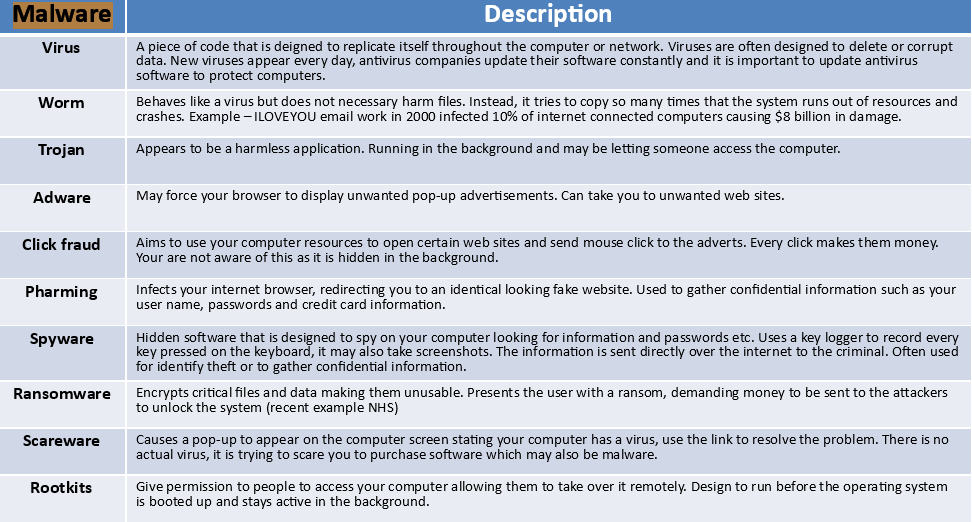
A packet number or sequence number / the order it will be reassembled in. - 40List various forms of malware on a computer and describe them. As many as you can.
- 41Describe social engineering ?A type of attack where a person is targeted rather than hardware or software. Examples include:
Bribing a user into allowing an attacker to access a system - 42Describe phishing ?Involves contacting such as e-mail pretending to be someone else (usually an authority figure). The attacker uses the fake authority to convince users to give up sensitive information such as passwords, bank account details. Example: email received stating your bank account is suspended, use the link below to reset your account login details. The link is to a fake website.
- 43Describe brute force ?A computer program is written to go through every possible combination of characters until the right one comes up. This method relies on be able to automatically try many different combinations, this can be prevented by limiting the number of attempts a user can logon within a certain time period. Dictionary attack is where the most popular words are used.
- 44Describe a denial of service ?This is a method of preventing legitimate users from connecting to a server. It floods the targeted server with millions of requests, so many that the server memory is used up and the server crashes.
- 45Describe data interception ?When data is moving across a network or the internet, data packets may be intercepted. An extra server or router is placed on the network so packets from the target computer are re-directed, copied and sent on. Encrypting each data packet is effective to protect against this form of attack.
- 46Describe an SQL injection ?This is a form of database attack with the aim of getting access to confidential information. When a user inputs their login details, an SQL request to the database is sent. The attacker tries to insert extra SQL commands into the input boxes hoping they will be carried out by the server. To validate the information properly is a way to protect against this form of attack.
- 47Describe poor policy ?The network administrator should have a security policy in place to safeguard the network. The policy may state; passwords must be hard to guess, user access levels, keeping login detail private, confidential emails and files should be encrypted, no use of unauthorised devices and memory sticks on the network.
Uses often have to sign an ACCEPTABLE USE document. - 48List ten methods to reduce security risks.anti-malware
firewalls
encryption
passwords
acceptable use policy
backup
disaster recovery
penetration testing
network forensics - 49Describe malware ?Malicious software, to disrupt computer operations (virus) or monitor what the user is doing (spyware)
Examples: Virus, Trojan, Spyware, Adware, Ransomware - 50What is penetration testing ?This usually involves hiring an external company to attempt to breach a network to locate any vulnerabilities.
- 51What is network forensics ?This involves reviewing the actions on a network such as using a data logger to see the transfer and receiving of data on the network.
Information
- Description
- Year 11 Computing Flashcards on Paper 1 GCSE Computing, created by cameron barton on 23/04/2018.
- Created by
- cameron barton
- Views
- 0
- Tags
- Rating