
Flashcards
18. Human Resource Development
Cards in this deck (15)
- 1The importance of knowledge in HRMIt is all about knowledge.
A knowledge economy: Where value is created from exploiting knowledge and technology rather than physical assets and manual labour (Levy et al., 2011). So…
→ Knowledge workers.
→ Knowledge-intensive work.
→ Knowledge as a strategic capability.
→ Knowing what and knowing how (competencies).
⇒ But to which extent is ‘managing knowledge’ possible? - 2Forms of knowledge• Codified knowledge (e.g. Glasgow is in Scotland → explicit).
• Tacit knowledge (e.g. the ability to play an instrument → inexplicit).
• Gut feeling? - 3What is human resource development?Human resource development (HRD) is ‘planned and systematic modification of behaviour through learning events, programmes and instructions that enable individuals to achieve the levels of knowledge, skill and competence needed to carry out their work effectively’ (Armstrong, 2006).
- 4The role of HRD At a national level• Investment in human capital is viewed as the foundation for success in the ‘knowledge economy’ (Thompson, 2004).
• Appropriate skills/knowledge is needed (UKCSES, 2011). - 5The role of HRD At an organisational level• High skill levels combined with high discretion in work and decision-making is linked to improved performance (Camps and Luna-Arocas, 2012).
• Continuous organisational learning is used as a source of adaptability and responsiveness to change. - 6The role of HRD At an individual level• Skills/knowledge and continuous learning are associated with continued employability (Beckett and Hager, 2015).
- 7From training to learning and development (L&D)→ Training is more of a ‘deficit model’, i.e. is there to fill gaps in capability.
→ Development is ‘the growth or realization of a person’s ability and potential through the provision of learning and educational experiences’ (Armstrong, 2006).
→ Kolb (2015) defines learning as ‘a major process of human adaptation’.
⇒ We have therefore created a ‘learning culture’ or ‘climate’, moving away form a ‘one size fits all’ approach to training which acknowledges diverse, individual learning styles. - 8Areas of potential HRD intervention(1) Cognitive capacities: ‘Beyond knowledge’, includes the development of imagination, creativity and decision-making.
(2) Capabilities: The discrete abilities or skills involved in effective performance, including capabilities in dealing with ‘data’, ‘people’ and ‘things’.
(3) Behaviours: Developed through learning and development to change attitudes, develop values and ‘emotional intelligence’.
(Gibb, 2002) - 9Strategic HRD includes...→ Integration of HRD with organisational missions and goals (vertical integration).
• Lack of clarity is a common barrier to alignment (CIPD, 2015).
→ Line manager commitment and involvement.
→ The existence of complementary HRM activities (horizontal integration).
→ Expanded trainer role.
→ Recognition of culture.
→ Emphasis on evaluation.
→ The importance of recruiting employees on the basis of their ability to learn and develop.
(Garavan, 1991) - 10Contemporary themes in HRD→ Learning organisations.
• Practices to enhance the learning of groups and individuals.
• Emphasize the importance of adaptation, innovation and creativity.
• Realizing the challenge to move on from the existing organizational culture and embedded ways of thinking and doing.
→ Organisational learning.
• ‘Communities of practice’
→ Employee ownership over personal learning.
→ Role of line managers in coaching, mentoring, etc.
→ E-learning/blended/technology-enhanced learning.
• Computer-based/online/web-based learning. - 11What to consider when designing and delivering HRD interventionsDecisions to be made – should HRD…
• Be in-house or externally provided?
• Be on-the-job or off-the-job?
• Be individual or collective?
• Focus on ‘facilitation’ vs ‘instruction’?
⇒ Furthermore, HRD should consider the role of interest groups. - 12Evaluation of HRD activity→ Most evaluations focus on learner and manager feedback.
→ Three in ten quantify the impact of L&D on productivity.
→ Organisations use a range of metrics to quantify the impact of L&D on productivity.
→ Evaluation data is most often used to update L&D interventions.
→ Barriers to evaluation: ‘Other business priorities’ followed by IT systems.
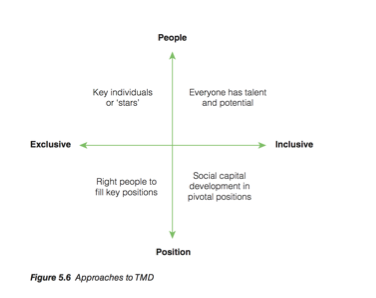
(CIPD, 2015) - 13Talent management→ The exclusive approach: Key individuals or stars are necessary for the organization’s success.
→ The inclusive approach: Everyone has talent and potential for high performance.
⇒ The approach used for talent management is guided by the cultural values of the business – everything should ‘fit’ with the corporate vision. - 14Coaching‘Coaching is mainly concerned with current performance and development issues, based on a relationship between a line manager and an employee, and structured around specific issues and goals’ (Bratton and Gold, 2017)
- 15What is HRD essentially about?Is HRD ultimately about performance, or learning and human development? (Rigg etal., 2007).
→ ‘Double loop learning’ (Argyris, 1977).
Information
- Description
- Business and Management 2B (Human Resource Management) Flashcards on 18. Human Resource Development, created by Nina Olsson on 30/04/2018.
- Created by
- Nina Olsson · Apr 2018
- Updated
- Apr 30, 2018
- Views
- 1
- Rating