
Flashcards
Exam Revision CIB
Cards in this deck (146)
- 1What is evolution?The unifying force that produced the diversity of life on Earth.
Bacteria
Flowering Plants
Mammals - 2What is Darwin's theory of Evolution?Organisms share many characteristics
All organisms descend from a common ancestor in the past - 3What is biological evolution?Any change in heritable traits of biological populations over successive generations
- 4What is a heritable trait?Any feature that is inherited from parent to offspring
- 5What is an aquired trait?Something that is picked up during a lifetime
- 6Why does evolution occur in biological populations, not individuals?Individuals cannot evolve, groups of individuals evolve
- 7What are the three ingredients for evolution?trait variation in a population
Trait must be heritable
variation in reproductive success in individuals - 8What is reproductive success?amount of offspring an individual produces through reproductive aid
→ Random (genetic drift in populations)
→ Non-random (= natural selection) - 9what are the 5 basic mechanisms for evolutionMutation
Migration
Sex/recombination
Genetic drift
Natural selection - 10What is a mutation'random' change in the DNA sequence of an individual
can be beneficial, neutral or harmful. - 11What is migration/gene flowmovement of individuals from one population to another
- 12What is sex/recombination?Sexual reproduction generates new combinations of genes by shuffling genetic variation
- 13What is genetic driftthe random process occurring in populations
more important in small populations - 14What is natural selection?Individuals vary in inherited traits
Not all individuals survive/reproduce to full potential
Those with inherited traits give them a greater chance of surviving and reproducing - 15What is adaptation?Process - the evolutionary process where an organism becomes better suited to its habitat
Product - Inherited characteristics of organisms that enhance their survival and reproduction - 16What is the artificial selection?Natural selection caused directly by humans
- 17What are Meristems and where will you find themPlant tissue that has active dividing cells forming new tissue:
In the shoot tip
in the roots - 18What is a Haustorium?Attachment points from the host to the parasite
Remove water and nutrients from host - 19What is a parasite?An organism that feeds on the cell content, tissues, or body fluids of another species while in or on the host organism.
- 20what happens in mitotic cell division1 cell gives rise to 2 daughter cells
Mitosis aims to partition the genetic material equally to the 2 daughter cells - 21What happens at ProphaseChromosome condensation
Nuclear envelope breakdown
Assembly of the mitotic spindle
Separation of the sister chromatids of each chromosome - 22What happens at MetaphaseAlignment of the condensed chromosomes on metaphase plate
Every chromosome aligns on the metaphase plate before separation begins - 23what happens at anaphaseDivision of the centromere
Separation of the sister chromatids of each chromosome to the opposite spindle poles - 24What happens at TelophaseDisassembly of the mitotic spindle
Reformation of the nuclear envelope
Chromosome de-condensation
division of the cytoplasm - 25What do cells need for growthRaw materials (CHNOPS)
Information (DNA, RNA)
Energy (from food) - 26What is the role of an autotrophConvert radiant energy into chemical energy.
- 27What is the role of a heterotrophLive on energy produced by autotrophs.
- 28What is metabolismterm used to describe all chemical reactions in an organism
Arises from interactions between molecules
Transforms matter and energy - 29What are the laws of thermodynamicsEnergy can be transferred and transformed
Energy cannot be created or destroyed - 30What is the regeneration of ATP

- 31What is energy couplingIs a key feature in the way cells manage their energy resources to do this work
- 32What is ATPATP is used to transfer energy for cellular activities
Energy is released when the terminal phosphate group is hydrolysed - 33What is the process of ATP hydrolysis

- 34What are the three types of cellular work

- 35How is metabolism arranged

- 36How do molecules move across membranesthe process of diffusion
causes net movement substances from regions of high concentration to regions of lower concentration.
Results in equilibration of concentration - 37What are the 4 mechanisms of Movement of molecules across membranes

- 38What are the Three Essential Characteristics of Facilitated DiffusionSpecific (selective)
Passive (requires no input of energy)
Saturates (non-linear dependence on concentration) - 39What does active transport requireinput of energy
the active transport moves molecules against their concentration gradients in uncharged molecules
Enables cells to gain molecules to higher concentrations than in extracellular fluid.
active transport moves molecules against concentration + electrical gradients in charged substances - 40What are the two steps of coupled transportEstablish the down gradient.
(Sodium-potassium or proton pump.)
Use this gradient to drive a molecule up a gradient
- 41In which organisms does photosynthesis occurPlants, prokaryotes, algae and certain protists
- 42What are the two possible routes for electron flow during the light reactions of photosynthesisNon-cyclic electron flow
Cyclic electron flow - 43What is cyclic electron flowUses only Ps I
Only generates ATP
Active in far-red light
Does not release O2 - 44What is non-cyclic electron flowUses both PS I & PS II
Generates ATP and NADPH
Releases O2 - 45Where does photosynthesis occurin chlorophyll located in the centre of a leaf (cross section)
- 46Why are not all wavelengths of light equally effective at driving photosynthesisLight for photosynthesis is absorbed by pigments
different pigments absorb different wavelengths - 47What is the difference between an action spectrum and an absorption spectrumAn action spectrum describes the wavelength of light that are the most effective at driving photosynthesis
An absorption spectrum describes the wavelengths of light that are absorbed by pigments - 48What is the most abundant protein on earth?Rubisco
- 49What reaction does Rubisco catalyse

- 50What is the product of carbon fixation?3-phosphoglycerate (3 carbons) = C3 photosynthesis
- 51What are the three stages of the calvin cycleCarbon fixation
Reduction
Regeneration - 52What are the inputs to the Calvin cycleMore ATP is needed than NADPH
ATP and NADPH are produced by non-cyclic electron flow
Extra ATP can be produced by cyclic electron - 53What is the flow of information in a cell? (Gene to Protein)DNA Replication
Transcription
RNA
Translation
Protein - 54What is the hierarchy of order prevails connected through the flow of informationCells
Tissues
Organs
Systems
Organism
Population - 55In Eukaryotes the chromosomes are an assembly of what?Histones, that form a chromatin
- 56genetic information is transmitted through what processreproduction through chromosomes
- 57what is the purpose of mutationDriver for evolutionary change. can be positive or negative
- 58what is the purpose of nucleotidessubunits are linked to form the nucleic acids, (RNA) and (DNA)
cell's storehouse of genetic information. - 59what is the Basic Structure of a Nucleotidesugar
one of four bases
and a phosphate. - 60what are the four Bases in DNAAdenine (A)
Guanine (G)
Thymine (T)
Cytosine (C) - 61what are the Essential Attributes of Genetic Material (DNA)Stability
Information
Replication - 62what is the DNA structureDNA molecule is a double helix
sugar-phosphate backbone
A-T, GC bonding with hydrogen bond
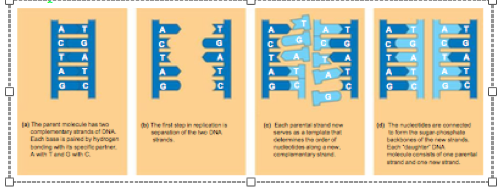
opposite polarity in strands - 63what does each newly replicated DNA double helix molecule containone parental strand and one daughter strand
- 64what is the process of DNA replication
- 65What is required for DNA ReplicationTemplate
Origin(s) of replication (oriR)
Primer
Enzyme(s)
Building Blocks - 66what is the purpose of the templateThe double helix untwists
builds two new strands
The template strand is ordered 3'-5' - 67what is the purpose of origins of replicationnucleotides that indicate the start of synthesis
synthesis proceeds in a bidirectional way of 2 advancing replication fo - 68what is the purpose of the enzymespolymerase enzyme can only synthesise DNA in a 5'-3' direction.
requires a pre-existing length of a double stranded nucleic acid with a free 3' OH - 69what is the purpose of the primera short piece of RNA is used to prime DNA synthesis to make DNA Pol to commence polymerisation.
- 70what is the purpose of the Building blocksFree nucleotides are required
where N=A or G or C or T - 71what does replication proceed through the formation ofLeading and
Lagging strands
This allows bi-directional replication to occur - 72what is the purpose of the leading and lagging strandsThe leading strand is synthesised continuously in direction of replication fork
DNA is unwound by a helicase
primase subunit lays down RNA primers on the lagging strand - 73what proteins are required during DNA replicationDNA Helicase
DNA Primase
DNA Polymerase
DNA Ligase - 74What is the DNA PolymeraseUses nucleotides as substrates
DNA polymerases cannot start a chain but can only extend from a pre-existing strand - 75what is the role of HelicaseHelicases bind at the replication fork and begin unwinding the double-stranded DNA
H-bonds are broken - 76what is the role of DNA primaseprimase can initiate new chains, but requires a DNA template
DNA Pol uses the RNA primer to commence DNA synthesis - 77what is the role of DNA ligaseJoins DNA fragments together to form continuous length of DNA.
Requires ATP to form a covalent bond - 78the replication forkThe leading strand is synthesis in a continuous fashion
A new RNA primer is used to generate each Okazaki fragment on the lagging strand - 79how does RNA differ from DNAPentose sugar in RNA contains a 2' OH group
RNA contains base Uracil - 80what are the three types of RNAtRNA
rRNA
mRNA - 81what are the requirements for transcriptionTemplate
Promoter
Enzyme
Building Blocks - 82what is needed for the synthesis of RNANon-template/coding strand
non-transcribed strand
Template/non-coding strand - 83what is a gene made up ofintrons and exons that encodes a specific RNA molecule.
- 84what are the three stages of Eukaryote mRNA Processing5'end is capped
Introns are removed and exons are spliced
3' end is tailed (poly A tail) - 85what is needed for transcriptionGene promoter
requires a DNA template strandand all four ribonucleotides - 86what does translation do?Produces a polypeptide from an mRNA molecule
- 87what are the properties of translationTriplet
Non-overlapping
Redundant excess coding capacity - 88Codon usage table

- 89Continuation of Codon Table61 codons specify a amino acid
3 codons are a signal to STOP translation - 90what is the purpose of mRNAmRNA carries the genetic message from the DNA to the protein
- 91what is the role of the 'adaptor' tRNA moleculeTransfer RNA (tRNA) transport and position amino acids
- 92What is the purpose of a ribosomeSite of translation
Composed of rRNA and proteins assemble to form small and large subunits - 93what are the three binding sites in tRNAThe P site
The A site
The E site - 94what forms the zygoteThe union of sperm and egg at fertilisation
- 95what are somatic cellsdo not give rise to the next generation
- 96what are Germline cellsgive rise to the next generation
- 97what happens prior to replication in the DNAeach nucleus contains 2 copies of the genome
DNA is then replicated before the chromosome divide - 98what happens during DNA replicationthe DNA amount in the nucleus is doubled
The two copies remain joined at the centromere and the chromosome is comprised of two genetically identical sister chromatids - 99What is diploidtwo chromosomes of each type (homologous pairs)
- 100what is haploidthey have only one chromosome of each type, their DNA is un-replicated
- 101what are the benefits of genetic variationimproves chances of survival for individuals
- 102what is diploidyfundamental to sexual reproduction
main driver of the evolution of eukaryotes - 103Are homologous chromosomes genetically identical or do they differ?genes on one homologue are in same order & look similar
- 104What are Allelestwo or more alternative forms of a gene that arise by mutation and are found at the same place on a chromosome.
- 105what are the key events in meiosisHomologous chromosome pair together and form structure with 4 chromatids
Bivalents align on metaphase plate
Homologues separate - 106What happens in Meiosis ProphaseMeiosis starts with a diploid cell
homologues PAIR together
chromosome of a homologous pair has two sister chromatids
Each homologue carries a replicated allele - 107what happens in Meiosis AnaphaseThe two homologues separate
One of each pair goes to opposite spindle pole - 108What happens in Meiosis IINo DNA replication occurs
Chromosomes line up again
Sister chromatids separate
Chromosomes decondense and cells divide - 109what does Meiosis II producefour haploid gametes with genotype a or A
- 110What happens at fertilisationOnly one sperm from the father can fertilise one egg.
- 111What do Bivalents doorientate randomly at metaphase I and separate randomly to the poles at anaphase I
- 112what happens during bivalent pairing at prophase Imaternal and paternal homologues can swap one or more sections of non-sister chromatid: 'crossing over'
- 113what does crossing over lead togenetic recombination and gives genetic variability to the gametes
- 114what is Homozygoustwo 'identical' alleles
- 115what is heterozygoustwo different alleles
- 116what is a homologueone pair of like chromosomes
- 117what is a dominant allelethe allele that determines the phenotype in a heterozygous organism
- 118what is a recessive allelethe allele that is 'hidden' in a heterozygous organism
- 119What is Mendel's 2nd law of geneticsalignment of one pair of homologues does not influence alignment of other pairs
Each pair of alleles segregate independently of other pairs of alleles during gamete formation - 120what is Mendel's first law of geneticslaw of segregation
The two alleles "segregate" at Anaphase I when the homologs segregate before being passed to the next generation - 121What happens in the mitotic cell cycle

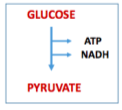
- 122What occurs in glycolysis
- 123What occurs in the citric acid cycle

- 124what is the role of the nucleolusRibosomes are synthesised
DNA is contained in chromatin (wrapped around proteins) - 125What is the role of the nucleusHouses chromosomes made out of chromatin (DNA and proteins)
contains nucleoli where ribosomal subunits are made
pores regulate entry and exit of materials - 126What are the two types of ERRough ER = ribosomes
Smooth ER = no ribosomes - 127What is the role of endoplasmic reticulumUses ribosomes to translate message from nucleus and form proteins that can be sent for modification
Smooth ER does not form proteins but it is the place where lipids are synthesised - 128What are ribosomes and what is their roleMade up of protein and RNA
Large subunit and small subunit
Synthesises protein
Ribosomes are attached to the endoplasmic reticulum - 129What is golgi and what is its roleStacks of flattened membranous sacs; has polarity
modification of proteins, carbohydrates on proteins, and phospholipids; synthesis of many polysaccharides; sorting of Golgi products - 130What are lysosomes and what is their functionThe membranous sac of hydrolytic enzymes (in animal cells)
Function: breakdown of ingested substances, cell macromolecules and damaged organelles for recycling
E.g. phagocytosis (lysosomes fusing with food vacuoles), autophagy (eating the cells) - 131What is a gametea mature haploid male or female germ cell which is able to unite with another of the opposite sex in sexual reproduction to form a zygote.
- 132What is a phenotypethe set of observable characteristics of an individual resulting from the interaction of its genotype with the environment.
- 133What is a genotypethe genetic constitution of an individual organism.
- 134How do you work out f1 progeny

- 135How do you work out F2 progeny

- 136What are sponges?Sponges are basal animals that lack true tissues and are porifera
- 137What are cnidarians?hydras, jellyfish, sea anemonies and corals
unique stinging structures housed in specialised cells, radially symmetrical, gastrovascular cavity - 138What are Lophotrochozoansflatworms, rotifers, snails, clams and squid
No digestive tract
head with ciliated crown
Feeding structured with ciliated tentacles
three body parts (muscular foot, visceral mass, mantle)
segmented body wall and internal organs - 139What are the EcdysozoansSegmented body, jointed appendages, exoskeleton made out of protein and chitin
Cylindrical bodies with tapered ends, no circulatory system - 140Why are Echinoderms and chordates deuterostomes?(Chordata)
Have a norochord, dorsal hollow nerve cord, pharyngeal slits, post-anal
Bilaterally symmetrical larvae, five part radial organisation as adults, unique water vascular system, endoskeleton - 141What do chordates have?Notochord and a dorsal, hollow nerve cord
- 142Are vertebrates chordates?Vertebrates are chordates that have a backbone
- 143What are Gnathostomesvertebrates that have jaws
- 144What are tetrapodsGnathostomes that have limbs
- 145What are amniotes?Amniotes are tetrapods that have a terrestrially adapted egg with four chambers and a hard shell
- 146Are Mammals amniotes?Mammals are amniotes that have hair and produce milk
Information
- Description
- Tertiary Concepts in Biology Flashcards on Exam Revision CIB, created by Olivia Gniadek on 18/06/2018.
- Created by
- Olivia Gniadek
- Views
- 2
- Rating
More on Population Genetics and Evolutionary Mechanisms