
Flashcards
Week 6
Cards in this deck (35)
- 1What type of response are the B and T lymphocytes involved in?B= humoral response
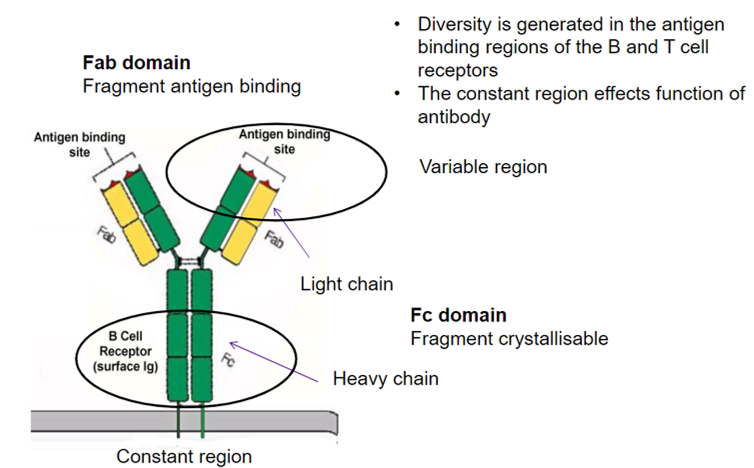
T= cellular response - 2Describe the structure of an antibody
- 3Difference between germline and somatic mutations?Germline: mutations that are genetically inherited
Somatic: genetic changes to a cell that are not passed on to offspring - 4Describe the germline coding for chains located on T/BCRs-V and D regions with joining J segments
-C are constant regions
-Light: V and J
-Heavy: V, D and J - 5Describe the order of gene rearrangement for B cells-Heavy chain rearranges its gene segment before the light chain
-Heavy chains: V, D and J gene segments
-Light chains: kappa/lambda- V and J only - 6Describe the order of gene rearrangement for T cells-Alpha and beta chains instead
-Beta chain rearranges first with V, D and J segments
-Alpha chains have V and J only - 7What is V, (D) and J rearrangement coordinated by?RAG
-Enzyme that excises and repairs DNA
-Excision leads to looping out of DNA segments - 8How are BCRs different to TCRs?-BCRs are secreted by the cell (become Ig or antibodies)
-Diverse when they leave the bone marrow but undergo further differentiation on encountering an antigen
-Bind with high affinity
-Able to recognise the entire antigen - 9How to TCRs work differently to BCRs?-Only recognise short aa sequences
-Pathogen has to be broken down into smaller peptides within an APC
-The APC presents the peptides on its MHC
-T cell then recognises antigen (slower response) - 10Describe MHC Class I-Present peptides derived from intracellular pathogens
-Binds to CD8 (cytotoxic) T cells
-All cells present it except RBCs - 11Describe MHC Class II-Present peptides derived from extracellular pathogens
-Binds to CD4 (helper) T cells
-Only present on APCs - 12What does TCR engagement result in?Activates the lymphocyte to proliferate and respond
- 13Describe the overview of the life of a B cell-Precursor rearranges its immunoglobulin genes
-Negative selection in the bone marrow
-Mature B cell bound to foreign antigen is activated in peripheral lymphoid organs
-Activated B cell create plasma/memory cells in bone marrow/lymphoid tissue - 14Describe the order of gene rearrangement in B cellsHeavy chain first (pro-B cell)
-D-J rearranging
-V-DJ rearranging
Light chain (pre-B cell)
-V-J rearranging - 15What is expressed in mature but naive B cells?IgM and IgD
- 16Describe the screening process for B cells-If it is a multivalent self molecule, cell undergoes apoptosis (recognises self)
-If it is a soluble self molecule, cell becomes anergic (non-responsive) - 17What immunoglobulins are involved in the T-independent/dependent response?T-independent: IgM, low affinity antibodies
T-dependent: IgM, IgG, IgA, IgE, high affinity antibodies, memory cells - 18Where is... located? IgM IgD IgG IgE IgANaive B cells, serum
Naive B cells
Memory B cells, serum
Mast cells, allergic response
Mucosa, serum - 19What is the order of prevalence of Ig in the serum? (IgM, IgD, IgG, IgE, IgA)IgG
IgA
IgM
IgD
IgE - 20How do IgM and IgA exist?IgM: pentamers
IgA: monomer in the blood but dimer for secretion - 21What is an epitope?-Part of an antigen which antibodies bind to
-Antigens can contain more than 1 epitope and so different antibodies can bind at once - 22Describe the antibody-dependent cellular cytotoxicity (ADCC) mechanism1) Antibody binds to antigens
2) Fc receptors on NK cells recognise bound antibody
3) Cross-linking of Fc receptors signals NK cell to kill target
4) Apoptosis of target cell - 23Summarise the functions of antibodies-Opsonisation
-Neutralisation
-Precipitation
-Complement activation (classical pathway)
-Direct cell activation by Fc receptors
-ADCC (NK activation) - 24What are 2 uses of antibodies in therapeutics?-Immunoglobulin replacement: passive administration of IgG
-Monoclonal antibodies eg. anti-TNF alpha therapy for RA - 25Where does negative selection of auto-reactive B cells take place?Bone marrow
- 26Consequence of Di George syndrome on immunity? Why?Thymus aplasia leads to no T lymphocytes and no cellular immune response
- 27What is positive selection?-Allows thymocytes with the potential to recognise foreign peptides with self-MHC to mature to functional T cells
-Cells which fail to recognise MHC molecules are not selected and die by a neglect mechanism - 28What is negative selection?-Removes potentially dangerous T cells that recognise self-peptides
-Induces apoptosis - 29Describe the cortex in the thymus-TCR gene rearrangement takes place
-Positive selection of T cells
-Immature T cells are present which express both CD4 and CD8 molecules - 30Describe the medulla in the thymus-Separated from the cortex by a cortico-medullary junction which contains macrophages and dendrites
-Successful TCR gene rearrangement is complete
-Additional rounds of negative selection occur - 31What is tolerance?Process of eliminating/neutralising self-reacting lymphocytes
- 32What is central tolerance?Mechanisms that lead to lymphocyte tolerance of self that occur in the primary lymphoid organs (thymus/bone marrow)
- 33What is peripheral tolerance?Mechanisms that contribute to self-tolerance in the periphery for T cells that have escaped previous mechanisms. Includes:
-regulatory T cells
-lack of co-stimulation
-auto-regulation by T cells themselves
-apoptosis - 34Describe Treg (T regulatory) cellsSuppress other T cells actively by blocking activation or inactively by release of anti-inflammatory cytokines
- 35What is AIRE? (Auto-Immune REgulator)-Gene/TF expressed by thymic epithelial cells
-Results in transcription of organ-specific genes
-Allows maturing thymocytes can be exposed to tissue specific antigens before being released into the circulation
Eg. AIRE directs insulin expression in the thymus so T-cells that recognise insulin undergo negative selection (no diabetes)
Information
- Description
- Recognition of antigen by the adapt immune system B cell development T cell development
- Created by
- Dolu Falowo
- Views
- 0
- Rating