
16147615
Description

Flashcards by Juliette Carroll, updated more than 1 year ago

|
Created by Juliette Carroll
about 7 years ago
|
|
| Question | Answer |
| Review diagram | |
| Which type of cell is histamine released from? | Mast cells |
| What is degranulation? How does it affect capillary permeability? | ~The release of granules contained within mast cells - these contain histamine ~Increases it |
| Where are mast cells mostly found? | Near external environment ie. skin and GI tract |
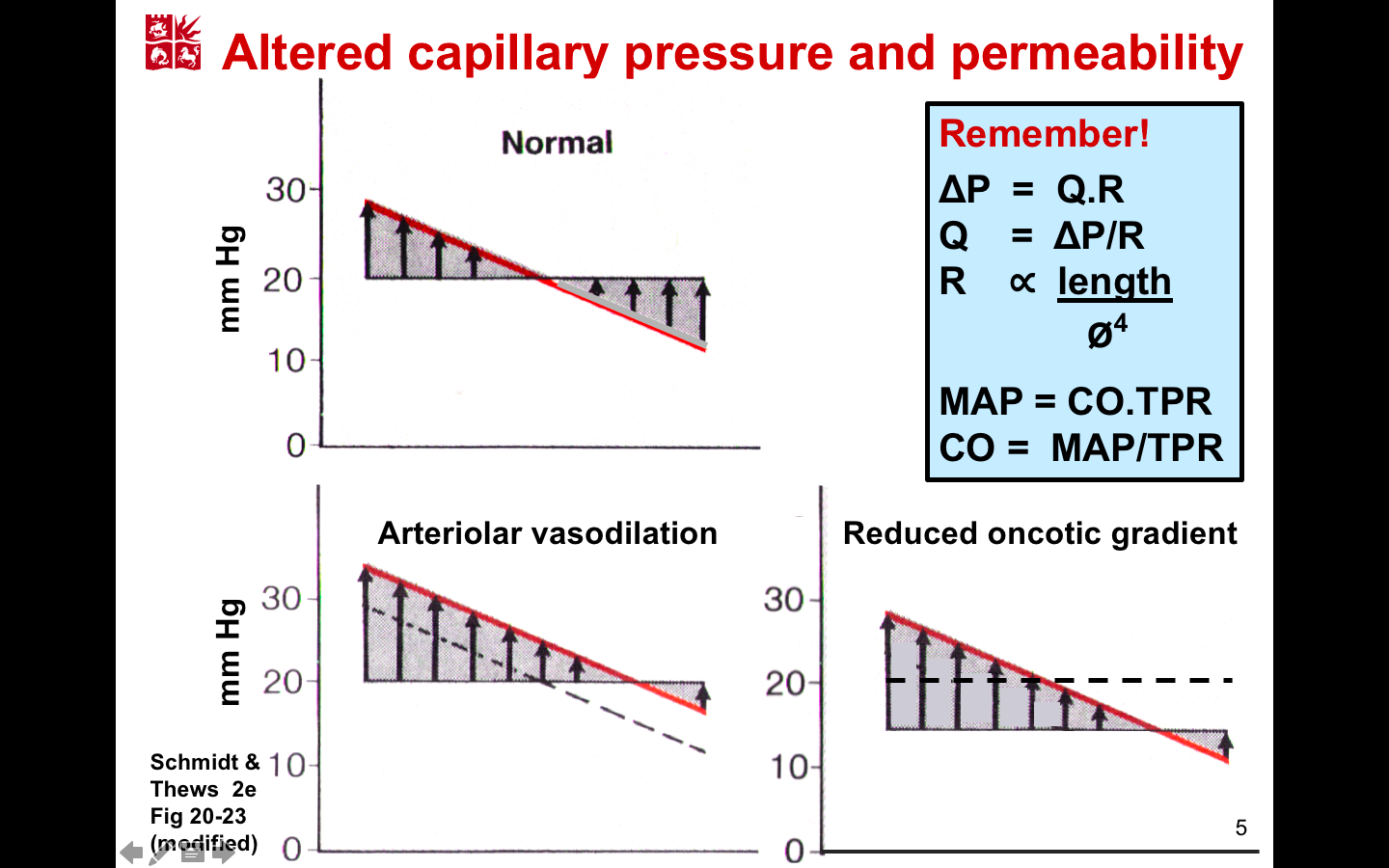
| What effect does increased capillary permeability have on the body? | Causes swelling |
| What happens when histamine is released from mast cells? | ~Redness ~Swelling ~Itching |
| What is orthodromic conduction? | The conduction of an AP in the direction it is expected/supposed to go in |
| Describe an axon reflex | ~Pain receptors detect stimulus ~Send AP in orthodromic direction ~At branches, some APs go in opposite direction back to skin ~Causes chemicals to be release (mainly peptides) to form inflammatory soup |
| Why is action "reflex" a misnomer? | A reflex by definition must involve the nervous system and this action doesn't |
| Review diagram. When does this happen? | |
| What happens if the capacity of the lymphatic system to carry fluid is exceeded? | Oedema |
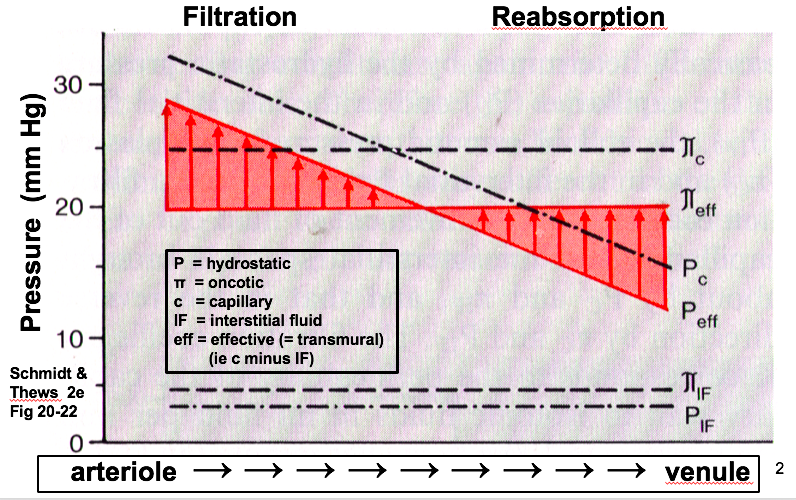
| What is hydrostatic pressure? | Force generate by by pressure of fluid within/outside capillary on capillary wall |
| What is the difference between hydrostatic and oncotic pressure? | ~Oncotic is pressure created by proteins in plasma ~Hydrostatic refers to force generated on BV walls by vol of blood |
| How does vasodilation affect VR? | Reduces it |
| How does an increase in capillary permeability affect the CVS? | Fluid lost into ISF |
| How does widespread vasocilation affect TPR? | Reduces it |
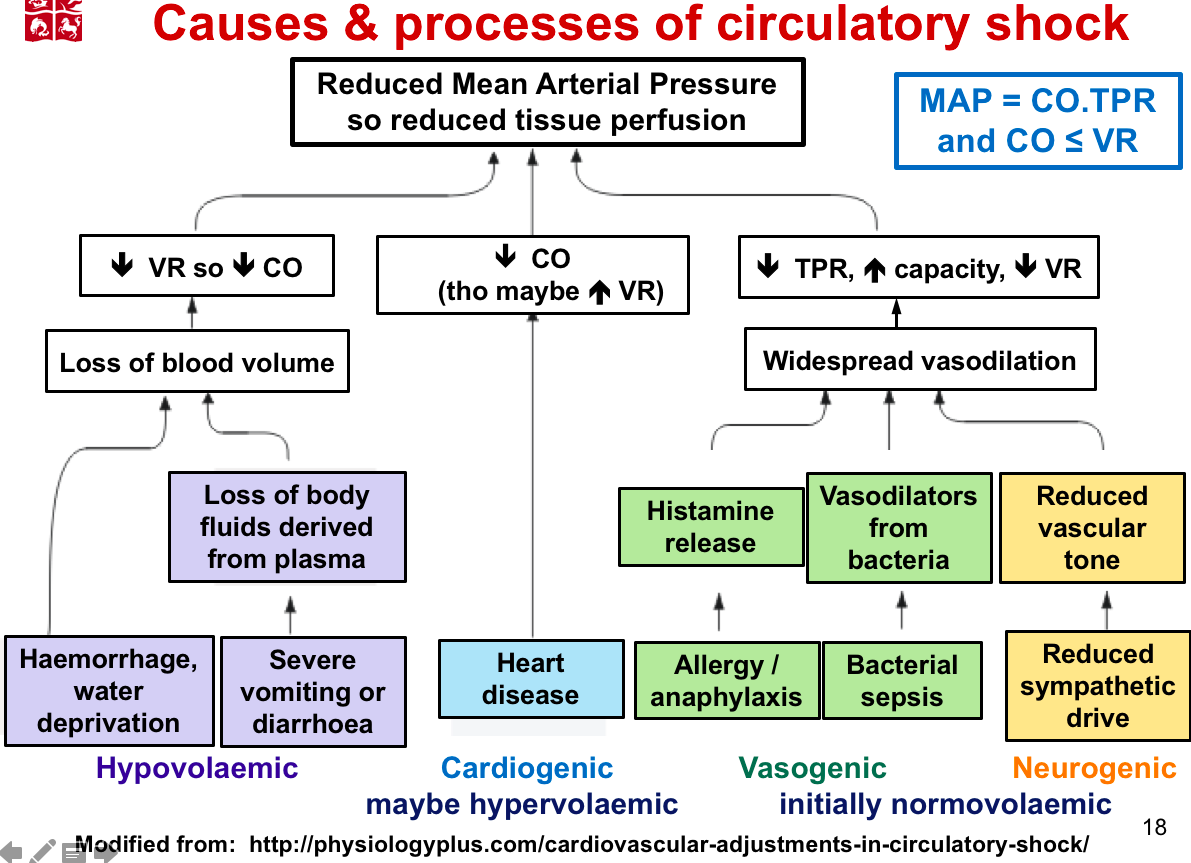
| What is cardiovascular shock? | State in which MAP and/or CO too low to maintain peripheral tissue perfusion |
| What can CV shock cause? | ~Decrease CO ~Decrease MAP (vessels collapse) ~Decrease in ability to move blood against gravity |
| What are the presenting symptoms of CV shock? | Collapse |
| What is hypovolemic shock? | Reduced blood vol |
| How does a decrease in VR affect CO? | Causes it to reduce |
| What happens to VR during hypovolemic shock? Why? | Decreases because less blood to pump back to heart |
| Describe what happens during normovolemic shock | ~Same blood vol ~Histamine released (or some other stimulus) ~Vasodilation ~Vol of tubes increased ~Lower VR ~Lower CO |
| Describe hypervolemic shock | ~Heart unable to pump as much as usual ~BP decreased ~Fluid retained |
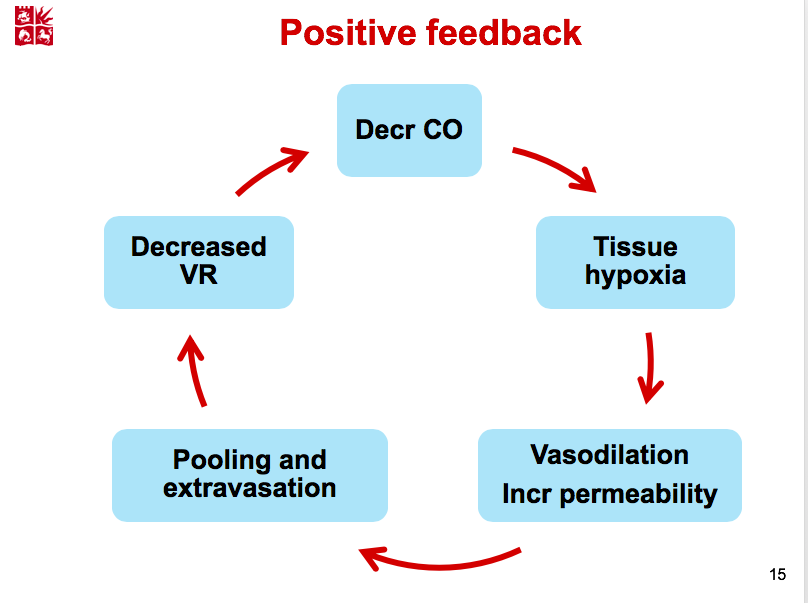
| Describe the sequence of events that follows on from a decrease in peripheral tissue perfusion in relation to vasodilation | ~Inadequate supply O2 to tissues ~Leads to anaerobic resp ~Build up of lactic acid ~Causes vasodilation ~Decreases TPR ~Increase in BV vol but no increase in blood vol ~Decrease VR ~So decrease CO ~Further decrease in peripheral tissue perfusion |
| How does an increase in capillary permeability further affect the state induced by a decrease in TPR? | ~More blood vol lost to ISF ~Further reduction in VR ~Further reduction in CO ~Less BF |
| Which type of feedback are the events induced by a decrease in TPR? | Positive feedback |
| Describe the sequence of events that follows on from a decrease in CO in relation to baroreceptors | ~Decrease in CO means must be a decrease in VR ~Reduces BP ~Baroreceptor reflex activated ~Vasoconstriction ~Less BF as a result to peripheral tissues (although BP is maintained) ~Less O2 supplied ~Anaerobic resp. ~Lactic acid ~Increase in vasodilation and cap. permeability ~Decrease VR |
| What happens to the charge on RBCs when there is a lack of oxygen? | It is lost and rouleaux forms |
| What results in metabollic acidosis? | Formation of rouleaux as a result of lack of O2 resulting from increased vasodilation and cap. permeability |
| How do damaged and undamaged epithelia behave differently? | Undamaged releases chemicals which prevent clotting, damaged releases chemicals which stimulate clotting |
| How does clotting happen as a result of hypoxia? How does this affect BF? | ~Epithelium stops releasing chemicals which prevent clotting and clot therefore forms ~Peripheral vessels blocked further |
| Review diagram | |
| What is hypoxia? | A deficiency in the amount of oxygen reaching the peripheral tissues |
| What is extravasation? | Loss of fluid from BVs into tissues |
| How should hypovolaemic shock be treated? | 1) Remove initial cause (eg. allergen) 2) Balance circulating vol of blood to vol of circulation (vol of BVs) 3) Drugs 4) Fluid replacement |
| Why is giving whole blood generally inappropriate when treating hypovolaemic shock? | Because the PCV is the same, but plasma level is reduced so giving more RBCs unnecessary (need to increase fluid component of blood) |
| What's the downside to treating hypovolaemic shock with NaCl? | NaCl goes everywhere, not just CVS (end up with ions in intersitial spaces) |
| What do plasma expaners contain? Why are these preferable to NaCl when treating hypovolaemic shock? | ~NaCl and high molecular weight protein to restore oncotic pressure in BVs ~Preferable because encourages fluid to return to CVS from tissues rather than just increasing fluid everywhere (incl. tissues which already have elevated fluid) |
| How can normovolaemic shock be treated? | 1) Give antihistamine if reacting 2) Deal with initial cause 3) Vasoconstrictor drug |
| What usually causes hypervolaemic shock in animals w/chronic heart disease? | Excessive exercise |
| How is hypervolaemic shock treated? | 1) Diuretic to remove excess fluid pumped by CVS 2) Give vasodilator to reduce TPR to reduce workload on heart |
| Review diagram |
Want to create your own Flashcards for free with GoConqr? Learn more.