
Flashcards
TNK108 DATANÄT V2
Cards in this deck (77)
- 1What transport services does an app need?Data Integrity
Timing
Throughput
Security - 2What layers does the OSI-model consist of?Application
Presentation
Session
Transport
Network
Data Link
Physical - 3What layers does the TCP/IP-model consist of?Network
Internet
Transport
Application - 4What does the protocol for the application layer define?Type of messages exchanged.
Message syntax.
Rules for how and when processes send and recieve msgs. - 5What does DoS stand for and how is it utilized?Denial of service:
Attackers overwhelm the target with data - 6When does packet loss occur?When the buffer/queue is full
- 7What factors affect queueing delay?Time waiting at output link for transmission
Congestion level at router - 8What factors affect transmission delay and what formula is used to calculate it?Packet Size (bits) - L
Link Capacity (bits/s) - B
d(trans) = L / B - 9What is the difference between packet- and circuit switching?Packet Switching - Msgs are broken up into packet at the application layers and sent over multiple links to reciever.
Circuit Switching - One link is set up to reciever and used to its full capacity. - 10What is the pros/cons of packet switching?Pros - Better utilization of network, connectionless.
Cons - Higher chance of delay and loss. - 11What does "store and forward" mean?That the entire message must arrive at a router before it can be transmitted to the next link.
- 12Name three types of guided physical media?Coxial cable
Twisted Pair
Fiber - 13What is the difference between guided/unguided media and give an example of each?Unguided - Doesn´t use a physical direct link between sender/reciever. ex. Wifi
Guided - Uses a physical link between sender/reciever. ex Fiber - 14What are the differences between the Client/Server model and P2P (Peer-Peer) model and give an example of how these are used?Client/Server - Uses server between sender and reciever to store data. ex. Email via server.
P2P - Direct communication between two hosts. ex. Skype - 15What factors affect propagation delay and what is the formula used to calculate it?Distance between sender and reciever, distance of used link (m) - D
Propagation speed of wave signal (b/s) - S
d(prop) = D / S - 16What formula is used to calculate the nodal delay? a) dnodal = dproc – dqueue + dtrans + dprop b) dnodal = dproc + dtrans – dqueue c) dnodal = dproc + dqueue + dtrans + dprop d) dnodal = dproc + dqueue – dtrans – dpropc) dnodal = dproc + dqueue + dtrans + dprop
- 17What service is provided by the Internet Protocol (IP)?Adresssing, providing nodes with unique IP-adresses used for routing and forwarding.
- 18What is the key difference between Collision Avoidance (CA) and with Collision Detection (CD), and where are they used in?CA - Avoids any error that might occur. Can send Reguest to Send in order to accomplish this.
CD - Dectects error on a link that is being used an corrects it. - 19What is the purpose of ARPAdress Resolution Protocol
It connects the IP and MAC adress. - 20What is the service provided by DNS?Domain Name System
It connects domain name of (for example)
a website and the IP-adress. - 21What is the difference between routing and forwarding?Routing - Sets a table of routes for packets heading to different destinations.
Forwarding - Sends a data packet to the right interface in a router. This makes sure the packet is sent to the correct next hop. - 22True or false? HTTP response messages cannot have an empty message body.False
- 23True or false? The size of the TCP rwnd can change throughout the duration of the connection.True
- 24Which cause of delay typically dominates in highly utilized multi-hop networks and why?Queueing delay
- 25Transmission delay does not depend on a) Packet length b) Distance between the routers c) Transmission rate d) None of the aboveb) Distance between the routers
- 26Propagation delay depends on a) Packet length b) Transmission rate c) Distance between the routers d) None of the mentionedc) Distance between the routers
- 27In the transfer of file between server and client, if the transmission rates along the path is 10Mbps, 20Mbps, 30Mbps, 40Mbps. The throughput is usually a) 10Mbps b) 20Mbps c) 40Mbps d) 50Mbpsa) 10 Mbps
- 28What is the difference between IP and MAC-adresses?IP-adresses are attached to network devices via software.
MAC adresses are unique within a network (local network) and attached to hardware. - 29How big is the MAC address space? The IPv4 adress space? IPv6?MAC: 2^48
IPv4: 2^32
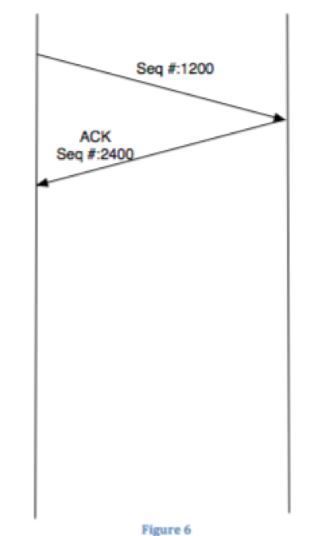
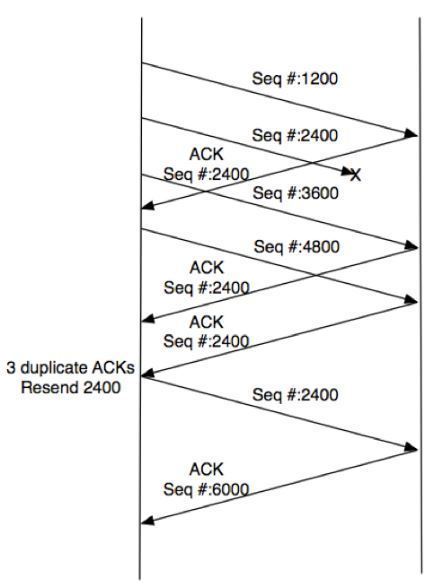
IPv6: 2^128 - 30Assume a TCP sender transmits 4 TCP segments with respective sequence numbers 1200, 2400, 3600, 4800. The sender receives four acknowledgements with the following sequence numbers, 2400, 2400, 2400, 6000. Complete Figure 6 to show what TCP segments are exchanged between sender and receiver.Seq #2400 doesn´t arrive but the sender sends the rest and the reciever acknowledges them but keeps asking for #2400
- 31What is always done in the beginning and ending of a communication between two hosts using a TCP-connection?An Handshake
- 32What are the two types connections for HTTP? And what are their differences?Non-Persistent: The connection is closed after the server sends the requested object to the client.
Persistent: The connection only closes after a certain amount of time of no information shared. - 33What is the main difference between s TCP and a UDP - connection?TCP - Requires handshake before sending data between sender/reciever.
UDP - No handshake, each packet has the destination IP and port attached to it. - 34What is the pros and cons of a UDP connection?Pros - Faster, especially when sending heavy amount of data.
Cons - Risk of loss, out of order. - 35What is the main service of the transport layer?Providing a logical connection between applications running on different networks.
- 36What does rdt stand for and what is the main problem with rdt2.0?Reliable Data Transfer
If a ACK or NACK is corrupted, the sender doesn´t know what to do. (one cannot simply send again...) - 37What is the main difference between rdt2.0 and rdt2.2?rdt2.2 is a NAK-free protocol.
- 38What is TTL?o Time-To-Live. Antal hopp eller sekunder som ett paket överlever innan discard
- 39• Vad är Pipelined protocols? Vilka typer finns det?o Skickar flera obekräftade paket för att öka utilization
o Go-Back-N
N unacked packets
Skickar bara ack för senaste paket, doesn’t ack packet if there’s a gap
Timer for oldest unacked pack
o Selective repeat
N unacked packs
Rcvr sends individual ack för varje ack
Sender har timer för varje unacked packet - 40• Vad är ett Virtual circuit network?o Connection service(similar to telephone circuit)
o Packets carry VC indentifier
Link and router can be allocated to certain VC
o Simple end systems - 41• Vad är Datagram network?(internet)o Connectionless service
o Packets forwards by host destinaiton address
o Complex end systems - 42• Vad är och hur funkar IP fragmentation?o Datagrams that exceed MTU split up
o Reassembles at final dest
o IP header bits used to know the order of fragments - 43• Vad är ett Subnet?o Device interfaces with same subnet part of the IP address
o The subnet part of the IP address starts when all hosts can be addressed + 2 reserved addressed
o Can physically reach each other without interfering router - 44• Vad står CIDR för? Vad är det?o Classless InterDomain Routing
o Subnet portion of address of arbitrary length(Subnet part/Host part)
o Address format a.b.c.d/x
o /x number of bits in subnet mask - 45• Vad star DHCP för? Vilken tjänst erbjuder det?o Dynamic Host Configuration Protocol (assigns IP address to host)
o Allow host to dynamically obtain IP-address from network server when it joins network
o Only hold addresses while the host is connected
o Also gives:
subnet mask
name and IP of DNS server
address of first-hop router for client - 46• Vad står NAT för? Hur funkar det?o Network Address Translation
o All datagrams leaving local network has same single source NAT IP address
o Krävs då bara en IP-adress för hela lokala nätverket
o Kan ändra adresser i nätverket utan att påverka omvärlden
o NAT router must translate every incoming and outgoing datagram and remember every translation - 47• Vad star ICMP för? Vad gör det?o Internet Control Message Protocol
o Used by hosts & routers to communicate network-level info
o Network-layer “above” IP
o Error reporting
o Used in traceroute - 48• Hur fungerar IPv6? Varför behövs det?o 32-bit address space will soon be occupied for IPv4
o Has fixed length header 40 bytes
o No fragmentation
o No checksums - 49• Vad är Tunneling? Hur funkar det?o Sätt så att IPv6 kan samarbeta med IPv4
o IPv6 carried as payload in IPv4 routers - 50• Vilka olika Routing algorithm classifications finns det? Vad innebär de?o Global
All routers know link cost of whole network
Link state algorithms (Djikstras)
o Decentralized
Router only know links costs to neighbors
Iterative computations, shares new info with neighbors
Distance vector algorithms (Bellman-Ford equation)
o Static
Route change slowly
o Dynamic
Routes change more quickly - 51• Hur funkar Distance vector algorithm?o Time-to-time, each node sends its own DV estimate to neighbors
o Router receives new DV from neighbor Updates its own using B-F equation
o If DV changes, router notifies neighbors - 52• Vad står AS för? Vad är det?o Autonomous Systems (kinda like subnets)
- 53• Vad är en Gateway router?o Edge router in AS
o Has link to another AS - 54• Vad gör ett Inter-AS?o decides which gateway router the datagram should exit through
o If dest AS can be reached through multiple gateways, choose the one with the least cost - 55• Vilka Intra-AS Routing protocols finns det? Använder de DV eller LS?o RIP – Routing Information Protocol
DV algorithm, DV contains # hops
o OSPF – Open Shortest Path First
LS algorithm (uses Djikstras)
o IGRP (not important) - 56• Vad står RIP för? Hur funkar det?o Routing Information Protocol
o DVs exchanged every 30sec, sent via UDP
o DV measured in number of hops, each link has cost 1
o Number of hops in DV is to subnets
o No advertisement heard after 180 sec link declared dead
o RIP routing table managed by application level process - 57• Vad står OSPF för? Hur funkar det?o Open Shortest Path First
o Advertisements shared to whole AS
o Sent over IP
o Uses Djikstra’s algorithm - 58• Hur funkar Hierarchical OSPF? Vilka olika routers består det av?o Two-level hierarchy: local area, backbone
o Area border routers: summarize distance to nets in own area, adv. to other area border routers
o Backbone routers: run OSPF routing only in backbone
o Boundary routers: connect to other AS - 59• Vad står BGP för? Var används det?o Border gateway protocol
o It is an Inter-AS used by internet
o eBGP: obtains subnet reachability info from neighboring AS
o iBGP: propagate reachability info to all AS internal routers
o Determines good routes to other networks
o allows subnet to advertise to internet: “I am here!” - 60• Vad står VLSM för? Användning?o Variable Length Subnet Mask
o Används för att dela in I flera subnät med olika antal hosts beroende på behov - 61• What is the link layer responsibility?o Responsible of transferring datagram from node to physically adjacent node over a link
- 62• Does link layer provide reliable data transfer over link?o No, depends on which protocol is used
- 63• What is the link layer’s services?o Framing, link access
o Reliable delivery from node2node
o Flow control
o Error detection
o Half/full duplex - 64• Error detection: Hur kan errors uppstå? Vilka handlingar kan göras vid error?o Caused by attenuation(dämpning), noise
o Receiver detects error signals for retransmission or drops frame - 65• Vilka typer av Parity checking finns? Vad gör de?o Single bit parity
Detects single bit errors
o Two-dimensional bit parity
Detect and corrects single bit errors - 66• Vilka typer av MAC protocols finns det?o Channel partitioning
Divides channel into smaller pieces
Allocate piece to node exclusively
o Random access
Allows collisions
Collision recovery
o “Taking turns”
Takes turns, nodes with more to send can take longer turns - 67• Vilka MAC Channel partitioning protocols finns det?o TDMA, Time Division Multiple Access
Each station has fixed length slot
Unused slot go idle
o FDMA, Frequency Division Multiple Access
Each station assign to fixed frequency band
Unused frequency band goes idle - 68• Vilka Random access protocols finns det?o Slotted ALOHA
o ALOHA
o CSMA, CSMA/CD, CSMA/CA - 69Hur funkar slotted ALOHA? Node obtains frame Transmit in next slot
• No collision node can send in next slot
• Collision node transmits frame in each subsequent slot with prob p intil success - 70• What is the definition of efficiency?o Long-run fraction of successful slots
- 71• What is different with Pure (unslotted) ALOHA compared to slotted ALOHA?o Simpler, no synchronization
o When frame arrives transmit immediately
o Collision probability increases (eftersom frames överlappar) - 72• Vad är CSMA? Hur funkar det?o Carrier Sense Multiple Access
o “Listen before transmit, don’t interrupt others”
o Propagation delay can cause two nodes not hearing each other
o If collison entire packet transmission time wasted - 73• Vad är CSMA/CD?o Collision Detection
o Collisions detected in short time
o Colliding transmissions stopped, reducing channel waste - 74• How are “Taking turns” MAC protocols compared to other MACs?o Channel partitioning MAC protocols
Share channel effiecently and fairly at high load
Ineffiecent at low load
o Random access MAC protocols
Efficient at low load: single node can fully utilize channel
High load: collisions occur
o Taking turns look for the best of two worlds - 75• What “Taking turns” MAC protocols are there?o Polling
o Token passing - 76• Vad är ARP? Vilken funktion fyller det?o Address Resolution Protocol
o Determines interface’s MAC address from know IP address.
o ARP table: each IP node on LAN has table - 77• Hur funkar ARP I ett enskilt LAN?o A wants to send to B, but don’t know B’s MAC address
o A broadcasts ARP query packet, containing B’s IP address
o B receives it and sends back its MAC address
o A saves it in ARP table until info gets old and is removed
Information
- Description
- Computer Science Flashcards on TNK108 DATANÄT V2, created by Simon Karlsson on 09/01/2020.
- Created by
- Simon Karlsson
- Views
- 22
- History
-
- Created by Tobias Aspegårdh · Jan 8, 2020
- Copied by Simon Karlsson · Jan 9, 2020
- Rating