
Flashcards
Untitled
Cards in this deck (13)
- 1Rounding if the number is 5 or more you round up, but if its less than 5 you round down. E.g. 4.6-5Length- 1cm=10mm 1m=100c1km=1000m
Capacity-1cl=10ml 1l=100cl 1l=1000ml
Mass- 1kg=1000g - 2Mode=most common number Mean=total of the numbers divided by the amount of numbers Median=the middle value(has to be ordered in smallest to largest first)Data
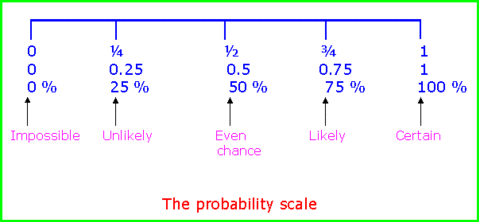
If you are carrying out a survey make sure that you: ask enough people, choice of people is fair and representative, the information is accurate and reliable especially if you get it from the internet. - 3Probability: how likely something is to happen. Can be in the form of words, decimals, fractions and percentages.An angle is a measure of a turn, measured in degrees or °. There are 360° in a full turn.One whole turn is 360°. a is an example of a whole turn.
One quarter turn is 90° or a right angle. b is an example of a quarter turn.
One half turn is 180° or a straight line. c is an example of a half turn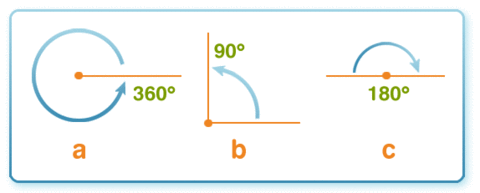
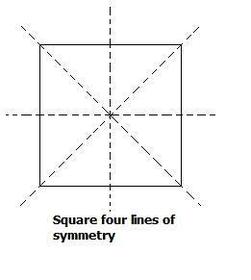
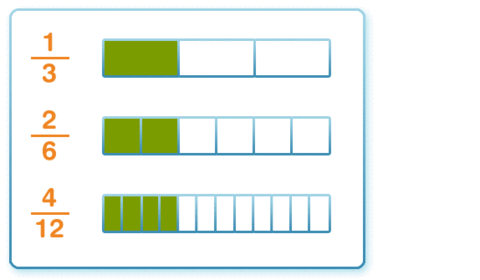
- 4A 2D shape is symmetrical if a line can be drawn through it so that either side of the line looks exactly the same. The line is called a line of symmetry.Equivalent fractions are fractions that look different but show exactly the same amount. You can make equivalent fractions by multiplying or dividing the numerator and denominator by the same number.
- 5Factors are numbers that divide exactly into another number. The factors of 12, for example, are 1, 2, 3, 4, 6 and 12. Factors Factors can be shown in pairs. The factors of 12 can be shown: 1 and 12 1 x 12 = 12 2 and 6 2 x 6 = 12 3 and 4 3 x 4 = 12 Each pair multiplies to make 12.Multiples
The multiples of 5 are all the numbers in the 5 times table:
5, 10, 15, 20, 25 and so on.
Multiples of 5 always end with a 5 or a 0. You can tell 465, for example, is a multiple of 5 because it ends with a 5 - 6Converting fractions to decimals You can use a calculator to turn a fraction into a decimal. Just divide the numerator by the denominator.Compare 2/3 and 3/5 and find out which fraction is bigger.
•First look at the denominators (the bottom numbers).
•Find a new number that both denominators go into:
•Try 9 - you can divide 9 by 3 but you can't divide 9 by 5.
•Try 10 - you can divide 10 by 5 but not by 3, so that isn't right either.
•Try 15 - you can divide 15 by 5 (which equals 3) and you can also divide 15 by 3 (which equals 5), so 15 is the new denominator.
•Now you have found a new denominator that is divisible by both numbers, you need to change the numerators (the top numbers).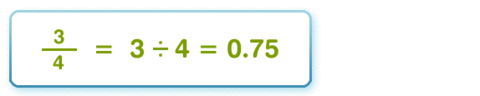
- 7Multiplication Written method: line up the units, tens and hundreds underneath each other and then multiply each digit, starting with the units. 246 x 3 Start by multiplying the 3 by the 6 to give 18.Division
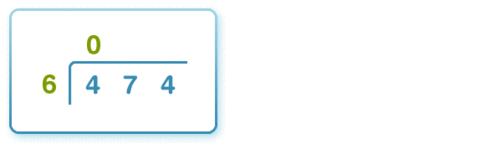
If the numbers are too difficult to divide in your head, use a written method. This is called long division.
Try 474 ÷ 6:
•6 doesn't go into 4, so put 0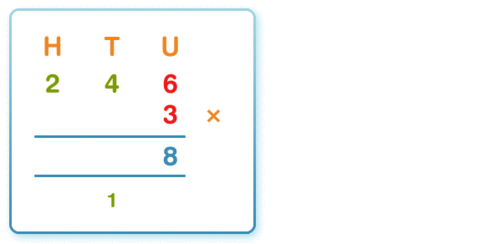
- 8Negative numbers: Numbers don't just stop at zero. When you count backwards from zero, you go into negative numbers. Positive numbers are more than zero. Negative numbers are less than zero.Converting between percentages and decimals:
To change a percentage to a decimal, divide by 100. Change 48% to a decimal: 48 ÷ 100 = 0.48 To change a decimal to a percentage, multiply by 100. Change 0.67 to a percentage: 0.67 x 100 = 67%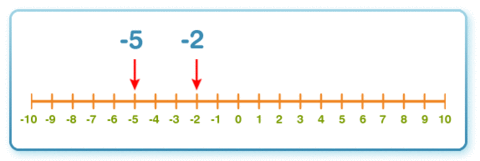
- 9Converting between percentages and fractions: Write the percentage as a fraction over 100 and then simplify:Per cent means 'out of 100'
The sign % stands for 'per cent' which means 'out of 100'. So, •40% means 40 out of 100
•11% means 11 out of 100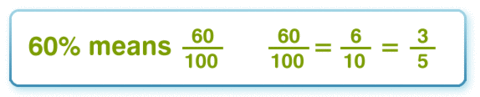
- 10Tips for using a calculator •Look at the display to make sure you've pressed the right button. •Press the equals button at the end of every calculation. •Only press the equals button once. Pressing it a second time may repeat the calculation you've just done.Calculations with brackets
For calculations with brackets, you'll need to work out the parts inside the brackets first. So you'll need to do these calculations in more than one step. e.g.
(23 + 75) x (4.85 - 3.05)
1.Work out 23 + 75 and write the answer down or store it in the calculator's memory. The answer to this part is 98.
2.Work out 4.85 - 3.05. The answer to this part is 1.8.
3.Multiply the two answers together:
98 x 1.8 = 176.4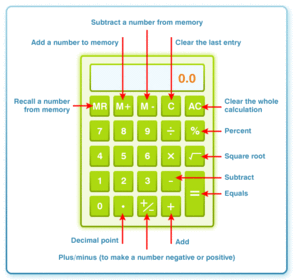
- 11Calculations with money When you work out money problems on a calculator, make sure you read the display correctly. You'll sometimes need to add a zero.eg You have £6.53 and you spend £1.73. How much do you have left? •On the calculator type 6.53 - 1.73. •The answer is 4.8. Remember to write this as £4.80.Converting fractions to decimals
You can use a calculator to turn a fraction into a decimal. Just divide the numerator (the top number of the fraction) by the denominator (the bottom number of the fraction). e.g.
Convert 3/4 to a decimal using your calculator. •Type 3 ÷ 4, then press the = sign. •The answer is 0.75.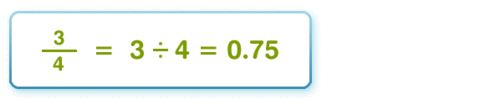
- 12Prime numbers Prime numbers are special numbers that can only be divided by themselves and 1. 19 is a prime number. It can only be divided by 1 and 19. The number 1 is not thought of as a prime number. 9 is not a prime number. It can be divided by 3 as well as 1 and 9. The prime numbers below 20 are: 2, 3, 5, 7, 11, 13, 17, 19Square numbers
A square number is a number multiplied by itself (a number 'squared'; the symbol for squared is 2. 12 = 1 x 1 = 1.They're called square numbers because they can be made into square shapes.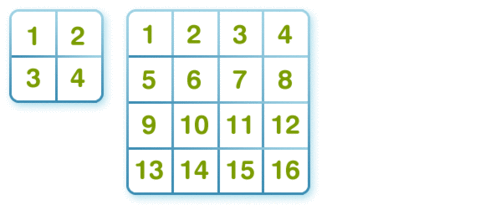
- 13Number sequences A number sequence is a list of numbers that are linked by a rule. If you work out the rule, you can work out the next numbers in the sequence. Below are some examples. eg 9, 15, 21, 27, In this example, the difference between each number is 6:So the rule for this sequence is to add 6 each time.Even and odd numbers
•Even numbers can be divided exactly by 2. The sequence of even numbers is:
2, 4, 6, 8, 10, 12, 14 ... and so on. Even numbers always end with a 2, 4, 6, 8 or 0. You can tell 3788, for example, is an even number because it ends with an 8. •Odd numbers cannot be divided exactly by 2. The sequence of odd numbers is: 1, 3, 5, 7, 9, 11, 13 ... and so on. Odd numbers always end in 1, 3, 5, 7 or 9. You can tell 4399, for example, is an odd number because it ends with a 9.
Information
- Description
- Maths Flashcards on Untitled, created by inayahchowdhury1 on 30/04/2015.
- Created by
- inayahchowdhury1
- Views
- 0
- Rating