
Flashcards
Settlement
Cards in this deck (49)
- 1What is a settlement?A settlement is a place where people live.
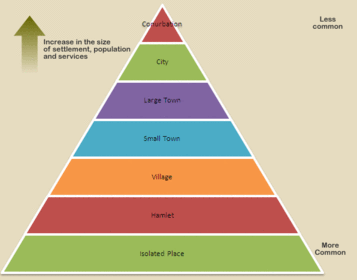
They vary in size, ranging from a single dwelling to cities housing millions of people.. - 2What is a hierarchy?A hierarchy of settlements puts items in order, usually in order of population size. So settlements higher up the hierachy (large cities) are called high-order settlements. There are fewer of these but they are spaced further apart. Settlements lower down the hierachy (villages) are called low-order settlements. There are more of these and they are more closely spaced.
- 3Hierarchy of Settlements
- 4Hierarchy of servicesSmaller settlements are likely to have services that people use almost everyday, such as a primary school or small shops. People tend to travel short distances to these.
Large towns and cities provide a wider range of goods and services, so people tend to travel long distances for some of these, but go less freqeuntly (e.g. A furniture shop) - 5Sphere of influenceThis is the area served by a settlement. The sphere of influence of a small village will be very small, while the sphere of influence of a city might be very large.
- 6Factors that affect the size of sphere of infleunce1. The settlements size and the services it provides (A large town with many services and high order services will have a large sphere of influence)
2. The area's population density (In a sparsely populated area, services will be widely spaced and spheres of influence will be very large)
3. The wealth of the people in the area (In wealthy areas, people have more money to buy goods and services. Therefore with a wider range of service outlets, the sphere of influence will be smaller)
4. The transport facilities (Good transport links allow people to travel further distances to reach services, so the spheres can be larger)
5. Competition from other settlements (If there is a settlement nearby that provides similar services, the sphere of influence will be smaller) - 7What is a threshold population?This is the minimum number of people needed to provide a large enough demand for service.
There are low order and high order services. - 8What is the range?The maximum distance people are prepared to travel in order to obtain a particular service.
- 9Rural settlement patterns?Nucleated: clustered dwellings that form villages, with few isolated dwellings.
Shape is compact and circular or square.
Reasons: People enjoy the social benefits of living close to everyone.
Easy access to services like shops and schools.
Helpful for defense in times of attack.
May be in areas with rich agriculture, so farmers can live in the village but still be near their fields.
The culture of the people may favour this.
Dispersed: Scattered dwellings, with small hamlets and few villages.
Reasons: This pattern may develop where agricultural land is poor and people need to farm large areas. So they live where their large land is situated.
Cultural reasons may also play a part.
This can be found in areas with commercial farms which are huge and take up space.
Linear: Settlements which are in long thin rows, often along roads or tracks.
Reasons: This pattern allows each dwelling to have access to a road or track for transport. Physical geography also plays a part or people may not want to waste good farming land and situate themselves in a line (next to fertile land). - 10Site and Situation?Site: Land that the settlement is actually built on. (Sites features include: Altitude, Gradient of the slope, Water supply, Crossing point of a river, Natural resources (such as minerals).
Situation: The position of the settlement in relation to the surrounding area. Features of the situation often allow a small settlement to grow into a larger town or city. (The features include: Transport routes, agricultural productivity of the area, position in relation to other settlements.) - 11Factors influencing the sites and development of rural settlements? Agricultural land useAgricultural land use: The land provides food supply for villages, so agricultural land was a key feature for their origin and development. Thus, the relief, soils, drainage and accessibility of the site allows agricultural land use to take place.
Villages have also developed as a result of mining mineral deposits, or tourism. In fact, people often live in villages from MEDCs and work in nearby towns (dormitory villages). - 12Factors influencing the sites and development of rural settlements? Relief (altitude, gradient and aspect)Relief:
Altitude - Rarely a factor, however, in mountainous regions (where the highest areas are quite cold) agriculture is difficult. Therefore, these areas can be sparsely populated (poor drainage, diseases, dense vegetation, and weather)
Gradient - An important factor in the site of settlements. Gentle slopes have advantages of being well drained, easy to cultivate and easier to build on. Settlements are often located along valley floors (avoiding steeper valley sides)
However in the past steep slopes provided defence against enemies (which was a benefit). Also, where flatter land is in short supply, people are forced to live on steep slopes. Unfortunatley, steep slopes make transport difficult and are prone to landslides which can destroy buildings and roads. - 13Factors influencing the sites and development of rural settlements? Relief (Aspect)Aspect - The direction in which a slope faces. In mountainous areas it is an important factor because the sun rises in east and sets in the west, in the northern hemisphere, it moves around the souther sky, etc.... So some slopes are warm and sunny while other are cold and shaded. So agriculture and settlements tend to be located on the sunny slopes.
- 14Factors influencing the sites and development of rural settlements? SoilsSoils - Areas with fertile soils are often more densely settled, because the greater productivity of the land can support a larger population.
But some people find that fertile soils are too important, and therefore are built on less fertile land. - 15Factors influencing the sites and development of rural settlements? Water SupplyMany settlements tend to establish themselves near rivers, springs or wells, as they could supply water for drinking, washing and, in some cases, crop irrigation.
Transporting water is time-consuming and hard, so settlements prefer to have their own nearby supply.
Sites with reliable water supplies from rivers, springs and wells are known as wet point sites. - 16Factors influencing the sites and development of rural settlements? Drainage and floodingVery low-lying areas, such as flood plains might have very fertile soils, but if they flood frequently they are not easy places to settle. They might also be waterlogged and difficult for farming.
In tropical regions these areas are prone to diseases, but in areas with large populations and a shortage of land (like Bangladesh) flood plains may be densely settled.
Areas slightly higher than flood plains, with gentle well-drained slopes, are good for farming and provide good sites for rural settlements. - 17Factors influencing the sites and development of rural settlements? AccesibilityTo sell produce or to buy goods and services, settlements need access to roads or tracks and therefore a linear settlement develops.
- 18Name and explain an LEDC Case Study on settlements....
- 19Name and Explain an MEDC Case Study on rural settlement....
- 20Urban settlements What is urbanization?Urbanisation is the growth of towns and cities - leading to an increasing percentage of the population living in urban areas.
- 21How did urbanisation start?It started over 200 years ago when countries went through the Industrial Revolution. People left their jobs in agriculture in rural areas and migrated to the growing towns and cities to work in factories.
Today, in richer countries, urbanisation is now very slow or has altogether stopped as most people already live in urban areas. - 22Why has urbanisation in LEDCS increased rapidly?- Overall population growth
- Rural-to-urban migration
- Increasing numbers of people working in secondary and tertiary industries, which are concentrated in urban areas. - 23What are conurbations? Give an example.When cities grow outwards, they merge with other towns and cities and eventually create conurbations. For example, tokyo-yokohama.
- 24What is counter-urbanisation?Urban - rural areas
Many of those who move are quite wealthy and have the money to live in the quiet rural areas and commute to work in urban areas at the same time. Or simply live in rural areas with no need to work, simply to relax, away from the urban areas.
Other have retired and therefore leave the urban areas for more peaceful rural areas.
Thus, rural areas may have cheaper housing than in urban areas. - 25What are mega-cities?Cities with populations of over ten million (including conurbations).
- 26Factors influencing the size, growth and functions of urban settlements Nodal Points (route centres)These are where natural routeways, such as river valleys, meet. These points often develop into important transport junctions and become the most accessible points in the area (seen as the best places to provide shops or social services).
- 27Factors influencing the size, growth and functions of urban settlements Agricultural centresThe growth of some towns and cities has been because they lie at centres of rich agricultural regions (has turned into the marketing points).
Transport links have been built to focus on these points and they have further developed. - 28Factors influence the size, growth and functions of urban settlements PortsA number of factors help to promote the growth and development of seaports:
- The prescence of deep water close to the shore (ships can anchor to unload their cargoes)
- Shelter from strong winds and rough seas, provided by bays and river estruaries
- A gap into ports in the Tropics in a coral reef (where ships can pass)
- The presence of a large area linked to the port from which goods are exported and to which goods are imported.
- Good transport links with the hinterland - 29Factors influencing the size, growth and functions of urban settlements Administrative towns and citiesThe towns and cities where the government and civil service are based. They are often located centrally.
- 30Urban land use features of the CBD?Central Buisiness District
- Government buildings
- High-order retail services
- Offices/Company headquarters
- Theatres, hotels, restaurants
- Historic buildings
- Multi-storey buildings
- Concentration of public transport services
- Few residents
- Many pedestrians and pedestrianised areas - 31Urban land use Reasons for the development of the CBD?- CBD usually contains the oldest buildings as it was the core of the settlement. The towns would then expand outwards from that point.
- The CBD was also the point where roads from the outskirts converged. (which made it the most accesible part of town)
- Desirable place for services to locate themselves. However, land prices increased and only certain services can afford to locate there. - 32Urban land use Residential areas (high and low density housings)Areas where people live.
Different styles of housing,
High density housing: Dwellings are relatively small and there is little or no space between them. Often found in older parts of towns/cities, closer to the centre.
Low density housing: In these areas there are fewer dwellings per square km and open space between housings. The areas are usually more modern and away from the centre. - 33Urban land use Different types of housingFlats (apartments)
Multi-storey buildings which can be found in any part of the town or city. Can be expensive and not always suitable for families.
Shanty houses
In other areas, favelas or bustees, but either way, these are a type of slum housing. They are built spontaneously out of any available materials (plastic sheets, metal sheets, cardboard). Often lack water supply, electricity supply, etc... - 34Urban land use Open spacesFound in most towns and cities where they are usually parks or sports grounds. Or may be less attractive areas waiting for re-development.
- 35Urban land use Industrial areasIndustrial areas are present in most towns and cities. They are of different types:
- Older industries which are located close to railways or canals
- Industries associated with sea or river ports, which involve imports and exports
- Newer industrial regions which are closer to the outskirts of cities. - 36Urban land use Transport useTransport routes are a key feature of urban land use. The high density areas are easier to serve by public transport.
- 37Urban structures in MEDC cities In urban areas, why are different types of lands, housings and industries located in separate zones?- The value of the land is different
- Certain types of land do not mix
- Patricular types of land use, once established, continue that way - 38Urban land use explained by models What is the Burgess's concentric zone model?
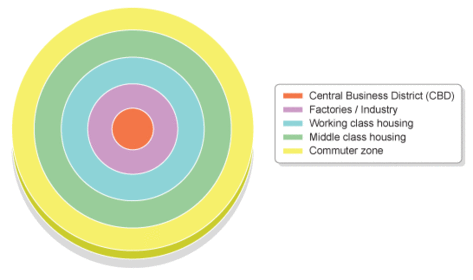
- 39Urban land use explained by models Hoyt's secotr model
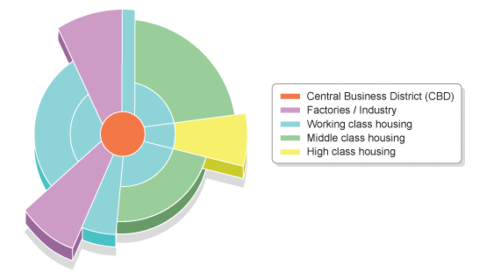
- 40Urban structures in LEDC cities........
- 41Problems associated with the growth of urban areasLack of space
Expensive land
Areas abandoned
Increased car ownership has led to congestion (leads to lack of parking space as well)
If more shops move, fewer people will visit the CBD and more shops in the CBD will be forced to leave
CBD can be empty in the evening, (only bars and clubs are open) which makes it unsafe (high crime rates) - 42Solutions to the problems of the CBD?Pedestrianization - Traffic free, allows access to delivery vehicles at certain times of day, creates a safer more relaxed environment (less air and noise pollution).
Shopping malls - Covered (so bad weather is not a problem), air conditioned or heated, contains different shops.
Visual improvements - By providing trees, seated areas, cleaning streets and litter, having sculptures, etc...
Security - Regular patrols, cameras, etc... - 43Crime and racial conflictAn area of poverty which also has a concentration of people from a particular immigrant community, is known as a ghetto. Conflict can arise between these communities.
- 44Squatter settlement problemsThey do not own land or have a legal right to occupy it, they may be evicted any time.
The houses are not weatherproof and can be cold in winter.
There is no proper sanitation and water supply, which leads to outbreaks of diseases.
No access to electricity (or is illegal)
No local employment
Suffer extreme poverty/unemployment
Overcrowding and high levels of crime, drug and alcohol abuse
Little public transport - 45Squatter settlement solutionsLow cost housing schemes that provide basic dwellings for families, with running water, electricity and proper sanitation.
Self-Help schemes which provide groups of people with the materials they need to build proper houses.
The provision of basic services such as sewerage and piped water. - 46The effects of urbanization on the environment: (Air pollution, Water pollution, Visual pollution and Noise pollution)Air pollution - Majour sources are motor vehicles, industry, power stations and open fires. Reducing traffic congestion has helped.
Water pollution - Raw sewage is a health issue, it can contaminate water supplies and can cause a variety of diseases which may lead to death. Providing proper sewage pipes will reduce the risk of untreated waste being released into rivers.
Liquid industrial waste has also killed many fish, but with strict regulation, industries have improved the situation.
Visual pollution - Some may consider grafitti to be ugly and offensive.
Noise Pollution - Cars, lorries, trains, air crafts, people, parties, all contribute to noise pollution. Some people may find it very disturbing. Solutions may include introducing laws to limit noise, seperating industrial areas from residential areas, building roads to reduce amount of traffic noise, restricting night flights. - 47What is urban sprawl?The spreading outwards of a city and its suburbs, leading to changes in the surrounding rural area.
- 48Urban sprawl problems?High car dependence and increased vehicle emissions
Inadequate facilities
Higher costs
Lost work time spent commuting (lower productivity)
High levels of racial and socio-economic segregation
Changes countrysides characteristics and takes away rural way of life - 49Urban sprawl solutions?The rural-urban fringe basically seperates the two areas to protect the countryside from the city.
Information
- Description
- Flashcards on Settlement, created by Karima Ranieri on 01/05/2015.
- Created by
- Karima Ranieri · May 2015
- Updated
- Mar 7, 2018
- Views
- 1
- Rating