
Flashcards
geography unit 2
Cards in this deck (83)
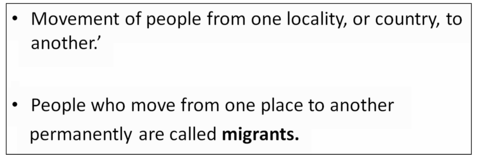
- 1Movement of people one locality or country to another people who move from one place to another permanently are called migrantsMigration
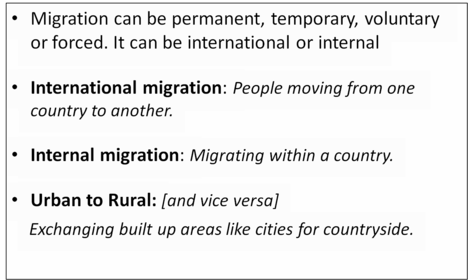
- 2Can be permanently, temporarily, voluntary or forced or internal or international international is moving country internal moving in a country urban to rural is exchanging built up area like cities to countrysideMigrants
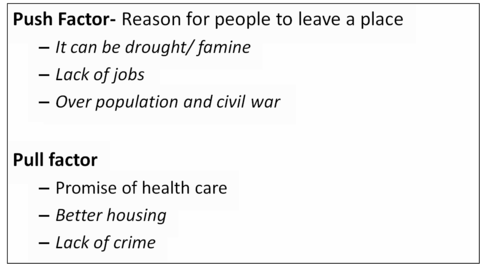
- 3Push factor- reasons to leave Drought, famine Lack of jobs overpopulation, civil warMigration
- 4Pull factors , reasons to stay promise of health care better housing lack of crime better standard of living jobopportunities education, weatherMigration
- 5Estimated 5.5 . mil British people permanently move abroad almost one in 10 of the UK populationLiving abroad
- 6Emigration of British people has happened in cycles of 200 years the trend is rising again, some 2000 British citizens moved permanently away from the UK every week in 2005Living abroad
- 7There were more than 1 million British born living in Australia. This is 5 percent of the populationMoving to Australia
- 8Positive- better economy as more skilled people coming over to work which increases development Negative - limited resources if everyone moves over here of not enough to jobs high unemploymentPolish migration
- 9Pull factors are vacancies for unskilled and semi skilled workers push factors are high unemploymentPull and push factors
- 10This allows any European union citizen to travel, work and settle within another member stateTreaty of Rome
- 11Due to the difference in living standards there were fears of mass economic migrationEconomic migration
- 12It was agreed that member states could limit migration from the A8 countries till 2011 but the UK agreed to accept migrants as long as the registered to workMigration
- 13In 2004 Poland joined the European union A8 countries Czech Republic, Estonia Hungary, Latvia litunania, poland Slovakia, Slovenia they had a standard of living of 40% of the European averageEuropean countries
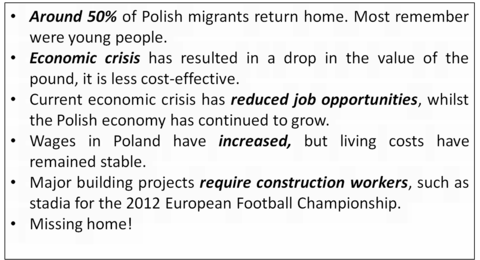
- 1450% or polish migrants return home most are young economic crisis results in drop in value of the pOund less cost effectivesituation now
- 15current economic crisis has reduced job and opportunities, whilst the polish economy has continued to grow - wages in Poland has increased but living costs have remained stable.situation now
- 16major building projects require construction workers such as stadium for the 2012 European football championship missing homessituation now
- 17rural to urban means the movement of people from the countryside to the citiesrural to urban migration
- 18people are attracted to things they do like in the cityPull Factors
- 19people who want to get away from things they do not like in the countrysidePush Factors
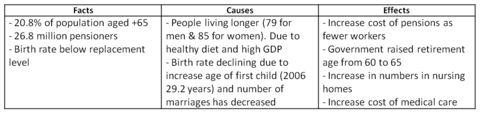
- 20when a country has a large number of people over the age of 65 in their countryAgeing Population
- 21Government policy used to encourage people to have fewer childrenAnti-Natalist Policy
- 22The number of births per 1,000 people in a yearBirth Rate
- 23the number of deaths per 1,000 people in a yearDeath Rate
- 24economic and social progress that leads to improvements in the quality of life for an increasing proportion of the population.development
- 25someone who has emigrated from one region to another region looking for employment or improved standard of living.economic migrant
- 26A person leaving a country or region to live somewhere else (for at least one year)emigrant
- 27when the population starts doubling itself very quickly - the bigger the population the faster it grows.exponential growth
- 28the average number of children born to a women in her lifetimefertility rate
- 29a person arriving in a country or region to live (for at least on year)immigrant
- 30the number of babies who die per 1,000 before the child's first birthday.infant mortality rate
- 31the average number of years a person might be expected to liveLife expectancy
- 32the movement by people from one place to anothermigration
- 33the change (increase/decrease) in population number resulting from the difference between birth and death ratesNatural change
- 34Is the number of people added to or lost from the population of every 1000 people in one year.natural increase
- 35An area that has too many people for the resources available.overpopulation
- 36A diagrammatic way of showing the age and sex structure of a populationPopulation pyramid
- 37The 'make up' or composition of a populationpopulation structure
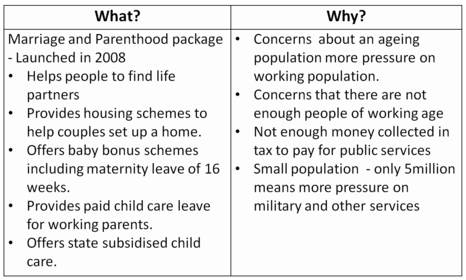
- 38A government policy used to encourage people to have more children.Pro-Natalist
- 39The point at which the momentum of a change is unstoppable.Tipping Point
- 40When there are too few people to develop fully the economic potential of an area or nation.Under Population
- 41This is when there are a very high percentage of people under the age of 15.Youthful Population
- 42(also called the replacement level), is where the population neither grows or declines, and remains stable.Zero population growth
- 43The world population is growing at an alarming rate in 2013 at least another 65 million people were added to the global total of 7.1 billion.global population
- 44Exponential Growth has been occurring (In 2000 the doubling time fell to 39 years)global population
- 45However since 2000 the rate of growth has become more uncertain in fact no country in the EU is producing enough babies to stop their population declining.global population
- 46development of modern medicines and the introduction of mass vaccinationsnatural increase variation
- 47cleaner drinking water and better sewage disposal, a lot more people have access to clean drinking water.natural increase variations
- 48better healthcare - more doctors, nurses and hospitals, means that people can be treated and not dienatural increase variation
- 49better diets - promoting 5 a daynatural increase variation
- 50changing social conditions - attitudes to marriagenatural increase variation
- 51technology might facilitate population growth - improved fertility treatmentnatural increase variation
- 52birth rate (per 1000) death rate (per 1000) natural increase life expectancy dependency ratiokey words
- 53catastrophes might occur such as natural disasters resources might run out causing famine/ward pandemics might occur - HIV/AIDS, Swine/Avian Fluunpredictable death rates
- 54High birth rate due to no birth control and high infant mortality High death rate due to disease and famineStages - STAGE 1 -
high fluctuating - Few remote tribes - 55High birth rate Falling death rates due to improved health care and nutritionStages - STAGE 2 - Early expanding - Niger, Bangladesh
- 56Falling birth rates due to birth control and wanting smaller families Falling death ratesStages - STAGE 3 - late expanding - India, Brazil
- 57Low birth and death rates due to working women delaying age to start their familiesStages - STAGE 4 - Low Fluctuating - USA, France
- 58- death rate higher than birth rate due to a 'grey' populationStages - STAGE 5 - decline - japan and Russia
- 59The dependency ratio is a relationship between those who are and are not working in an area (usually a country).dependency ratio
- 60The active population are usually those between the ages of 15-65, even if they are not employed, people in this category are called the economically active. Those aged under 15 and over 65 are the economically inactive and are called dependents.dependency ratio
- 61Those aged under 15 and over 65 are the economically inactive and are called dependents.dependency ratio
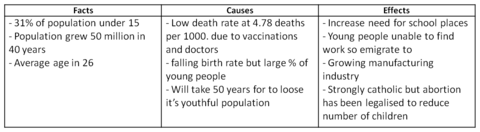
- 62Pressure on housing – not enough housing, people living in slums. This is very common around the big citiesthe issues relating to a youthful population
- 63Pressure on schooling – illiterate population. India’s literacy rate is 60%, Cambodia’s literacy rate is 69%the issues relating to a youthful population
- 64Pressure on food supplies - famine, food distribution difficulties. Natural disasters accentuate this problem e.g. droughtsthe issues relating to a youthful population
- 65Pressure on health services – a growth in diseases being spread around and not being dealt with adequately to stop the spreadthe issues relating to a youthful population
- 66High unemployment - Large numbers of people unable to find work so they emigratethe issues relating to a youthful population
- 67Health care Skilled health care workers, e.g. nurses, doctors, etc. Pensions - Increase in pension costs. More retired people means fewer workers in the economyissues relating to an ageing population
- 683 solutions Increase tax – not popular Raise retirement age – not popular Abolish state pensions – not popularthe issues relating to an ageing population
- 69-Not all countries have followed the same path of development or growth. -It is a generalisation. -Migration isn’t taken into account. -Some countries develop at faster speeds than others.As with any theory or model, The DTM isn’t without its critics though!
- 70—Youthful population: Mexico (LEDC)
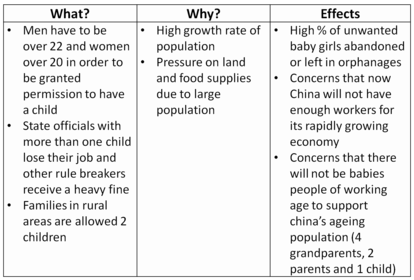
- 71—Ageing Population – Japan (MEDC)
- 72—Pro-Natalist Policy – Singapore
- 73—china - one child policy
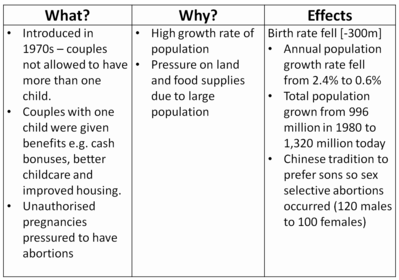
- 74—china - on child policy
- 75—migration
- 76—migration
- 77—reasons for migration
- 78—Migration policies in the UK
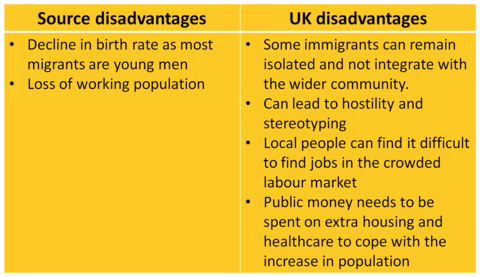
- 79—Migration policies in the UK
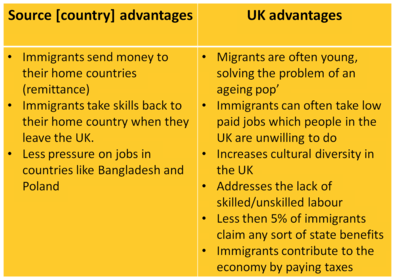
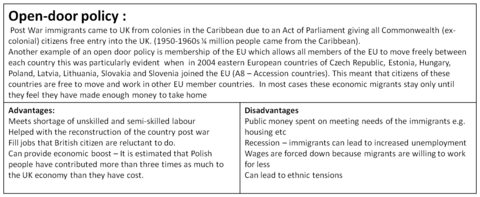
- 80—open door policy
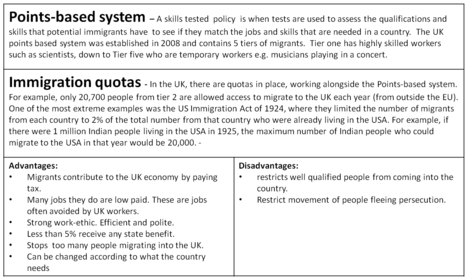
- 81—point based system
- 82—Tensions that arise as a result of migration

- 83—what happens next
Information
- Description
- gcse Geography Flashcards on geography unit 2 , created by Alice K Smith on 22/05/2015.
- Created by
- Alice K Smith
- Views
- 0
- Rating