
Flashcards
Tectonics- EQ3
Cards in this deck (20)
- 1What are the 2 broad categories of natural hazard?Hydro-met hazards: floods, storms, cyclones, drought have become more common likely due to global warming.
Tectonic disasters: number of events broadly the same over decades. - 2Trends of disasters: How have number of deaths changed since 1960?Deaths have fallen due to better response, preparation, prediction and technology.
Volcano: less frequent, rarely kill anyone.
Earthquake: vary but less than 30-40yrs ago. Single mega disasters can also skew data. - 3Trends of disasters: How have number of people affected changed?They have increased due to rising population and more people living in risky locations.
Volcanoes: More affected due to evacuation around area. - 4What is a mega disaster?High-magnitude, high impact, infrequent disasters that affect multiple countries (directly or indirectly), so their impacts are regional or even global.
- 5Trends of disasters: How has economic damage changed?Earthquake economic loss is increased: average $20-40 billion per year.
Eco losses overall rose: More ppl affluent/ comfortable take part in consumerism so hv more to lose e.g. property. - 6Examples of Mega disasters:Tohoku Earthquake (Japan): Caused closing of nuclear power plants globally due to possible dangers shown by Tohoku. Halted exports + manufacturing e.g. car.
Eyjafjallajokull volcano (Iceland): Ash disrupted European airways so many could not get home or use flights. - 7What are multiple-hazard zone?Places where two or more natural hazards occur and may interact to produce complex disasters. E.g. Japan, Indonesia, Philippines.
- 8ROLE OF SCIENTISTS: What is the difference between forecasting and prediction?Prediction: when/where natural hazard will strike on spatial/temporal scale that can be acted on meaningfully e.g. evacuation.
Forecasting: less precise, provides a percentage change of a hazard occurring e.g. 25% of mg 7earthquake occurring in next 20 yrs. - 9ROLE OF SCIENTISTS: Can earthquakes be predicted?Cannot be predicted.
Areas of high risk can be identified using risk forecasting. E.g. Seismic gaps, area overdue for earthquake (as not occurred in a while) - 10ROLE OF SCIENTISTS Can volcanoes be predicted?Can be predicted.
-Monitoring: measure changes of magma chambers e.g. filling as eruption nears.
-Tiltmeters: record bulging as magma rises.
-Seismometers: record minor earthquakes indicating magma movement.
-Gas spectrometers: analyse gas emissions = eruption likelihood. - 11ROLE OF EMERGENCY PLANNERS: What is the hazard management cycle?Illustrates different stages of managing hazards in an attempt to reduce the scale of a disaster.
- 12ROLE OF EMERGENCY PLANNERS: What are the stages of the hazard management cycle?1. Response: Immediate help to rescue and give aid e.g. shelter, food, water.
2. Recovery: Rebuilding infastructure and services, rehabilitating injured.
3. Mitigation: Acts to reduce next disaster e.g. land-use zoning, resistant buildings.
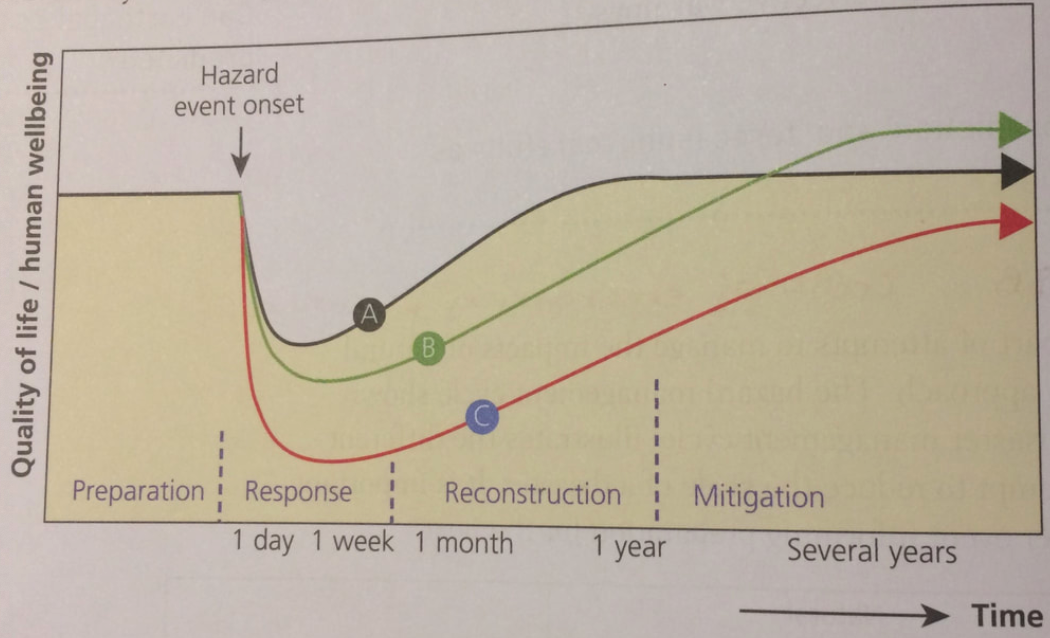
4. Preparedness: Education, prediction, warning, evacuation tech. - 13What is the Park's model?Provides illustration of impact of disaster, used to compare different events. Put quality of life against time & hazard management.
- 14ROLE OF PLANNERS, ENGINEERS: Disaster modification Modify the eventBefore the hazard strikes (Long-term)
Mitigate impacts of disaster by reducing areal extent or effective magnitude. - 15ROLE OF PLANNERS, ENGINEERS: Modify the event Land-use zoningPreventing ppl from building on low-lying coasts, close to volcanoes or on areas of high ground shaking/ liquefaction risk.
- 16ROLE OF PLANNERS, ENGINEERS: Modify the event Aseismic BuildingsBuildings strong enough to resist most earthquakes and prevent damage.
E.g. using cross-bracing - 17ROLE OF PLANNERS, ENGINEERS: Modify the event Tsunami DefencesSea walls and breakwaters (prevent waves travelling inland).
- 18ROLE OF PLANNERS, ENGINEERS: Modify the event Lava DiversionChannels, barriers and water cooling to divert or slow lava.
- 19ROLE OF PLANNERS, ENGINEERS: Modify the vulnerability Hi-tech scientific monitoring Community preparedness & education AdaptionUsed to modify behaviour of volcanoes and predict eruptions.
Education, earthquake kits
Moving out of harm's way and relocating to safe area. - 20ROLE OF PLANNERS, ENGINEERS: Modify loss Short-term emergency aid Long-term aid InsuranceSearch and rescue, emergency food/water/shelter.
Reconstruction plans to rebuild area
Compensation given to ppl to replace their losses.
Information
- Description
- EQ3: How successful is the management of tectonic hazards and disasters? Key idea 1: Understanding the complex trends and patterns for tectonic disasters helps explain differential impacts. Key idea 2: Theoretical frameworks can be used to understand the prediction, impact and management of tectonic hazards. Key idea 3: Tectonic hazard impacts can be managed by a variety of mitigation and adaption strategies, which vary in their effectiveness.
- Created by
- Qashrina Collier
- Views
- 3
- Rating