
Flashcards
Chem Final
Cards in this deck (109)
- 1An element has three stable isotopes with masses of 27.977 amu, 28.976 amu, and 29.973 amu. The heavier two isotopes have an abundance of 4.68% and 3.09%, respectively. What is the mass of the element?28.085 amu
- 2All of the following will lead to a homogeneous mixture EXCEPTmud and water.
- 3Identify the characteristics of a gas.) no definite shape and no definite volume
- 4Identify the characteristics of a liquid.definite volume and no definite shape
- 5Which of the following statements about the phases of matter is TRUE?In both solids and liquids, the atoms or molecules pack closely to one another.
- 6The mass number is equal tothe sum of the number of protons and neutrons.
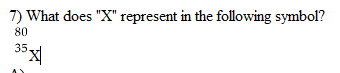
- 7—bromine
- 8What mass (in mg) does 2.63 moles of nickel have?) 1.54 × 10⁵ mg
- 9How many moles of Kr are contained in 398 mg of Kr?4.75 × 10⁻³ moles Kr
- 10How many moles of Cs are contained in 595 kg of Cs?4.48 × 10^3 moles Cs
- 11Calculate the mass (in kg) of 4.87 × 1025 atoms of Zn.5.29 kg
- 12Calculate the mass (in ng) of 2.33 × 10²⁰ atoms of oxygen.6.19 × 10^6 ng
- 13Calculate the wavelength (in nm) of the blue light emitted by a mercury lamp with a frequency of 6.88 × 10¹⁴ Hz.436 nm
- 14Calculate the energy of the orange light emitted, per photon, by a neon sign with a frequency of 4.89 × 10¹⁴ Hz.3.24 × 10-19 J
- 15Calculate the energy of the violet light emitted by a hydrogen atom with a wavelength of 410.1 nm.4.85 × 10-19 J
- 16What value of l is represented by a d orbital?) 2
- 17What value of l is represented by an f orbital?) 3
- 18How many orbitals are contained in the third principal level (n = 3) of a given atom?) 9
- 19How many sublevels are contained in the second shell (n = 2) of a given atom?) 2
- 20Give the possible values for ml for a d orbital.-2, -1, 0, 1, 2
- 21Give the numbers for ml for an f orbital.-3, -2, -1, 0, 1, 2, 3
- 22Predict the charge that an aluminum ion would have.3+
- 23Predict the charge that an ion formed from sulfur would have.2-
- 24Which of the following elements is NOT a metal? A) Ba B) Mg C) Xe D) Pb E) GaXe
- 25Give the electron configuration for Sr.) [Kr]5s2
- 26) How many valence electrons do the halogens possess?) 7
- 27) Place the following in order of increasing atomic radius. As O BrO < Br < As
- 28) an atom that has lost an electron isa cation
- 29When waves of equal amplitude from two sources are out of phase when they interact, it is calleddestructive interference.
- 30Give the complete electronic configuration for Ca2+.1s22s22p63s23p6
- 31Place the following in order of decreasing radius. Te2⁻ F⁻ O2⁻Te2⁻ > O2⁻ > F⁻
- 32) Place the following in order of increasing atomic radius. As O BrO < Br < As
- 33Which second period element has the successive ionization energies (IE) given in the following? IE(1) = 800 kJ/mol, IE(2) = 2430 kJ/mol, IE(3) = 3660 kJ/mol, IE(4) = 25060 kJ/molBoron
- 34A covalent bond is best described as A) the sharing of electrons between atoms. B) the transfer of electrons. C) a bond between a metal and a nonmetal. D) a bond between a metal and a polyatomic ion. E) a bond between two polyatomic ions.the sharing of electrons between atoms.
- 35What is the empirical formula for Hg2(HCO3)2?HgHCO3
- 36Give the name for SnO.tin (II) oxide
- 37Give the correct formula for sodium sulfite.Na2SO3
- 38Determine the name for N2O5.dinitrogen pentoxide
- 39Calculate the molar mass of Al(C2H3O2)3.204.13 g/mol
- 40How many molecules of N2O4 are in 76.3 g N2O4?4.99 × 10²³ N2O4 molecules
- 41How many millimoles of Ca(NO3)2 contain 4.78 × 10²² formula units of Ca(NO3)2?79.4 mmol Ca(NO3)2
- 42Calculate the mass percent composition of lithium in Li3PO4.17.98 %
- 43How many atoms of carbon are contained in 47.6 g of Al2(CO3)3? The molar mass of Al2(CO3)3 is 233.99 g/mol.3.68 × 1023 C atoms
- 44Determine the empirical formula for a compound that is found to contain 10.15 mg P and 34.85 mg Cl.PCl3
- 45Determine the empirical formula for a compound that contains C, H and O. It contains 52.14% C and 34.73% O by mass.C2H6O
- 46Give the ground state electron configuration for Rb⁺.[Ar]4s23d104p6
- 47Place the following in order of increasing metallic character. Rb Cs K NaNa < K < Rb < Cs
- 48Which element has the highest first ionization energy?Cl
- 49—2 bonding pairs and 2 lone pairs

- 50Identify the number of bonding pairs and lone pairs of electrons in CO2.4 bonding pairs and 4 lone pairs
- 51Identify the compound with the smallest dipole moment in the gas phase.Cl2
- 52Choose the bond below that is LEAST polar.C-I
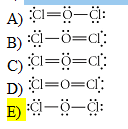
- 53What is the best Lewis structure for OCl2.
- 54Give the number of valence electrons for CH2Cl2.20
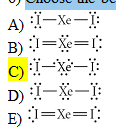
- 55Choose the best Lewis structure for XeI2.
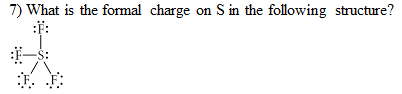
- 56—0
- 57Determine the electron geometry (eg) and molecular geometry (mg) of PF5.eg = trigonal bipyramidal, mg = trigonal bipyramidal
- 58Determine the electron geometry (eg) and molecular geometry (mg) of BrF3.eg = trigonal bipyramidal, mg = T-shape
- 59Determine the electron geometry (eg) and molecular geometry (mg) of CH3+.eg = trigonal planar, mg = trigonal planar
- 60Determine the electron geometry (eg) and molecular geometry (mg) of the underlined atom CH3OCH3.eg = tetrahedral, mg = bent
- 61—C1 = trigonal planar, C2 = tetrahedral
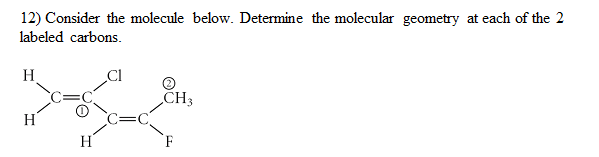
- 62Of the following elements, which has the lowest electronegativity? A) Mg B) Cl C) Ca D) Br E) BeCa
- 63) How many lone pairs of electrons are on the Br atom in BrF4+?1
- 64How many lone pairs are on the Cl atom in ClF2-?3
- 65Identify the number of electron groups around a molecule with sp2 hybridization.3
- 66—C1 = sp2, C2 = sp3
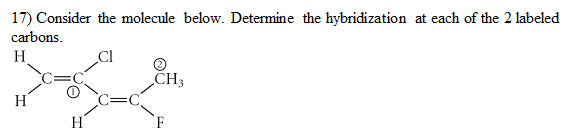
- 67List the number of sigma bonds and pi bonds in a double bond.1 sigma, 1 pi
- 68—6A

- 69Identify the weakest bond. A) single covalent bond B) double covalent bond C) triple covalent bond D) All of the above bonds are the same strength E) Not enough informationsingle covalent bond
- 70Identify the strongest bond. A) single covalent bond B) double covalent bond C) triple covalent bond D) All of the above bonds are the same strength E) Not enough informationtriple covalent bond
- 7122) A physical change A) occurs when iron rusts. B) occurs when sugar is heated into caramel. C) occurs when glucose is converted into energy within your cells. D) occurs when water is evaporated. E) occurs when propane is burned for heat.occurs when water is evaporated.
- 72—


- 73—


- 74—


- 75Determine the molarity of a solution formed by dissolving 468 mg of MgI2 in enough water to yield 50.0 mL of solution.0.0337 M
- 76According to the following reaction, how many moles of Fe(OH)2 can form from 175.0 mL of 0.227 M LiOH solution? Assume that there is excess FeCl2. FeCl2(aq) + 2 LiOH(aq) → Fe(OH)2(s) + 2 LiCl(aq)1.99 × 10⁻² moles
- 77How many milliliters of a 0.184 M RbNO3 solution contain 0.113 moles of RbNO3?614 mL
- 78What volume (in mL) of 0.0887 M Mg Br2 solution is needed to make 275.0 mL of 0.0224 M Mg Br2 solution?69.4 mL
- 79Determine the concentration of a solution prepared by diluting 20.0 mL of a 0.200 M KCl to 250.0 mL.0.0160 M
- 80How many grams of AgNO3 are needed to make 250. mL of a solution that is 0. 155 M?6.58 g
- 81When NaCl dissolves in water ________.the Na+ ions are attracted to the partial negative charge on the oxygen atom of the water molecule
- 82In water, a substance that partially ionizes in solution is called aweak electrolyte.
- 83Determine the oxidation state of C in CO32-.+4
- 84Determine the oxidation state of nitrogen in NO.+2
- 85What element is undergoing reduction (if any) in the following reaction? Zn(s) + 2 AgNO3(aq) → Zn(NO3)2(aq) + 2 Ag(s)Ag
- 86What element is undergoing oxidation (if any) in the following reaction? Zn(s) + 2 AgNO3(aq) → Zn(NO3)2(aq) + 2 Ag(s)Zn
- 87Determine the oxidation state of Cl in ClO3-.+5
- 88—


- 89Define potential energy.energy associated with the position or composition of an object
- 90A sample of copper absorbs 43.6 kJ of heat, resulting in a temperature rise of 75.0°C, determine the mass (in kg) of the copper sample if the specific heat capacity of copper is 0.385 J/g°C.1.51 kg
- 91How much energy is required to decompose 612 g of PCl3, according to the reaction below? The molar mass of PCl3 is 137.32 g/mol and may be useful. 4 PCl3(g) → P4(s) + 6 Cl2(g) ΔH°rxn = +1207 kJ1.34 × 103 kJ
- 92Using the following equation for the combustion of octane, calculate the amount of moles of oxygen that reacts with 100.0 g of octane. The molar mass of octane is 114.33 g/mole. The molar mass of carbon dioxide is 44.0095 g/mole. 2 C8H18 + 25 O2 → 16 CO2 + 18 H2O ΔH°rxn = -11018 kJ10.93 moles
- 93Use the standard reaction enthalpies given below to determine ΔH°rxn for the following reaction P4(g) + 10 Cl2(g) → 4PCl5(s) ΔH°rxn = ? Given: PCl5(s) → PCl3(g) + Cl2(g) ΔH°rxn = +157 kJ P4(g) + 6 Cl2(g) → 4 PCl3(g) ΔH°rxn = -1207 kJ-1835 kJ
- 94Use the bond energies provided to estimate ΔH°rxn for the reaction below. 2 Br2(l) + C2H2(g) → C2H2Br4(l) ΔH°rxn = ? Br-Br 193 C≡C 837 C-C 347 C-Br 276 C-H 414-228 kJ
- 95Use the bond energies provided to estimate ΔH°rxn for the reaction below. C2H4(g) + H2(g) → C2H6(g) ΔH°rxn = ? C-C 347 C-H 414 C=C 611 C≡C 837 H-H 436-128 kJ
- 9622) Use the standard reaction enthalpies given below to determine ΔH°rxn for the following reaction 2 S(s) + 3 O2(g) → 2 SO3(g) ΔH°rxn = ? Given: SO2(g) → S(s) + O2(g) ΔH°rxn = +296.8 kJ 2 SO2(g) + O2(g) → 2 SO3(g) ΔH°rxn = -197.8 kJ-791.4 kJ
- 9723) Use the standard reaction enthalpies given below to determine ΔH°rxn for the following reaction 4 SO3(g) → 4 S(s) + 6 O2(g) ΔH°rxn = ? Given: SO2(g) → S(s) + O2(g) ΔH°rxn = +296.8 kJ 2 SO2(g) + O2(g) → 2 SO3(g) ΔH°rxn = -197.8 kJ1583 kJ
- 98Choose the thermochemical equation that illustrates ΔH°f for Li2SO4. A) 2 Li+(aq) + SO42-(aq) → Li2SO4(aq) B) 2 Li(s) + 1/8 S8(s, rhombic) + 2 O2(g) → Li2SO4(s) C) Li2SO4(aq) → 2 Li+(aq) + SO42-(aq) D) 8 Li2SO4(s) → 16 Li(s) + S8(s, rhombic) + 16 O2(g) E) 16 Li(s) + S8(s, rhombic) + 16 O2(g) → 8 Li2SO4(s)2 Li(s) + 1/8 S8(s, rhombic) + 2 O2(g) → Li2SO4(s)
- 99Use the information provided to determine ΔH°rxn for the following reaction ΔH°f (kJ/mol) CH4(g) + 4 Cl2(g) → CCl4(g) + 4 HCl(g) ΔH°rxn = ? CH4(g) -75 CCl4(g) -96 HCl(g) -92-389 kJ
- 100Use the information provided to determine ΔH°rxn for the following reaction ΔH°f (kJ/mol) CH4(g) + 3 Cl2(g) → CHCl3(l) + 3 HCl(g) ΔH°rxn = ? CH4(g) -75 CHCl3(l) -134 HCl(g) -92-335 kJ
- 101According to the following balanced reaction, how many moles of KO are required to exactly react with 4.33 moles of H2O? 4 KO(s) + 2 H2O(l) → 4 KOH(s) + O2(g)8.66 moles H2O
- 102How many moles of PCl5 will be produced if 0.331 moles of P4 is reacted with an excess of Cl2 using the following equation. P4(s) + 10 Cl2(g) → 4 PCl5(g)1.324 mol
- 103How many grams of Li3N can be formed from 1.75 moles of Li? Assume an excess of nitrogen. 6 Li(s) + N2(g) → 2 Li3N(s)20.3 g Li3N
- 104How many moles of nitrogen are formed when 58.6 g of KNO3 decomposes according to the following reaction? The molar mass of KNO3 is 101.11 g/mol. 4 KNO3(s) → 2 K2O(s) + 2 N2(g) + 5 O2(g)0.290 mol N2
- 105Consider the following balanced reaction. What mass (in g) of CO2 can be formed from 288 mg of O2? Assume that there is excess C3H7SH present. C3H7SH(l) + 6 O2(g) → 3 CO2(g) + SO2(g) + 4 H2O(g)0.198 g CO2
- 106According to the following reaction, how many grams of sulfur are formed when 37.4 g of water are formed? 2 H2S(g) + SO2(g) → 3 S(s) + 2H2O(l)99.8 g S
- 107Determine the limiting reactant (LR) and the mass (in g) of nitrogen that can be formed from 50.0 g N2O4 and 45.0 g N2H4. Some possibly useful molar masses are as follows: N2O4 = 92.02 g/mol, N2H4 = 32.05 g/mol. N2O4(l) + 2 N2H4(l) → 3 N2(g) + 4 H2O(g)LR = N2O4, 45.7 g N2 formed
- 108According to the following reaction, what amount of Al2S3 remains when 20.00 g of Al2S3 and 2.00 g of H2O are reacted? A few of the molar masses are as follows: Al2S3 = 150.17 g/mol, H2O = 18.02 g/mol. Al2S3(s) + 6 H2O(l) → 2 Al(OH)3(s) + 3 H2S(g)17.22 g
- 109Give the percent yield when 28.16 g of CO2 are formed from the reaction of 4.000 moles of C8H18 with 8.000 moles of O2. 2 C8H18 + 25 O2 → 16 CO2 + 18 H2O12.50%
Information
- Description
- Chemistry Flashcards on Chem Final , created by Alex Bonaker on 07/12/2021.
- Created by
- Alex Bonaker
- Views
- 0
- Rating