
Flashcards
flash cards on everything
Cards in this deck (51)
- 1What is a sequence?The order in which steps are taken.
- 2What is selection?A decision that determines our next steps.
- 3What is iteration?To repeat certain steps until a decision is made to stop repeating.
- 4What are the two different types of searching?Linear and Binary.
- 5Does Binary searching need to be in an ordered list?Yes.
- 6Does linear searching need to be in a sorted list.No.
- 7How does a binary search work?It splits the list to find the value.
- 8How does a linear list work?It goes through each value till it finds he one.
- 9Name the different types of sorting.Bubble, Merge and Insertion.
- 10What are the Pros of an Insertion sort?Relatively simple and easy to implement.
- 11What are the Cons of an Insertion sort?It is Inefficient for large lists.
- 12What are the Pros for a bubble sort?It is popular and easy to implement.
- 13What are the Cons of a bubble sort?It does not deal well with a list containing a huge number of items.
- 14What are the Pros of a Merge sort?A very efficient algorithm.
- 15What are the Cons of a Merge sort?Can be slower for small lists.
Needs additional memory. - 16In computational thinking what does ADA stand for?Algorithmic thinking.
Decomposition.
Abstraction. - 17What is Algorithmic thinking?The steps we take to get to a solution.
- 18What is Decomposition?breaking down a problem into smaller bits.
- 19What is Abstraction?Getting rid of unimportant information.
- 20Give examples of Decomposition.Math's (Splitting the problem then completing each bit then putting them together to find the answer), Merge Sorts and music (Choosing each instrument and creating the music it will play then putting them together to make a pace of music).
- 21Give examples of Abstraction.London underground (The map only shows the places you can go on different lines not descriptive drawings of the town), Putting in a username and password (Doesn’t show where the computer puts it and doesn’t tell you just have to put your name in), Turning on a car (You don’t need to know the interworks of the car and Engine to turn it on).
- 22Name the 3 boolean operators.AND, NOT, OR
- 23Name the comparison operators.== equal
!= not equal
< less than
<= less than or equal too
> Greater than
>= greater than or equal too - 24Name the arithmetic operators.+ addition
* Multiply
- Subtraction
/ Division
MOD
DIV
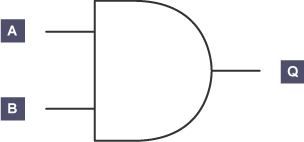
^ to the power - 25What does AND gate look like?
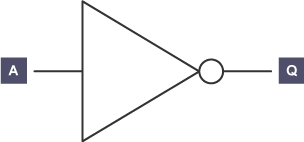
- 26What does NOT gate look like?
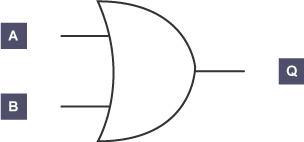
- 27What does OR gate look like?
- 28What does AND gate do?In an AND gate, both inputs need to be 1 for the output to be 1.
- 29What does NOT gate do?The output is always the opposite of the input.
- 30What does OR gate do?In an OR gate, at least one input must be 1 for the output to be 1.
- 31What does the MOD function do when coding?It is the remainder when dividing. For example, “5 mod 3 = 2” which means 2 is the remainder when you divide 5 by 3.
- 32What does the DIV function do when coding?divides two integers and discards any remainder.
- 33What are the data types and there uses?Integer – A hole number.
Real – A decimal number.
Boolean – A True or a False.
Character – Everything on your key board is a character.
String – If there is more than one character it is a string. - 34What data type is a phone number?It is a string.
- 35what will a string always be represented by.?with speech marks at the front and the back.
- 36What is a float?A data type for decimal numbers.
- 37What is a list?A data structure to store multiple values.
- 38What is casting?The act of changing from one data type to another.
- 39What is string concatenation?The act of joining character strings.
- 40What is a constant?A data store containing the value that can't be changed.
- 41What is a variable?A storage location that can contain one value.
- 42What is the assignment operator?The operator used to assign a value to a data store.
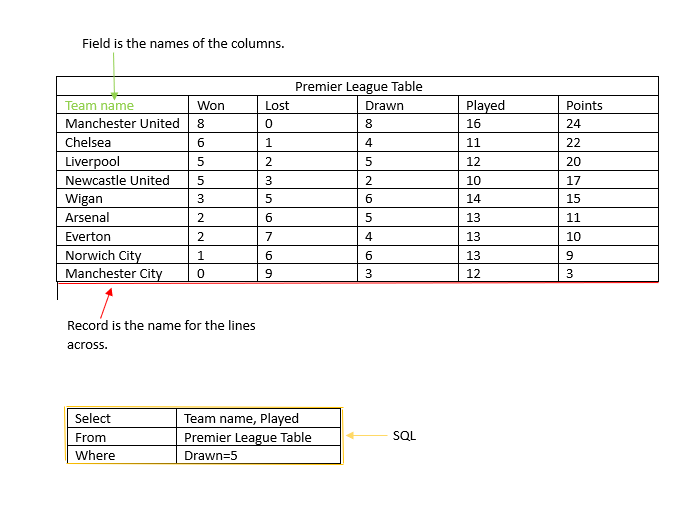
- 43What are the three things you need for a SQL?Select
From
Where - 44Show an example of a SQL.
- 45What is maintainability in code.maintaining code should use comments, indentation, Naming conventions and sub programs or sub routines.
- 46What is validation.checking the data is correct.
- 47What is a defence design.trying to deal with invalided data. Making sure code does not crash.
- 48name two types of testing and what they do.Iterative – testing as your writing the program.
Final/terminal - testing you do at the end of a project - 49Name 3 types of test you can do and what they are.Normal – the data your using/the code you would expect someone to enter.
Boundry – It is on the edge of the data.
Invalid – Entering a data which will be rejected by the computer. - 50What is a logic error.When your code still runs but not in the way you wanted e.g. you wanted the character to go right but it went left.
- 51What is a syntax error.an error in the spelling or grammar used when coding.
Information
- Description
- GCSE Computing Flashcards on flash cards on everything, created by Fran Monk on 29/10/2024.
- Created by
- Fran Monk
- Views
- 0
- Rating